



Ormolu Garniture Set
An ormolu garniture set brings coordinated metalwork and classical symmetry to a mantelpiece, usually pairing a central clock with matching candelabra.
Ormolu Garniture Set
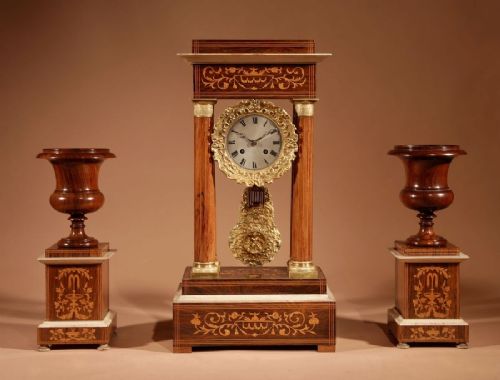
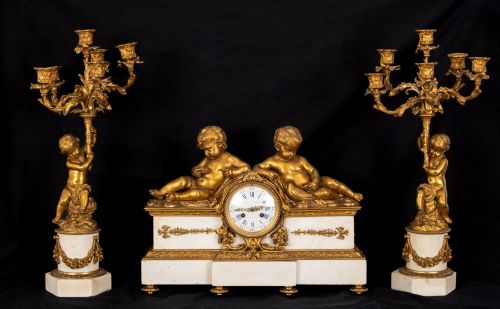
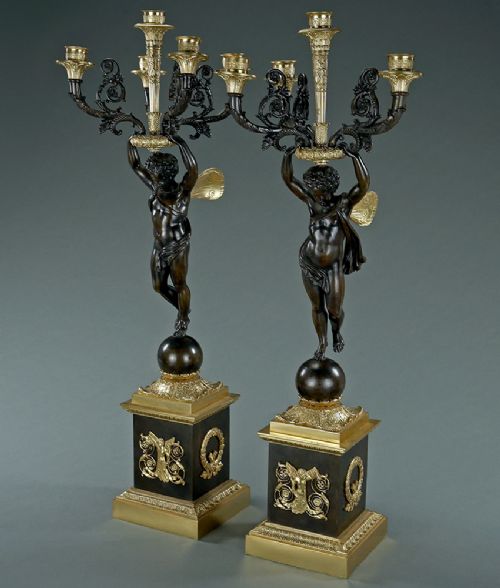
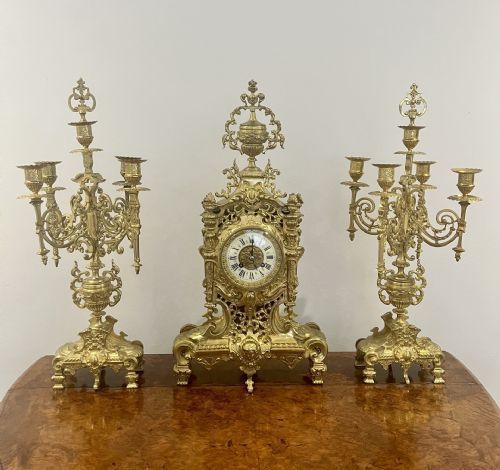
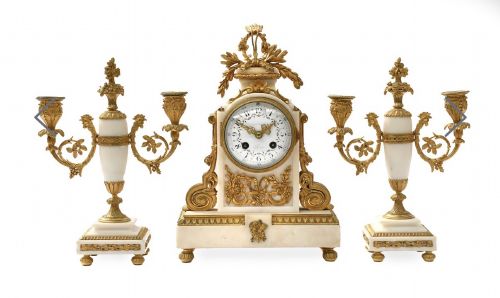
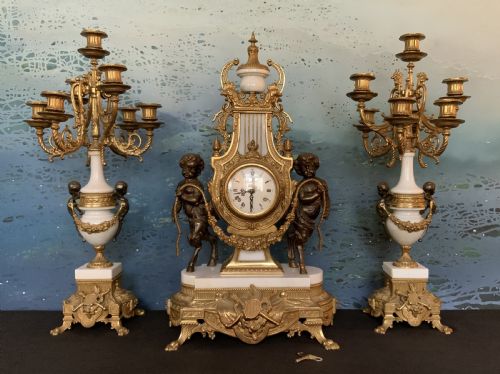
An ormolu garniture set comprises a central mantel clock flanked by matching side pieces such as candelabra or urns, designed as a unified decorative scheme. When you search for an ormolu garniture set, you encounter matching suites intended for nineteenth-century drawing rooms and grand salons. These assemblies rely on French design vocabularies, predominantly drawing on Louis XVI Revival, Napoleon III, and Rococo styles.
The materials span gilt bronze, white or coloured marble, and porcelain panels, often incorporating cherubs, urns, or classical motifs. Most examples date from the nineteenth century, reflecting the Victorian appetite for ornate domestic display. The central timepiece typically anchors the arrangement, accompanied by matching side ornaments that maintain the decorative rhythm across a mantel or console.
How they were made
The metal components rely on mercury gilding or electrogilding applied to bronze or brass bases, creating the characteristic rich, golden surface known as ormolu. Artisans chased the cast metal details by hand to sharpen foliage, drapery, and figurative elements before mounting them onto marble, onyx, or porcelain bodies.
Clock movements house eight-day striking mechanisms, frequently produced by specialised Parisian makers and mechanical workshops. Stonework such as white or coloured marble was turned and polished to provide solid architectural foundations for the gilded mounts.
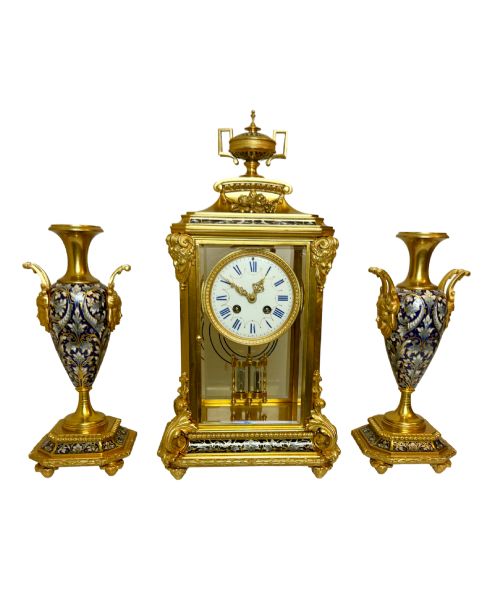
Listings feature nineteenth-century French and Italian pieces utilising gilt bronze, marble, porcelain, and champleve enamel within Louis XVI Revival and Rococo styles.
What varies in quality
The integration of the side pieces with the central clock determines the success of the garniture as a matched suite. Finer sets maintain uniform patination, consistent casting quality across all components, and movements signed by recognised makers.
Henry Dasson·A D Mougin·H Luppens Paris·Vincenti of Paris
The Ormolu Garniture Set Glossary
- Ormolu
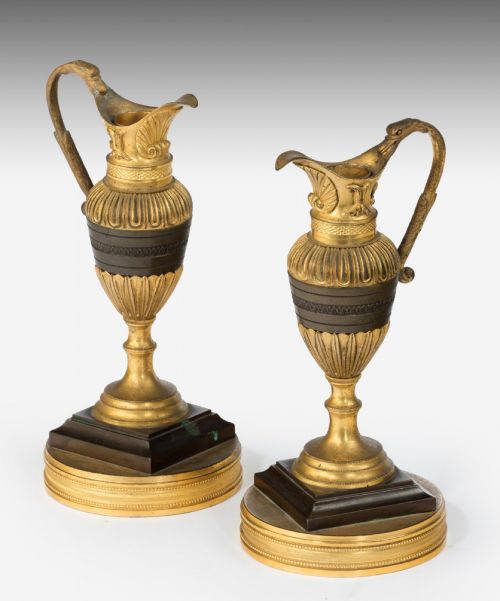
- Gilt bronze created by applying a gold and mercury amalgam to a bronze base and heating it, or through later electroplating methods. This technique yields a warm golden finish that resists tarnish.
- Garniture
- A set of ornamental objects designed to match and be displayed together on a mantelpiece or sideboard. Typically consists of a central clock paired with two side candelabra or urns.
- Champlevé
- An enamelling technique where troughs or cells are hollowed out of a metal surface and filled with vitreous enamel before firing. It frequently appears on late nineteenth-century clock dials and mounts.
- Portico clock
- A mantel clock housed within a architectural frame supported by four or more columns. These structures are often executed in marble and accented with gilt bronze mounts.
- Bleu de Roi
- A deep, rich royal blue ceramic glaze developed at the Sèvres porcelain factory. It often forms the background colour for decorative porcelain panels set into clock cases.
Ormolu Garniture Set: Frequently Asked Questions
What is included in a garniture set?
A standard garniture set includes a large mantel clock accompanied by two matching side pieces, such as candelabra, urns, or vases.
These components share identical stylistic motifs, materials, and gilding to create a unified display across a fireplace mantle.
How do you wind a nineteenth-century clock?
Most period clocks utilise an eight-day mechanical movement wound via a dedicated key inserted into specific winding holes on the dial face.
Care must be taken not to overwind the mainspring, and professional servicing is recommended to keep the striking train accurate.
Where were these clock sets made?
The majority of these decorative ensembles originated in France, particularly in Parisian workshops that combined bronze casting, stonework, and clockmaking.
Retailers and makers across Paris exported these suites throughout Europe and Britain during the Victorian era.
How do you clean ormolu metalwork?
Ormolu requires gentle dusting with a soft, dry brush to prevent the accumulation of dirt in the chased recesses.
Harsh metal polishes must be avoided entirely, as they strip away the thin layer of gold leaf or gilding from the bronze base.