
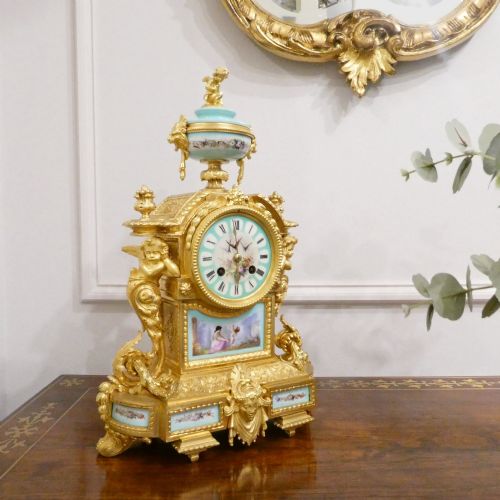
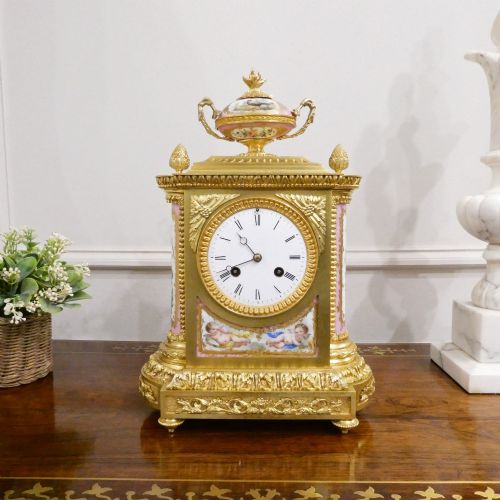
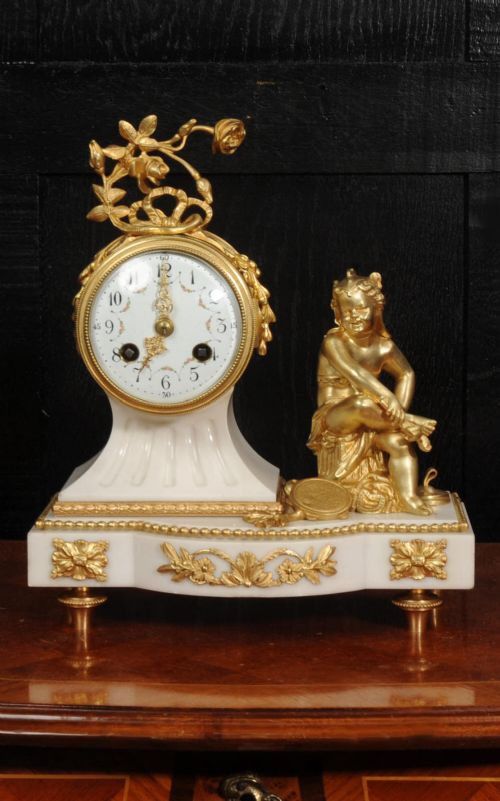
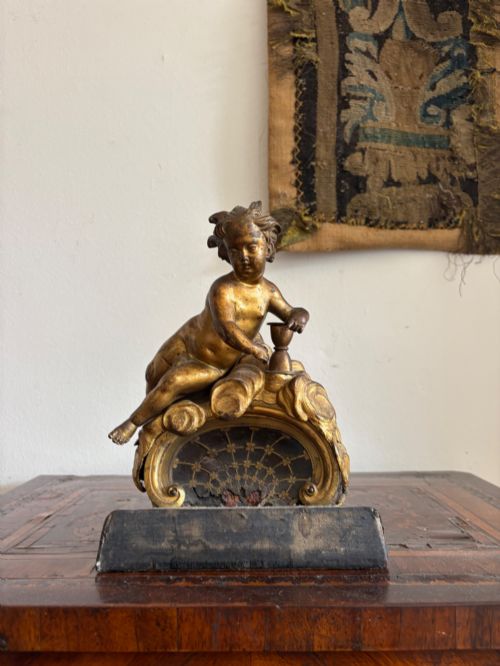
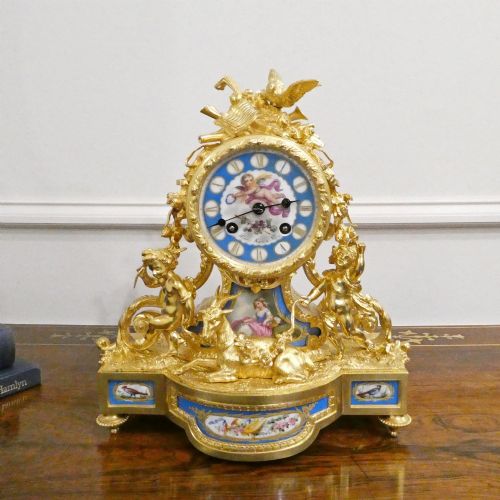
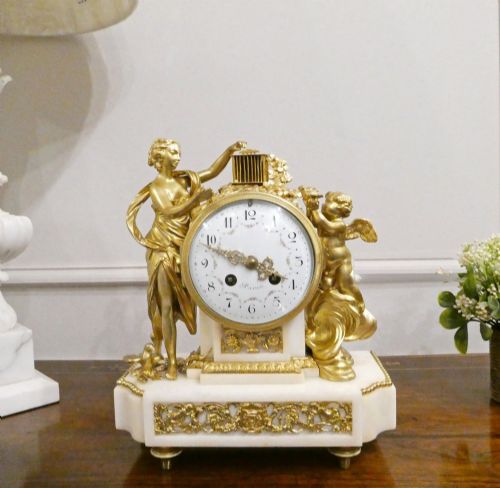
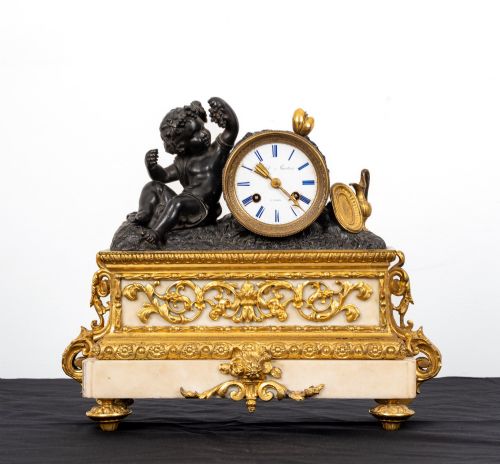
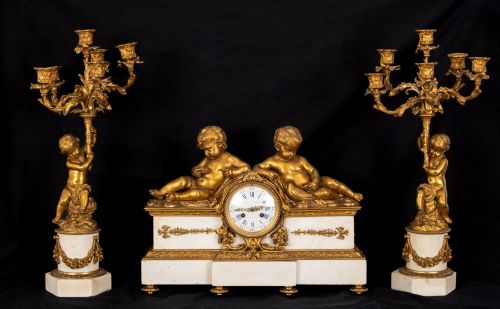
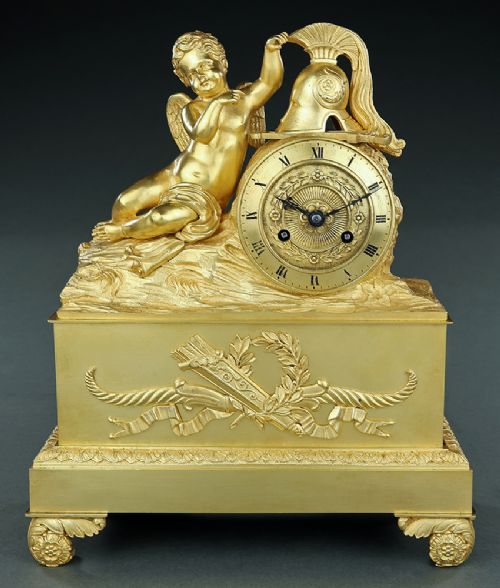
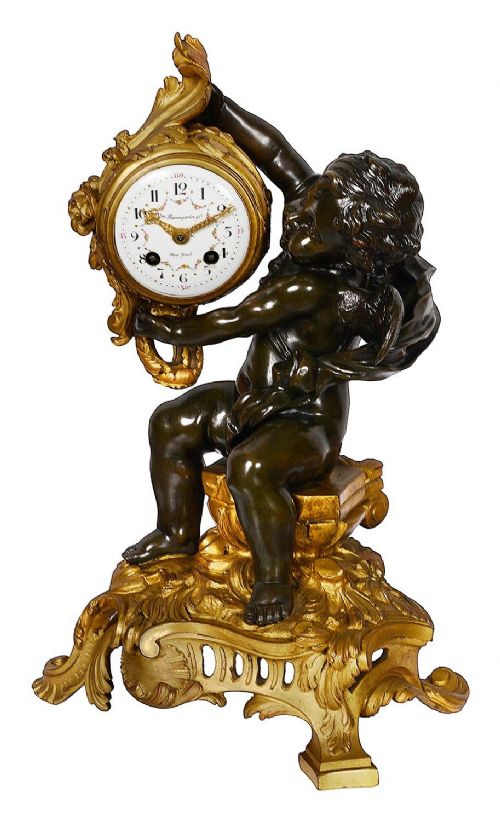


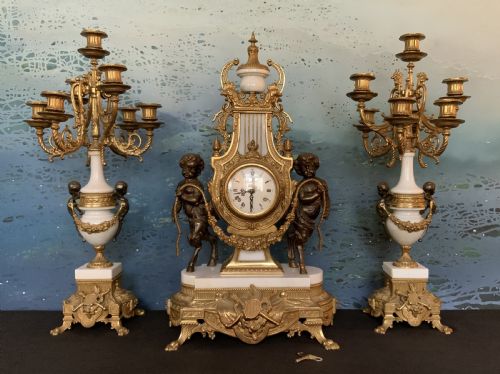


Ormolu Cherub Mantel Clock
An ormolu cherub mantel clock brings together French metalwork and figurative sculpture to keep time with undeniable presence.
Ormolu Cherub Mantel Clock
An ormolu cherub mantel clock combines cast metal mounts with a clock movement, often framed by decorative garnitures. You are looking at pieces that most frequently date to the nineteenth century, reflecting periods such as the French Empire and Louis XVI revivals.
The dominant forms on this page include mantel clocks and multi-piece clock garnitures incorporating candelabras. These objects originate largely from French makers and workshops working in styles spanning Rococo to classical revival.
How They Were Made
Gilt bronze and ormolu form the primary metallic structure, paired frequently with white marble, onyx, and porcelain panels. Metal components undergo precision casting before receiving a mercurial or electroplated gold finish.
Dials often feature hand-painted enamel details, whilst movements are driven by mechanical gear systems requiring professional assembly and adjustment.
Materials recorded across these items include ormolu, gilt bronze, white marble, Sevres porcelain, and champleve enamel.
What Varies in Quality
The crispness of the chasing on the ormolu bronze separates standard production from exceptional examples. Deeper relief work on figurative cherubs and mounts indicates a superior hand in the casting process.
Integration of materials also dictates standard, where cohesive deployment of Sevres porcelain panels and unblemished marble bases elevates the overall construction.
Jean-Baptiste Delettrez·Henry Marc·Siffel and Cartier·Henry Dasson·Le Roy Paris·Japy Freres·Leon Message·Jollet et Cie·Samuel Marti·Achille Brocot·H Luppens Paris
The Ormolu Cherub Mantel Clock Glossary
- Ormolu
- Finely chopped high-karat gold applied to a bronze base using mercury amalgamation or modern electroplating. It provides a bright, durable golden surface.
- Garniture
- A set of matching decorative objects, typically comprising a central clock flanked by matching candelabras or urns. These sets coordinate mantel displays.
- Chasing
- The manual tooling of cast bronze surfaces with small punches and chisels to sharpen details. This step defines feathers, hair, and drapery.
- Dial
- The face of the clock displaying numerals, frequently produced in enamel on copper plates. Hand-painted markers denote individual workshop production.
- Putto
- A figure of a small winged infant, frequently deployed as a cherub finial or mount. These figures anchor classical revival compositions.
Ormolu Cherub Mantel Clock: Frequently Asked Questions
How do I wind an antique clock?
Use the designated key provided with the movement, turning it gently until you feel resistance. Avoid over-winding to protect the internal springs.
Ensure the clock is placed on a level surface so the pendulum swings evenly and keeps accurate time.
What is a clock garniture?
A clock garniture is a matching set consisting of a central mantel clock and two flanking side pieces such as candelabras or urns. These sets were designed to create a balanced decorative display on a fireplace mantel.
They share identical motifs, materials, and stylistic treatments across all components.
How do I identify French revival styles?
Louis XVI revival pieces display classical symmetry, straight lines, and architectural details like urns and swags. Rococo revival pieces feature asymmetric scrolls, naturalistic foliage, and flowing organic shapes.
Examining the cast bronze mounts helps determine which historical French reign inspired the maker.
Where should I place a heavy marble clock?
Position the clock on a sturdy, level piece of furniture capable of supporting considerable weight from the marble and bronze construction. Keep the piece away from direct sunlight and damp environments to protect the enamel dial and mercury gilding.
Allow the movement to settle before setting the time and starting the pendulum.