

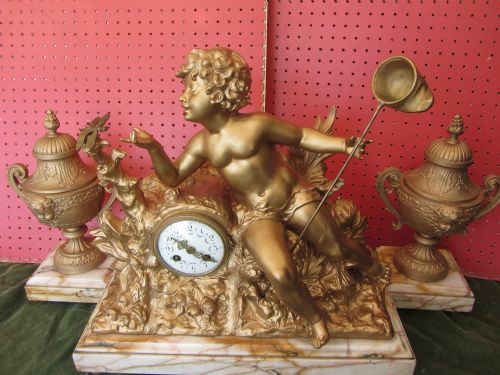



19th Century Figural Garniture
A 19th century figural garniture sets the visual anchor of a mantelpiece, bringing together a central clock and matching candelabra in bronze and marble.
19th Century Figural Garniture
A 19th century figural garniture typically takes the form of a matching three-piece set designed to sit together on a mantelpiece. These arrangements combine a central mantel clock flanked by matching candelabra or side urns, unified by shared materials and sculptural themes.
The versions most commonly met on this page originate from French workshops adhering to Louis XVI style, French Rococo Revival, or Victorian aesthetics. They rely on classical figures, cherubs, and animals cast in bronze, brass, or ormolu, mounted upon white or dark marble bases.
Mantel clock sets and clock garnitures from this era serve both a practical timekeeping function and a decorative purpose. They reflect the nineteenth-century preference for symmetrical interior decoration centred around the fireplace.
Materials and Construction
The manufacture of these sets relies on the combination of cast metals and carved stone. Founders shaped bronze, brass, gilt metal, and ormolu into sculptural figures and scrollwork, often applying patinated or parcel-gilt finishes to create textural contrast.
Marble forms the substantial bases and structural bodies for many pieces, paired with enamel dials for the clocks. Candelabra incorporate porcelain elements alongside gilt mounts, demonstrating the multi-material approach typical of nineteenth-century decorative arts.
19th Century Figural Garniture Retail Price Guide 2026
Typical asking prices for 19th century figural garniture among the pieces listed under this phrase on Sellingantiques today, from the lower quarter to the upper quarter. They describe what is for sale here now, not the wider market.
Dragonflies and cherubs keep a watchful metal eye over time from their perches on nineteenth-century clock cases.
Assessing Quality and Execution
The selection and treatment of the materials also dictate the tier of the piece. Superior garnitures employ high-grade marble free from heavy veining flaws, heavier gauge bronze with stable gilding, and harmonious proportions across all three matching components.
The 19th Century Figural Garniture Glossary
- Garniture
- A set of matching decorative objects designed to be displayed together on a mantelpiece or sideboard. A standard configuration includes a central clock accompanied by two matching candelabra.
- Ormolu
- A gilded bronze technique used extensively in French furniture and clockmaking during the eighteenth and nineteenth centuries. The process involves applying a finely ground high-carat gold-mercury amalgam to a bronze base.
- Candelabra
- Branched candlestick holders designed to support multiple candles. In garniture sets, these are sculpted to match the architectural and figural motifs of the central clock.
- Patinated bronze
- Bronze that has been treated with chemical solutions to produce a specific surface colour or dark tone. This finish contrasts against gilded highlights on figurative elements.
19th Century Figural Garniture: Frequently Asked Questions
What is a figural garniture?
A figural garniture is a matching set of decorative mantel ornaments consisting of a clock and paired side pieces. The designs frequently incorporate human figures, animals, or mythological subjects.
These sets were produced primarily in France and Britain during the nineteenth century to adorn formal reception rooms.
How do I style a clock set?
Place the central clock in the exact middle of the mantelpiece to establish visual balance. Flank it symmetrically with the matching candelabra or urns to complete the traditional arrangement.
Ensure the mantel shelf is deep and sturdy enough to support the substantial weight of marble and bronze components.
How do I identify French Revival styles?
Louis XVI style garnitures display neoclassical restraint, featuring straight lines, urn motifs, and classical figures. Rococo Revival pieces feature asymmetric curves, naturalistic scrollwork, and lively scenes.
Examining the casting style and ornamental vocabulary helps distinguish between these nineteenth-century revivals.
Are these sets entirely original?
Nineteenth-century garnitures often combine clock movements and bronze castings made by different specialists of the period. Components were paired together in workshops or retail showrooms before final sale.
Matching patination and uniform wear across the metal and marble parts indicate a set that has remained together over time.