
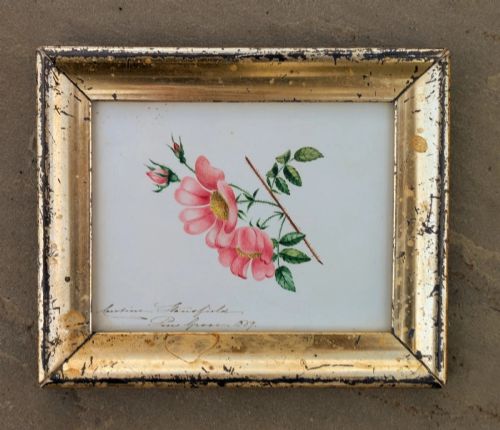
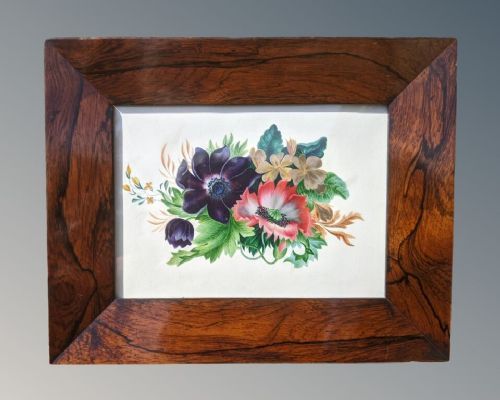
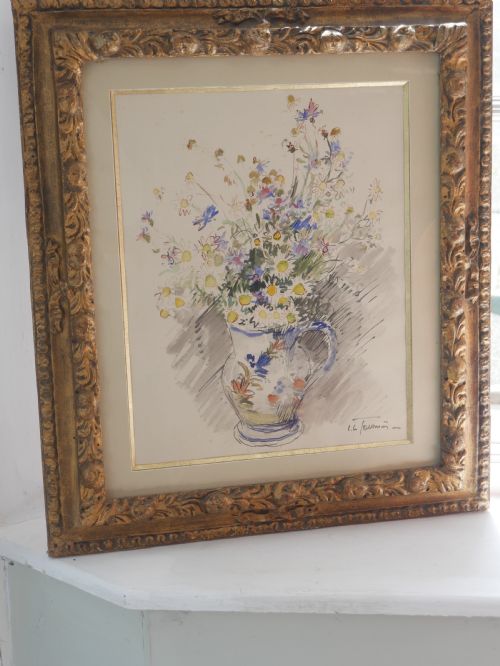


Original Watercolour Flower Painting
An original watercolour flower painting brings the quiet charm of a Victorian garden or a mid-century studio straight onto your wall.
Original Watercolour Flower Painting
An original watercolour flower painting captures botanical specimens and domestic still lifes across various periods, spanning from the nineteenth century through the Edwardian era and into mid-century modern works. Buyers frequently encounter detailed studies of roses, wallflowers, and garden jugs executed on paper by regional and exhibited artists alike.
The subjects range from rigid Victorian botanical recordings to loose British impressionism and wartime compositions painted during the nineteen-forties. Many pieces place seasonal blooms inside ceramic jugs, glass vases, or wicker baskets, preserving ephemeral flora through delicate washes of pigment.
The tradition encompasses both intimate domestic studies created by female specialists of the early twentieth century and bolder mid-century expressions. These works offer a direct window into historical gardening tastes and domestic interiors.
Materials and methods
Artists paint these floral studies primarily with water-soluble pigment on paper support, sometimes augmented by gouache for heavier opacity or ink for sharp definition. The transparent nature of watercolour allows light to reflect through the pigment layers from the white paper beneath.
Compositions often rely on delicate washes for petals and backgrounds, paired with fine brushwork for stems, leaves, and botanical details. Works are frequently preserved behind glass within period wood frames to protect the vulnerable paper surface from moisture and light damage.
The listings span multiple decades from the mid-nineteenth century through the nineteen-fifties, featuring paper supports, glass glazing, and wooden frames.
Assessing quality and execution
Quality rests heavily on the confidence of the brushwork and the artist's ability to render the translucency of petals without muddying colours. Stronger examples display crisp botanical accuracy or expressive gestural energy, whereas weaker pieces suffer from stiff composition and overworked pigments.
The preservation of the paper and the vibrancy of the original watercolour pigment significantly influence the visual impact. Works that have avoided excessive fading retain the delicate pinks, blues, and yellows intended by the painter.
James Tower·Harry Wanless·Henrietta Creswell·William Edward Fox·Theresa Stannard·Lester Sutcliffe·Lilian Stannard·Edith Barrow·Rowland Henry Hill·Grace Hastie·Margaret Laing·Phyllis I Hibbert·Marian Chase·Charlotte Isa James·Alice Macallan Swan·Beatrice Parsons·Marion Broom·Annie Mary Youngman·Edith Alice Andrews·Owen Bowen·Minnie Smythe·Mary Stevens·E M Davies·M Clay·Maria Harrison
The Original Watercolour Flower Painting Glossary
- Watercolour
- A painting method where natural pigments are suspended in a water-soluble binder and applied to paper. This technique creates luminous translucent washes prized for capturing floral softness.
- Botanical
- An artistic style focused on the scientifically accurate depiction of plant species. Such works prioritise precise structural detail over loose impressionistic interpretation.
- Gouache
- An opaque water-based paint containing pigment mixed with a binding agent and white filler. Artists use it alongside traditional watercolour to add solid highlights to flower petals.
- Still life
- A work of art depicting mostly inanimate subject matter, typically commonplace objects like pottery jugs filled with cut garden flowers. It remains a cornerstone format for these historical paintings.
- Support
- The physical surface, usually paper, upon which the artist applies the watercolour pigment. Its weight and texture heavily influence how the paint settles and ages.
Original Watercolour Flower Painting: Frequently Asked Questions
How should I frame an antique watercolour?
Protect the fragile paper by using acid-free mounting boards and framing the work behind glass to block harmful ultraviolet light.
Keep the piece away from direct sunlight and damp environments to prevent fading and foxing spots on the paper.
What subjects appear most often?
Common subjects include garden flowers arranged in ceramic jugs, glass vases, or wicker baskets, alongside wild meadow blooms.
Artists frequently painted seasonal favourites such as roses, delphiniums, anemones, and wallflowers gathered straight from domestic plots.
How do I date an old floral painting?
Examine the signature, framing style, paper type, and any handwritten inscriptions left on the reverse side by the artist.
Stylistic shifts between rigid nineteenth-century botanical precision and looser twentieth-century impressionism also offer reliable clues to the decade of creation.
Were these painted outdoors or inside?
Artists generally painted cut flowers arranged inside studios, though many also worked directly outdoors to capture garden borders and park landscapes.
Still life compositions allowed painters to control lighting and study the subtle translucency of petals up close.