
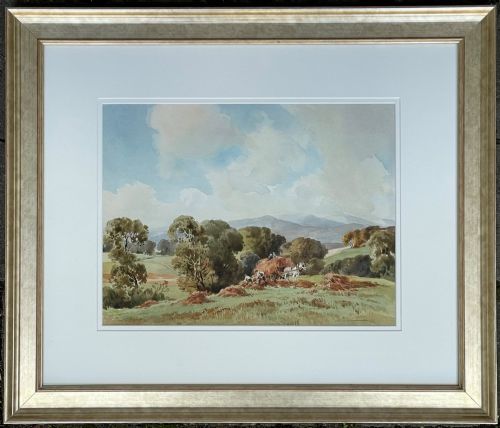
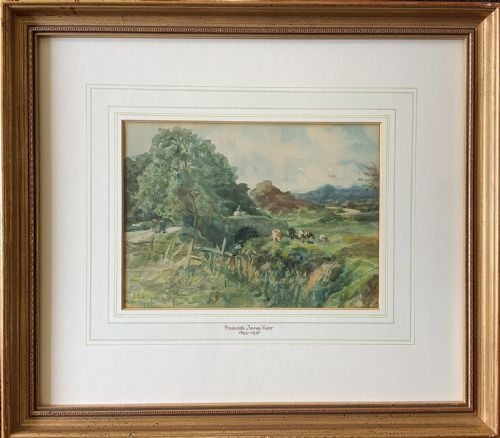


Original Pastoral Watercolour Picture
An original pastoral watercolour picture brings the quiet rhythm of the countryside, rural labour and traditional farm life directly onto the wall.
Original Pastoral Watercolour Picture
An original pastoral watercolour picture captures rural British life, depicting scenes of harvest, livestock, river valleys and farm workers across the nineteenth and early twentieth centuries. These watercolours span periods from the Victorian era through Edwardian times and into the 1930s, reflecting a deep national affection for the countryside.
Buyers will encounter framed artworks created within traditions such as British Impressionism, English School, and Victorian Pastoral. Common subjects include droving sheep, haymaking, cattle in landscapes, and village scenes at dusk, typically presented behind glass in wood or burr frames.
The works originate from named artists and traditional British painters who recorded local topography from Wales and Yorkshire to Devon and Hampshire. These paintings serve as historical windows into rural life before mechanisation fully transformed agricultural landscapes.
How they were made
These works are executed using watercolour pigment on paper, often built up with delicate washes and fine brushwork to capture atmospheric light and weather. Artists utilised the natural white of the paper to create highlights in clouds, water and clothing.
Framing materials commonly include wood, sometimes finished with gilt or gold leaf, paired with protective glass. The combination of paper support, watercolour pigment and period wooden framing remains standard across the selection.
Listings feature works dated from the Victorian era through the 1930s, executed on paper using watercolour pigment.
What varies in quality
Quality rests in the artist's handling of light, atmospheric depth and the naturalistic movement of figures and animals within the landscape. Masterly control over pigment dilution allows certain works to convey the heavy moisture of a river valley or the golden warmth of harvest time far more convincingly than standard topographical sketches.
The integrity of the original frame and the preservation of the paper support also define the standing of a piece. Works retaining their period wooden or burr frames without excessive fading or paper discolouration command greater appreciation among collectors.
Percy Lancaster·Frederick James Kerr·Cornelius Pearson·Henry Charles Fox·Frederick Septimus Lewis·John Atkinson·Helena Maguire·George Soper·Harold Lawes·Edmund George Warren·Basil Bradley·Joseph Kirkpatrick·J.V.R. Parsons·Walter Duncan·Walter Henry Sweet·George Faulkner Wetherbee·Charles James Adams·Henry John Kinnaird·William Stephen Coleman·James Stephen Gresley·Frank Saltfleet·J.D. Walker·George Graham·David Heward·Yeend King
The Original Pastoral Watercolour Picture Glossary
- Watercolour
- A painting method in which the paints are made of pigments suspended in a water-based solution. It relies on translucent washes applied to paper.
- Pastoral
- A genre of art that idealises rural life and farm work. These scenes typically feature shepherds, farm hands, livestock and open fields.
- Gilt
- Covered thinly with gold leaf or gold paint. This finish frequently appears on the inner edges of period picture frames.
- Edwardian
- Pertaining to the reign of King Edward VII, spanning from 1901 to 1910. In these listings, it denotes works created during the early twentieth century.
- English School
- A classification for artists trained or working within England. It describes the national tradition of landscape and genre painting.
Original Pastoral Watercolour Picture: Frequently Asked Questions
What subjects appear in these watercolours?
The paintings predominantly feature rural British life, including harvest fields, cattle droving, sheep shearing, and peaceful river valleys. Artists focused on the daily labour of farm hands and the changing moods of the English and Welsh countryside.
Scenes range from quiet village lanes at dusk to busy agricultural operations like haymaking and logging. Human figures and livestock are integrated into expansive topographical landscapes.
How should I hang a watercolour?
Watercolours are sensitive to bright sunlight and require placement away from direct windows to prevent the pigments from fading. Consistent indoor humidity levels help protect both the delicate paper and the historic wooden frame.
Using conservation-grade backing and UV-filtering glass during any future re-framing ensures the long-term preservation of the pigment. Secure picture hooks suited to the weight of the wood and glass protect the structural integrity of the piece.
Are these paintings original works?
Every piece listed is an original painting created by hand using watercolour pigments on paper. These are unique works of art rather than modern reproductions or mass-produced prints.
Artists painted these scenes directly from nature or in their studios during the nineteenth and early twentieth centuries, recording specific locations and working rural traditions.
How do I identify the period?
Dating relies upon artist biographical dates, stylistic movements such as British Impressionism or Victorian Pastoral, and framing materials. Signatures, dates inscribed on the mount or reverse, and subject dress can also indicate the era.
Victorian pieces often display heavier romanticism, while Edwardian and 1930s works frequently incorporate looser brushwork and brighter atmospheric effects characteristic of the period.