
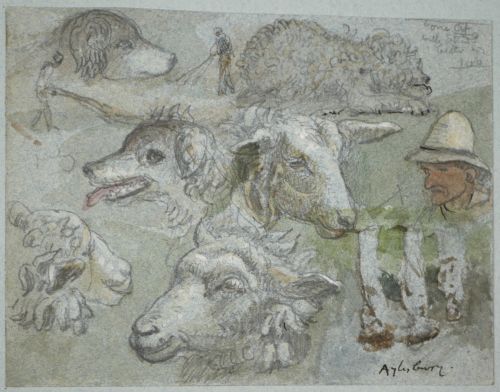


Original Agricultural Painting
An original agricultural painting brings the traditional rhythm of the countryside, rural labour and pastoral landscape directly onto the wall.
Original Agricultural Painting
When you search for an original agricultural painting, you encounter works capturing the traditional working life of the countryside, from haymaking and ploughing teams to farm hands and livestock. These pieces span from the mid nineteenth century through the Edwardian era and into the mid twentieth century, reflecting shifting artistic interpretations of rural labour.
You are most likely to meet watercolours on paper and oil paintings on canvas depicting harvests, horses and carts, and pastoral landscapes. The styles range from Victorian and Edwardian pastoral realism to British impressionism and mid-century interpretations.
The subjects focus heavily on working animals and farm workers, including bulls ploughing, horses leading timber, and young girls tending calves. These scenes record a specific era of rural industry before mechanisation altered the landscape permanently.
What separates works within this range
Quality rests upon the artist's ability to render human and animal anatomy convincingly, particularly when portraying working horses, plough teams and figures in motion. The handling of natural light across an open harvest field or farmyard also distinguishes a more accomplished composition from a standard topographical record.
The harmony between the artwork and its period frame contributes significantly to the integrity of the piece. Surviving contemporary frames, such as burr wood or ebonised surrounds, complement the visual weight of the canvas or watercolour.
Represented styles include British Impressionism, Pastoral Realism, and naive school painting, focusing on rural labour and farm life.
James Smetham·Oswald Garside·Henry Bailey·John Atkinson·James William Booth·George Soper·Arthur Winter Shaw·Rowland Henry Hill·Joseph Kirkpatrick·Frederick William Jackson·Arthur Claude Strachan·Ernest Higgins Rigg·Walter Duncan·George Hamilton Constantine·William Greaves·Sonia Lawson·Owen Bowen·George Graham·George Cole·Fred Lawson·Charles James Adams
The Original Agricultural Painting Glossary
- Pastoral Realism
- An artistic style focusing on the honest depiction of rural life and agricultural labour without romantic exaggeration. It emerged strongly in British art during the nineteenth and early twentieth centuries.
- Watercolour
- A painting method in which the paints are made of pigments suspended in a water-based solution, typically executed on paper. This medium allows for luminous washes that capture atmospheric daylight.
- Oil Painting
- A process of painting with pigments that are bound with a medium of drying oil, commonly applied to stretched canvas. This technique permits rich texture and depth of colour.
- Provenance
- The chronology of the ownership or location of a historical work of art. Documented origin helps establish the authenticity and history of an antique painting.
- Genre Painting
- Pictorial representation of scenes from everyday life, such as farm hands working in a field or milking time. These works provide a social record of historical rural occupations.
Original Agricultural Painting: Frequently Asked Questions
What subjects appear in these agricultural paintings?
The artworks predominantly depict rural scenes such as haymaking, ploughing teams with horses, farm hands, harvesting, and livestock like cattle. These subjects document traditional agricultural practices before the widespread arrival of mechanised farming.
Artists captured the daily toil and seasonal rhythms of the countryside, offering a direct window into rural labour across the nineteenth and early twentieth centuries.
How should I care for a vintage watercolour?
Watercolours on paper are sensitive to direct sunlight, which can fade pigments and discolour the paper over time. Hang them away from strong windows and maintain stable indoor humidity.
Keeping the original glass and frame intact helps protect the paper from dust and atmospheric pollutants while preserving the historical integrity of the piece.
How can I tell an oil painting from a watercolour?
An oil painting utilises thick pigments applied to a canvas, often showing visible brushstrokes and a textured surface. These works are typically framed without glass to allow the canvas to breathe.
Watercolours use transparent washes on paper and require a protective layer of glass set within a framed mount to prevent moisture damage.
Where were these rural landscape scenes usually painted?
Many British landscape painters travelled to rural counties known for agriculture, capturing local fields, stack yards, and coastal farming communities. Locations noted in the works range from Essex and Yorkshire to Arundel.
Artists often worked directly in the fields during harvest time to record the specific light and atmosphere of the region.