





Oriental Style Nested Tables
Oriental style nested tables are practical sets of graduating tables that slide neatly together, offering surface space without crowding a room.
Oriental Style Nested Tables
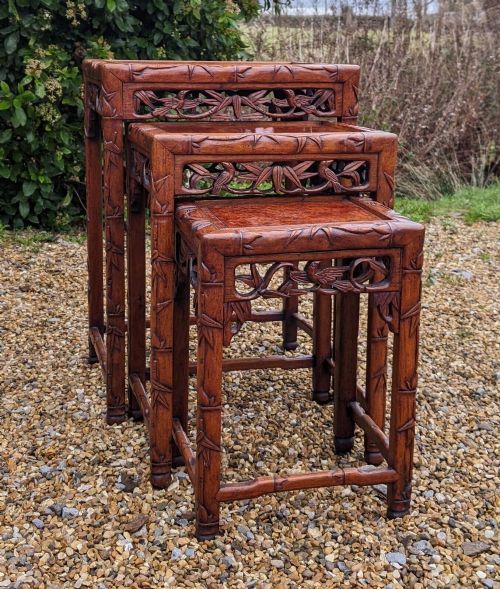
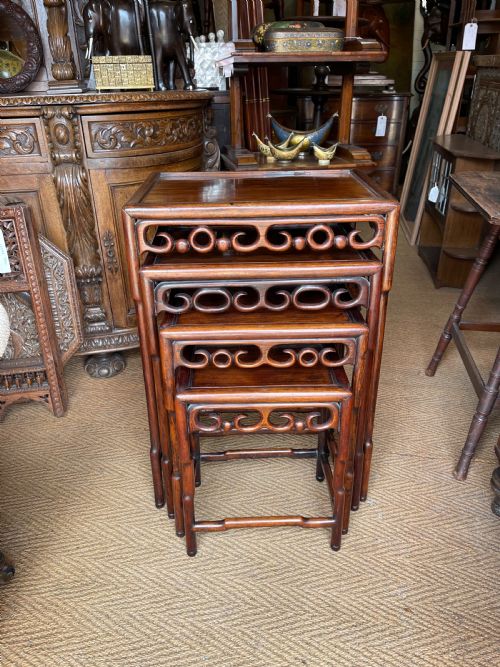
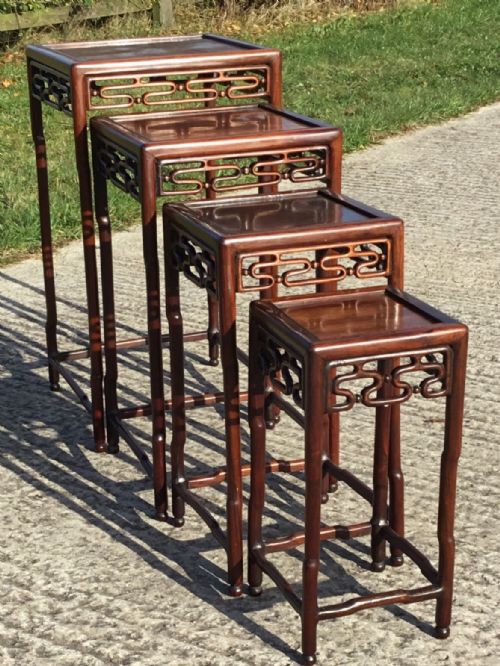
Oriental style nested tables comprise graduating sets of three or four occasional surfaces designed to stack one beneath another. When searching for oriental style nested tables, buyers encounter pieces primarily originating from the nineteenth century alongside early twentieth century interpretations.
The forms span Chinese export pieces, traditional Chinese constructions, and British Queen Anne style interpretations decorated with Chinoiserie motifs. Most examples encountered on this page consist of sets of four tables, though sets of three also appear regularly.
Materials range from dense Asian hardwoods such as huanghuali and rosewood to lacquered surfaces embellished with gilt paint and gold leaf. These tables function equally well as discrete tea tables or stacked together as a compact stand.
How they were made
Cabinetmakers utilised dense native hardwoods like huanghuali, rosewood, and hongmu, frequently combining them with burrwood veneers to create richly figured tops. These timbers provided the structural integrity required for frames that must slide repeatedly within one another without binding.
Surface decoration involved meticulous lacquering combined with hand-applied gold leaf, gilt paint, and intricate carving. Artisans shaped the frames following traditional Chinese Qing Dynasty styles or applied European Queen Anne forms with Asian pictorial schemes.
Clever nineteenth-century guests treated nested tables as musical chairs, quietly shifting sizes around the room until everyone had a surface for their teacup.
What varies in quality
The finesse of the surface finish dictates the upper tier of the range, particularly where hand-applied gold leaf and lacquer remain crisp and deep. Lesser examples rely on plain hardwood without the refined detailing or decorative lacquer work seen on export pieces.
The Oriental Style Nested Tables Glossary
- Nest of tables
- A set of graduating tables designed to fit neatly one beneath another to save floor space.
- Chinoiserie
- European artistic style reflecting Chinese motifs and decorative techniques, popular on furniture from the seventeenth century onwards.
- Hongmu
- A traditional Chinese term for dense red hardwoods used in fine furniture construction.
- Lacquer
- A durable resin finish applied in multiple layers and often decorated with gilt paint or gold leaf.
Oriental Style Nested Tables: Frequently Asked Questions
How were oriental style nested tables used historically?
These tables served as versatile furniture pieces in traditional settings, easily pulled out to serve tea or display objects and then stacked away to maximise floor space.
Their modular design made them exceptionally practical for entertaining guests in parlours and reception rooms.
What woods were commonly used for these tables?
Maker workshops utilised dense Asian hardwoods including rosewood, huanghuali, and hongmu, often pairing them with burrwood panels for decorative contrast.
These timbers offered the necessary weight and durability to withstand the daily friction of sliding tables in and out of the stack.
How do I date nineteenth-century sets?
Dating relies upon examining the timber grain, construction joints, and the wear patterns on the lacquer or polished hardwood surfaces.
Nineteenth-century pieces frequently display hand-cut joinery and aged patina that distinguish them from later twentieth-century reproductions.
Are sets of four more common than sets of three?
Listings demonstrate a clear preference for sets of four tables, though sets of three also appear across various periods.
Each smaller table must reduce in scale precisely to clear the framework of the next size up in the hierarchy.