
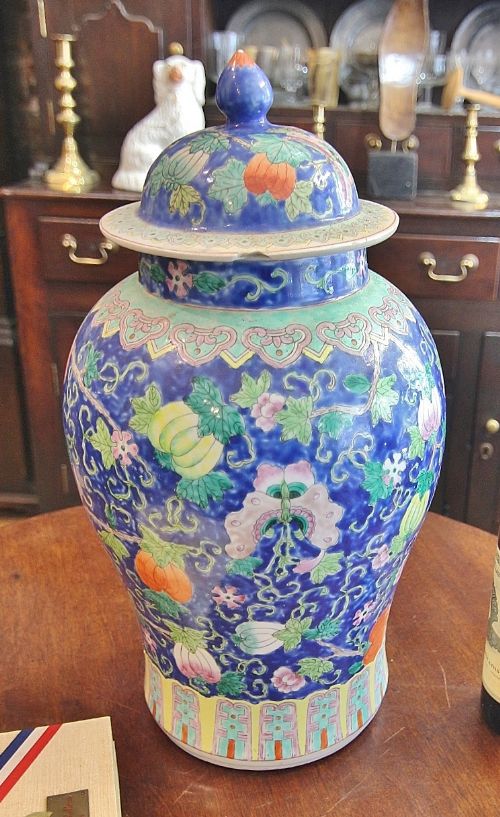


Oriental Lidded Display Jars
Oriental lidded display jars are substantial ceramic vessels carrying rich decorative schemes designed to command attention in a room.
Oriental Lidded Display Jars
When you search for oriental lidded display jars, you are looking at substantial vessels created for visual impact, often taking the form of ginger jars, covered urns, and decorative jars with matching lids. The pieces you are most likely to meet on this page span the eighteenth, nineteenth, and twentieth centuries, originating from Chinese and Japanese workshops.
The styles represented in these listings include Japanese Imari, Edo period work, Meiji pieces, and Qing dynasty ceramics. Forms range from large single vases to impressive pairs intended for symmetrical placement on mantelpieces or large furniture.
Makers and decorators utilised distinct regional palettes, from the cobalt blue underglaze and overglaze enamel of Chinese export wares to the iron-red and gold highlights characteristic of Japanese Imari production. Each piece functions primarily as a decorative anchor within an interior space rather than a utilitarian container.
How they were made
The foundation of these objects is porcelain, shaped into robust bodies designed to support heavy layers of decoration and repeated firings in the kiln. Artisans applied cobalt blue underglaze before the initial glaze firing, allowing deep blue motifs to fuse permanently with the ceramic body.
Overglaze enamels, gold leaf, and gilding were added in subsequent low-temperature firings to build up rich surface patterns. Certain decorative vessels also incorporate mounted or applied ormolu elements to enhance their status as high-end display objects.
Listings feature porcelain vessels spanning the eighteenth, nineteenth, and twentieth centuries, incorporating both Chinese and Japanese regional styles.
What varies in quality
Quality in these ceramic vessels rests upon the crispness of the underglaze painting and the precision with which overglaze enamels and gold leaf are applied. Finer examples display meticulous brushwork where every detail of a dragon or floral motif is rendered with deliberate control.
The weight and purity of the porcelain body, along with the stability and matching quality of the original lid, also define the upper tier of the range. Pieces that retain vibrant gilding and clear enamel separation without rubbing demonstrate superior historical preservation and skilled initial manufacture.
The Oriental Lidded Display Jars Glossary
- Imari
- A style of Japanese porcelain featuring a distinctive palette of underglaze cobalt blue, iron-red, and supplementary gold. This decorative approach became hugely popular for export to European markets.
- Doucai
- A Chinese porcelain technique where outlines of a design are painted in underglaze blue, then filled in with contrasting overglaze enamels after the initial firing. It requires exceptional precision from the decorator.
- Ormolu
- Gilded bronze mounts applied to furniture and decorative ceramics to add structural definition and decorative luxury. It elevates the visual weight of an object.
- Cloisonne
- An enamelwork technique where metal wire is soldered to a base to form compartments, which are then filled with coloured paste and fired. The resulting surface shows intricate coloured patterns bounded by thin metal lines.
- Ginger jar
- A wide-mouthed, bulbous ceramic vessel originally intended for storing spices. In later centuries, these jars were produced purely for decorative display alongside matching lids.
Oriental Lidded Display Jars: Frequently Asked Questions
What were oriental lidded display jars used for?
These large vessels were primarily manufactured for export and high-end interior decoration rather than practical storage. Wealthy households placed them on mantelpieces, consoles, and tables to demonstrate taste and global trade connections.
Over time, their role shifted entirely to ornamental display, where matched pairs created symmetrical focal points in formal rooms.
How do I tell an 18th century jar from a 19th century one?
Differentiating periods relies on examining the weight of the porcelain, the vibrancy and chemical composition of the enamels, and the style of the hand-painted motifs. Earlier pieces often exhibit softer cobalt tones and finer potting techniques.
Nineteenth-century revival pieces tend to feature bolder, brighter overglaze enamels and heavier, denser porcelain bodies produced to meet surging Western demand.
How should I display large lidded jars at home?
Due to their substantial size and visual weight, these jars require sturdy furniture such as sideboards, cabinets, or dedicated pedestals. Paired items work best when arranged symmetrically to frame a fireplace or a large architectural feature.
Keep them away from direct foot traffic where the lid or body might be accidentally dislodged or struck.
What is the difference between Imari and Kutani wares?
Imari ware typically relies on a strict triad of underglaze blue, iron-red, and rich gold accents over a porcelain body. It originated in Japan and is easily recognised by its dense, brocade-like patterns.
Kutani ware, by contrast, often employs a broader, more painterly palette dominated by deep greens and golds, depicting figurative scenes or bold nature studies.