
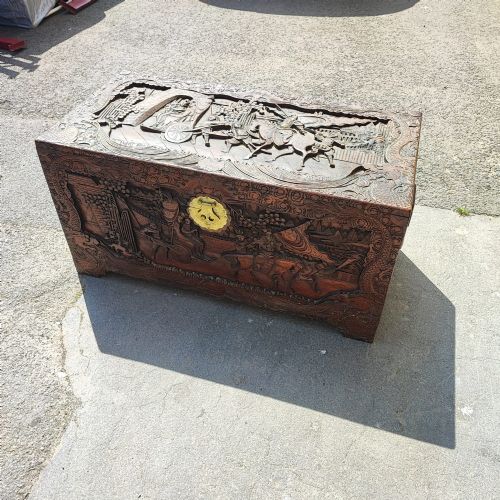


Oriental Carved Trunk
An oriental carved trunk brings rich aromatic wood and deep relief carving into a room, serving as practical storage with a distinct history.
Oriental Carved Trunk
An oriental carved trunk is a substantial storage piece built for travel and household use, often encountered in camphor wood or resilient hardwoods. These chests frequently appear from the nineteenth century and the early twentieth century, spanning Victorian examples through to the Art Deco period.
The form encompasses blanket boxes, luggage chests, and storage coffers alongside related seating or table variations such as occasional tables. Pieces emerge from various stylistic traditions including Chinese export, Anglo-Indian, and Zanzibar designs.
Most examples found here are constructed from fragrant camphor wood, prized for keeping textiles safe. Buyers encounter deep relief carvings depicting traditional scenes, landscapes, and floral motifs across the lid and sides.
How They Were Made
Cabinetmakers utilised dense woods such as camphor wood, teak, and rosewood, joining panels with traditional woodworking joints to withstand long sea journeys. These primary timbers were selected for durability and resistance to humidity.
Metal mounts in brass reinforced the corners and edges, often fastened with numerous small tacks or studs. Some iterations combined carved wooden surfaces with applied lacquer or protective metal coverings.
Carvers worked directly onto the solid timber using chisels to create multi-layered relief panels. The interior remained largely unpolished to preserve the natural scent of the wood.
Listings feature camphor wood, teak, rosewood, and brass, spanning the nineteenth century through the Art Deco period of 1930.
What Varies in Quality
The depth and detail of the carving distinguish finer examples, where figures and foliage possess crisp undercut edges rather than flat, summary styling. Superior chests display balanced compositions across every visible panel, including the back and sides.
Hardware and secondary materials contribute significantly to the overall standard of a trunk. Heavy brass handles, secure locks, and sturdy hinges indicate a higher grade of manufacture than thin metal substitutes.
The condition of the timber grain and the preservation of the natural aroma affect the desirability of the piece. Well-maintained camphor wood retains its structural integrity and characteristic scent without excessive dryness.
The Oriental Carved Trunk Glossary
- Camphor wood
- A strong aromatic timber harvested from the Cinnamomum camphora tree, commonly used for nineteenth-century storage chests to deter insects. The wood is easily recognised by its distinct medicinal scent.
- Zanzibar chest
- A heavy travel chest traditionally associated with East African trade routes, characterised by brass studding and strapwork. These pieces often feature secret compartments and sturdy wooden construction.
- Anglo-Indian
- A descriptive term for decorative arts produced in India under British influence, combining local craftsmanship with European forms. Such items frequently incorporate dense teak or hardwood carved with foliage.
- Chinese export
- Goods manufactured in China specifically for Western markets during the eighteenth and nineteenth centuries. These items adapt traditional domestic forms to suit European tastes.
- Chinoiserie
- European artistic interpretations of Chinese and East Asian artistic traditions, applied to furniture and decorative objects. This style appears on pieces finished with lacquer or pictorial motifs.
Oriental Carved Trunk: Frequently Asked Questions
What were oriental carved trunks used for?
These chests served primarily for storing clothing, blankets, and valuable textiles during long maritime voyages. Their aromatic wood protected contents from dampness and insects.
In domestic settings, they functioned at the foot of beds or in hallways to hold household linens while doubling as sturdy furniture.
How do I care for a camphor wood chest?
Keep the wood away from direct heat sources and sudden temperature shifts to prevent the solid timber from splitting. Regular dusting with a dry cloth maintains the surface.
Avoid applying heavy waxes or modern polishes that might seal the wood and mask the natural fragrance of the camphor.
How do I date a nineteenth-century trunk?
Examine the construction methods, the type of brass fittings, and the style of the relief carving on the panels. Nineteenth-century examples often display hand-cut joints and heavier brass studwork.
Compare the patination of the wood and the wear around the handles and feet with documented pieces from the Victorian era.
What is the difference between a Zanzibar chest and a camphor trunk?
Zanzibar chests typically feature heavy brass strapwork, studding, and robust teak or rosewood construction designed for maritime trade. They focus on structural fortification.
Camphor trunks rely on deep surface carving across the wood itself and utilise the aromatic properties of camphor wood to safeguard textiles.