



Open Tier Side Table
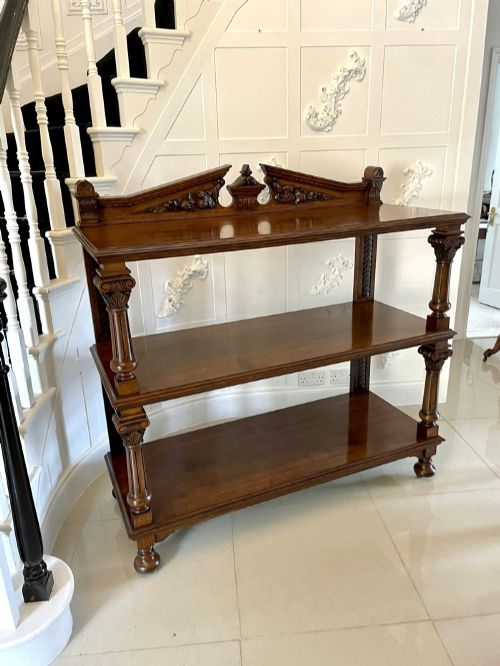
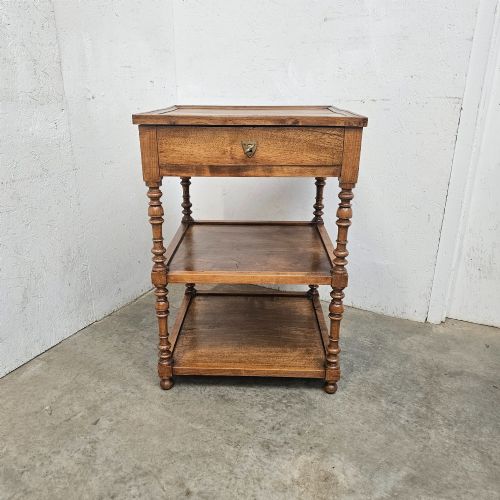
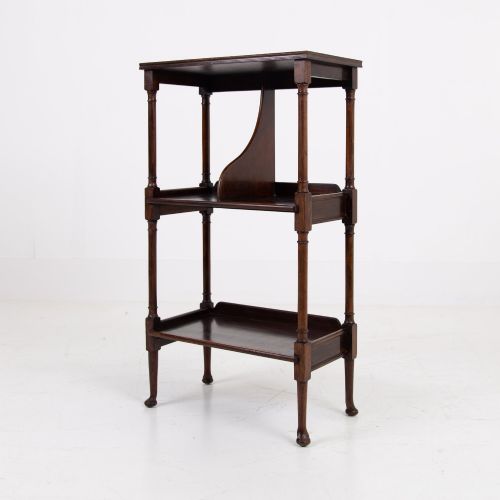
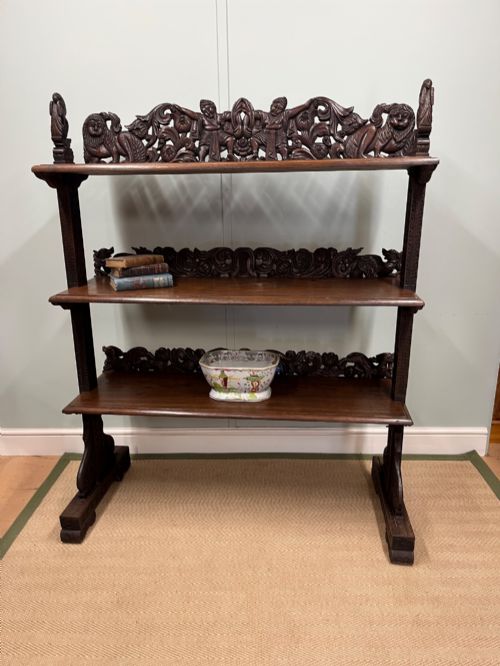
These open tier side table pieces are stacked display stands and whatnots that offer accessible shelving for books and ornaments.
Open Tier Side Table
An open tier side table typically appears on this page as a whatnot, étagère, or tiered buffet spanning Georgian, Victorian, and Edwardian periods. These multi-level pieces function as bedside tables, bookshelf combinations, and display stands.
The form spans straightforward utilitarian stands through to decorative French Provincial and Regency Revival designs. Most examples provide multiple open shelves supported by turned legs or columns.
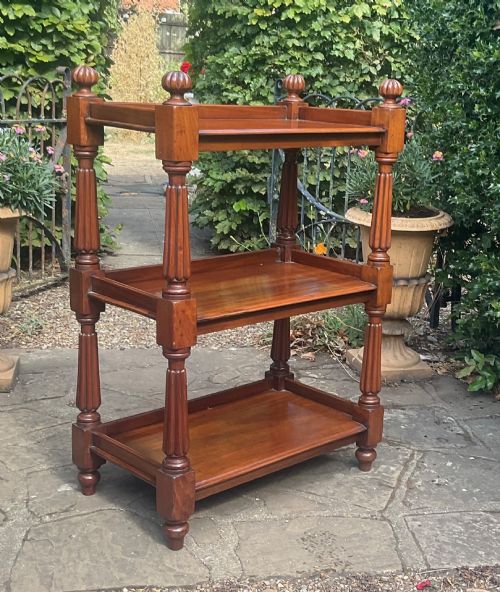
Origins range from English workshops to French makers working in walnut, mahogany, and oak. Buyers encounter these versatile stands in configurations from three-tier slim buffets to octagonal shapes.
How they were made
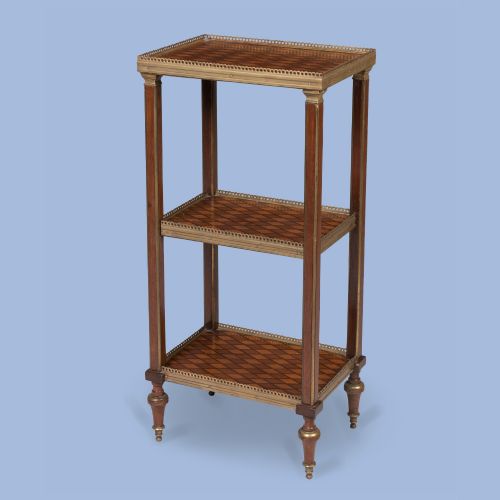
Cabinetmakers constructed these tiered pieces primarily in solid timbers such as mahogany, walnut, oak, rosewood, and teak, often applying marquetry veneer for decorative surface detail.
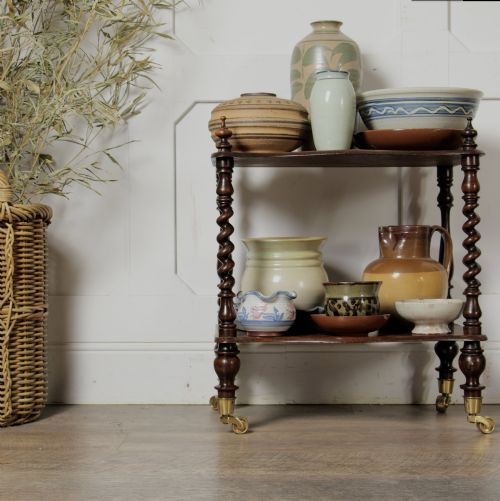
Structural elements include turned wooden legs, barley twist supports, and occasional brass mountings or original castors for mobility. Joinery relies on traditional framing methods to support multiple stacked shelves.
Listings feature woods such as mahogany, walnut, oak, rosewood, teak, kingwood, and marquetry veneer across Georgian, Victorian, and Edwardian periods.
What varies in quality
The refinement of the timber selection and the crispness of turning on the upright supports distinguish standard utility items from finer examples. Grain alignment in mahogany, walnut, and rosewood plays a major role in the visual impact of the tiers.
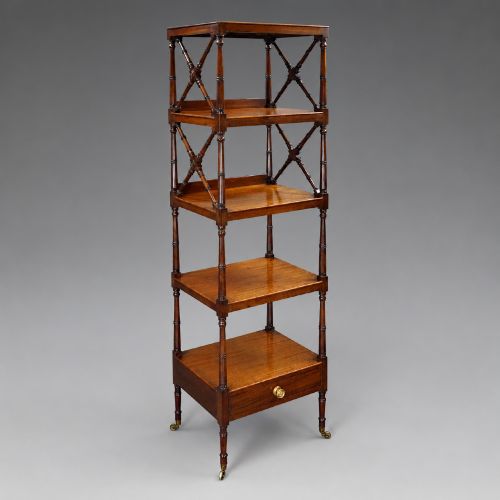
Proportion and stability across multiple levels dictate the architectural success of the piece. Superior examples maintain balance and elegance without feeling heavy, even when built with four distinct tiers.
The Open Tier Side Table Glossary
- Whatnot
- A piece of furniture consisting of a set of open shelves for displaying small objects. This form became popular in the Georgian and Victorian eras for parlours and bedrooms.
- Étagère
- A piece of furniture with a set of open shelves for holding ornaments or books. Originating in France, it functions as both a display stand and a side table.
- Buffet
- A tiered shelving unit or sideboard used for serving or display. Examples here often feature three or four open tiers.
- Barley twist
- A type of pillar or leg carved in a spiral twist resembling barley sugar. This decorative turning appears frequently on Victorian stands.
- Marquetry veneer
- Thin slices of decorative wood applied in patterns to a furniture surface. This technique adds pictorial detail to tabletops and shelf edges.
Open Tier Side Table: Frequently Asked Questions
What is an open tier side table used for?
These versatile pieces serve primarily as display stands, bedside night tables, or compact bookshelves in living spaces and bedrooms. The stacked shelves provide practical storage while keeping objects visible and accessible.
Historically, they held books, tea service items, or decorative ornaments in principal rooms. Today, they function similarly in modern interiors where floor space is at a premium.
How do I identify a Victorian whatnot?
Victorian examples often feature distinctive turning such as barley twist supports, heavier proportions, and darker timbers like mahogany or walnut. Many include original brass castors on the feet for easy movement.
Comparing the timber density and the complexity of the upright supports helps distinguish these from later revival pieces. The presence of multiple fixed tiers is a defining characteristic.
Are these tables sturdy enough for daily use?
Most tiered stands are constructed with traditional joinery connecting the shelves to vertical supports, making them structurally sound for holding books and ornaments. Proper placement on a level floor ensures stability across all levels.
While they are open and lack the enclosed storage of a cabinet, their multi-tiered design distributes weight effectively when loaded sensibly.
What is the difference between an étagère and a whatnot?
An étagère generally carries a slightly more decorative or continental association, often linked to French design influences and finer marquetry work. A whatnot is typically the traditional English equivalent for multi-tiered display shelving.
In practice, makers and dealers often use the terms interchangeably for open-shelved furniture from the nineteenth century.
What timbers were commonly used?
Mahogany and walnut predominate across Georgian and Victorian pieces, offering rich grain patterns and durable structural strength. Oak, rosewood, teak, and birdseye maple also appear in specific regional or period examples.
Finer pieces may incorporate exotic veneers like kingwood alongside brass mounts to enhance the decorative scheme.