
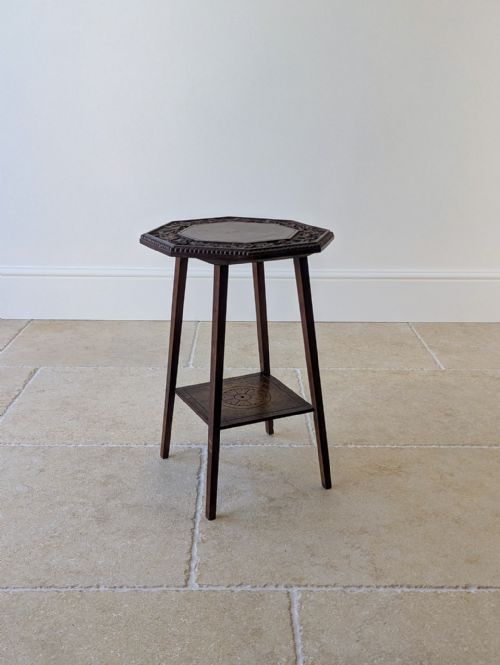
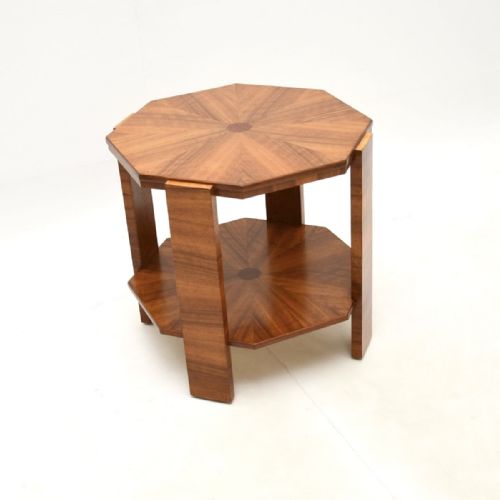

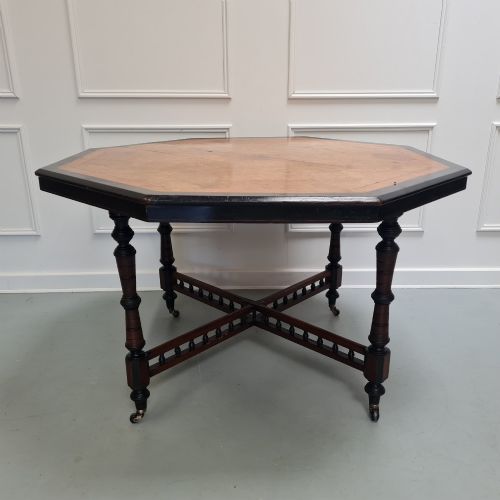
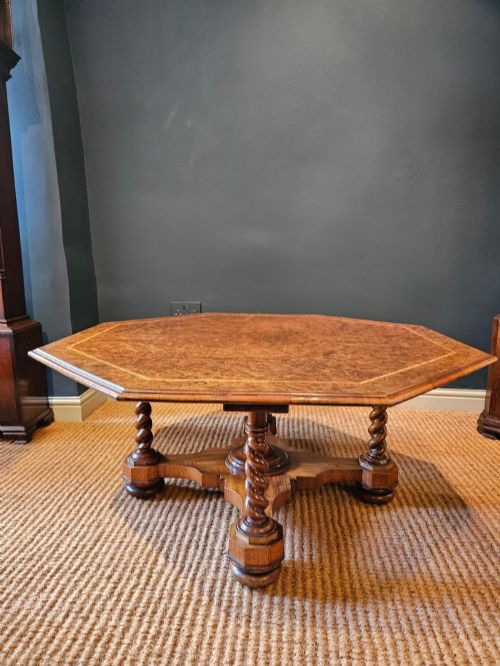

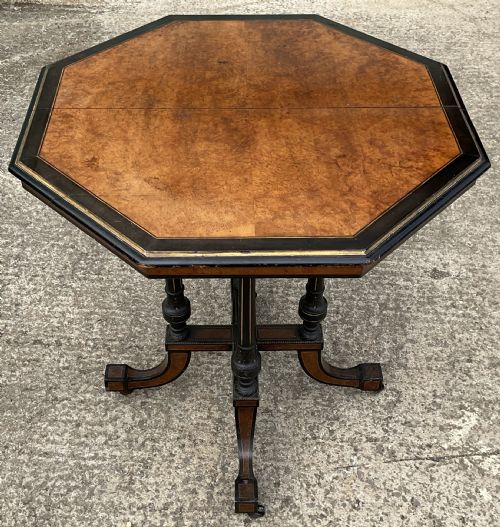
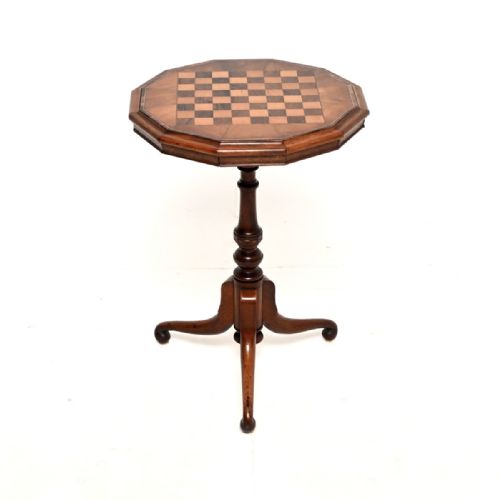


Octagonal Walnut Table
An octagonal walnut table brings geometric precision and rich timber figure to a room, shifting easily between Victorian sewing uses and Art Deco coffee heights.

Understanding the Octagonal Walnut Table
An octagonal walnut table appears in various forms across the Victorian, Edwardian, and Art Deco periods, serving as an occasional piece, a centre table, or a specialised sewing trumpet.
The most common examples on this page date from the Victorian era through the 1930s, utilising eight-sided tops that break the monotony of standard square or round furniture.
Makers adapted the eight-sided format for diverse domestic roles, including wine tables, lamp stands, window displays, and two-tier book tables.
Materials and Construction
Cabinet makers utilised solid walnut alongside burr walnut veneer and figured walnut to produce rich, swirling grain patterns across the eight-sided surfaces.
Workshops occasionally integrated contrasting materials such as ebony, brass, or fruitwood details, alongside inlaid decoration and Syrian or Moorish geometric motifs.
Retail Price Guide 2026
Typical UK retail prices for octagonal walnut table, calculated from the Sellingantiques database of over a million retail prices indexed since 2003. This retail price guide relies exclusively on Sellingantiques data; no external sources or auction records are used, so the figures do not describe the wider market.
Victorian sewing tables keep their secrets inside an octagonal trumpet skirt, originally designed to hide runaway spools of thread.
Assessing Quality and Execution
The distinction between standard domestic production and superior workshop output rests in the choice of timber figure, particularly the depth of burr walnut veneer on the top.
Structural complexity, such as cross-stick bracing, multi-tiered shelving, gallery edges, and specialised pedestal or trumpet bases, separates ambitious designs from simpler occasional furniture.
Morris and Co·Liberty and Co·Heals
The Octagonal Walnut Table Glossary
- Trumpet table
- A pedestal table featuring an octagonal, bell-shaped or trumpet-form body that conceals a sewing or work bag beneath the lid. These pieces were popular during the mid-Victorian period for needlework storage.
- Centre table
- A freestanding piece designed to be viewed from all sides rather than pushed against a wall. Their symmetrical eight-sided tops suit placement in the middle of a room or entrance hall.
- Aesthetic movement
- A late nineteenth-century design style prioritizing visual beauty over narrative meaning, often incorporating ebonised details or geometric inlay. Tables from this movement show simpler lines influenced by Japanese and Gothic art.
- Cross-stick bracing
- An intersecting structural arrangement of wooden stretchers beneath the top that stabilizes the legs. This technique provides both rigidity and visual interest in multi-tiered tables.
Frequently Asked Questions
What is an octagonal walnut table used for?
These eight-sided surfaces function primarily as occasional, lamp, or side tables, positioned beside seating to hold small objects. Larger examples serve as centre tables in halls or parlours.
Specific variants, such as trumpet tables, incorporate internal compartments designed for sewing materials and needlework.
How do I date a walnut octagonal table?
Dating relies on stylistic markers and construction methods, moving from heavy carved Victorian pedestals and inlaid sewing compartments through Edwardian gallery edges to clean-lined Art Deco forms from the 1930s.
Earlier Victorian pieces often display rich burr veneers and ebonised bases, while later Arts and Crafts or Cotswold School examples emphasise solid timber construction.
What is the difference between solid walnut and burr walnut veneer?
Solid walnut uses standard timber planks throughout the construction, displaying a straight, uniform grain pattern. Burr walnut veneer applies a thin slice of highly figured, knotty growth timber over a stable secondary wood base.
This technique creates dramatic, swirling patterns specifically chosen to decorate the primary viewing surfaces of Victorian and Art Deco tabletops.
How do I care for antique walnut furniture?
Maintenance requires keeping timber away from direct heat sources and strong sunlight to prevent the walnut veneer from drying or fading. Regular dusting with a soft, dry cloth preserves the finish without requiring heavy polishes.
Conditioning with appropriate wax occasionally helps maintain the moisture and natural lustre of the historical surface.