




Ochre Architectural Painting
Ochre architectural painting captures townscapes and cathedrals with earthy warmth, offering a characterful window into historical street scenes.
Ochre Architectural Painting
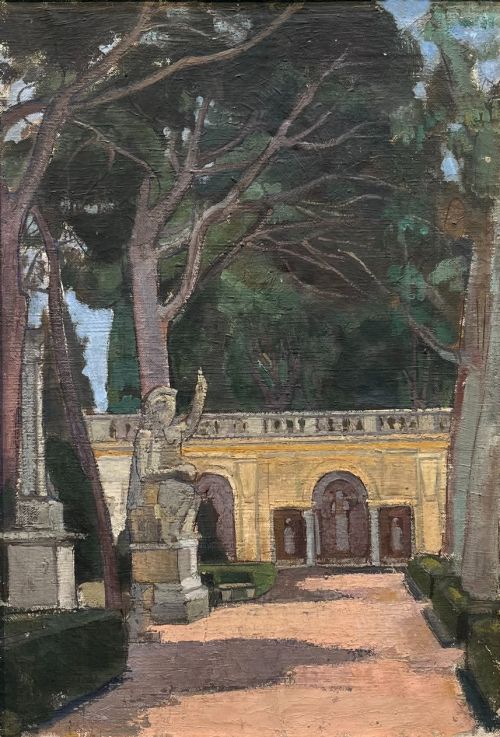
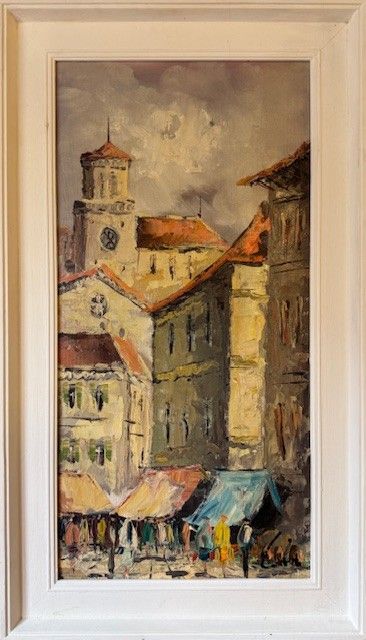
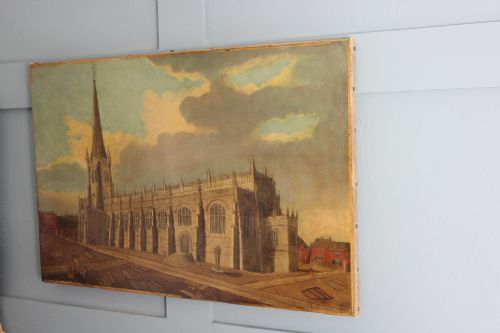
Ochre architectural painting encompasses works depicting urban street scenes, cathedrals, markets, and historical buildings rendered in earthy yellow and brown pigments. These pieces capture specific locations ranging from Venetian squares and Roman gardens to British cathedrals and London landmarks.
Buyers encounter variations spanning from Victorian and Edwardian watercolours to mid-century oil paintings and constructivist industrial scenes. The selection includes works by named British and European artists alongside pieces originating from Grand Tour travels.
The dominant forms are framed paintings on canvas, paper, board, and watercolour, reflecting both loose Impressionist brushwork and structured topographical detail.
How they were made
Artists utilised traditional painterly materials including oil paint and watercolour applied to paper, canvas, and wooden boards. These mediums were often housed within protective wood frames to preserve the surface.
Techniques range from fluid watercolour washes capturing atmospheric light in public squares to textured oil applications defining industrial brickwork and stone cathedrals.
Listings feature paper, canvas, and wood board as primary supports for oil and watercolour.
What varies in quality
Quality rests upon the handling of perspective, light, and architectural proportion within the composition. Stronger works demonstrate confident draughtsmanship in mapping complex structures like cathedral facades and busy market squares.
The sensitivity of the palette defines the tier of the piece, particularly how effectively the ochre tones establish depth and atmosphere across the painted surface.
Thomas Ellison·Charles James Lauder·Ron Folland·William George Meadows·Rowland Henry Hill·Benedetto Salviati·Joseph W Milliken·Robert Lesley Howey·John Cawthorn·Fred Lawson
The Ochre Architectural Painting Glossary
- Watercolour
- A painting method where fine pigment is suspended in a water-based solution, typically applied to paper. This medium allows for transparent washes of colour that evoke atmospheric light.
- Constructivism
- An artistic approach emphasising abstracted geometric forms and industrial subjects. In these listings, it appears in factory and structural compositions from the mid-century.
- Grand Tour
- A traditional cultural journey of Europe undertaken by upper-class travellers in the nineteenth century. It frequently resulted in topographical watercolours and paintings of classical sites.
- Impressionism
- A style focused on capturing the visual impression of a moment, marked by visible brushstrokes and an emphasis on light. This appears across British and mid-century interpretations of urban scenes.
Ochre Architectural Painting: Frequently Asked Questions
What periods do these paintings cover?
The available selection spans from the nineteenth century through the Edwardian era into the mid-twentieth century. This includes works from the 1890s, 1900s, 1920s, 1930s, 1950s, and 1960s.
Each period brings distinct stylistic approaches, moving from detailed topographical watercolours to mid-century impressionistic and constructivist interpretations.
Where do the architectural scenes usually originate?
The paintings feature subjects from across Britain and continental Europe. Common locations include London landmarks, Yorkshire cathedrals, French market squares, and Italian cityscapes.
Many works reflect travel subjects, including Grand Tour pieces from Italy alongside regional British townscapes.
How should I display a watercolour painting?
Watercolour works on paper require careful placement away from direct sunlight to prevent fading of the pigments. Proper framing behind glass with neutral mounts protects the delicate surface.
Maintaining stable indoor humidity levels ensures the paper and wooden frames remain preserved over time.
What is the difference between oil on canvas and watercolour?
Oil paint provides a heavier, textured surface on canvas or board with rich colour build-up. Watercolour relies on transparent washes on paper, offering a lighter and more luminous finish.
Both mediums were utilised to capture architectural details, but they create entirely different atmospheric effects.