
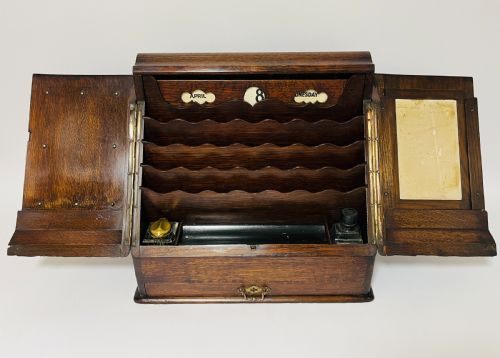


Oak Writing Desk Tidy
These oak writing desk tidy examples offer a practical desktop storage solution in durable timber, prized for organising stationery with period character.
Oak Writing Desk Tidy
An oak writing desk tidy brings order to papers and pens, encompassing forms such as stationery cabinets, inkstands, desk sets, and writing boxes. Buyers searching this phrase encounter practical desktop accessories designed to hold letters, envelopes, and writing implements.
The pieces on this page span the Victorian and Edwardian eras, alongside items from the mid-nineteenth century through to nineteen ten. Common configurations include fall-front boxes, letter racks with integrated ink bottles, and adjustable date stands.
Victorian and Edwardian workshops produced these wooden accessories in various sizes, from compact ink stands to large desktop stationery boxes. Oak remains the defining material across these functional desk furnishings.
Materials and Construction
Makers utilised solid oak, golden oak, and light oak to construct these boxes and stands, often incorporating brass hinges, handles, and mounts. Glass appears in the fitted ink bottles accompanying inkstands and desk sets.
Factors of Quality
Quality in an oak writing desk tidy rests on the selection of timber, the crispness of any applied carving, and the integration of fitted interiors like letter racks and ink bottles. Finer examples display superior joinery and retain matching glass components or original hardware.
Simpler pieces offer utilitarian desktop storage, whereas superior versions feature substantial brass mounts, fall-front mechanisms, or Arts and Crafts styling that elevate the accessory beyond basic function.
The Oak Writing Desk Tidy Glossary
- Stationery cabinet
- A desktop box designed to hold writing paper and envelopes, often featuring tiered compartments and a fall front.
- Inkstand
- A tray or stand holding one or more ink bottles alongside pen recesses.
- Letter rack
- A desktop accessory with upright dividers to hold incoming or outgoing correspondence.
- Arts and Crafts
- A design movement favouring craftsmanship and visible construction over excessive ornamentation, seen in certain oak desk pieces.
- Gothic Revival
- A nineteenth-century architectural and decorative style influencing some Victorian desk stands with pointed arches and heavy proportions.
Oak Writing Desk Tidy: Frequently Asked Questions
What is an oak writing desk tidy?
It is a desktop accessory designed to hold stationery, letters, and writing implements. These items range from compact inkstands to large stationery cabinets.
They originated primarily during the Victorian and Edwardian periods to keep desks organised.
How do I date an oak stationery box?
Dating relies on construction methods, hardware, and stylistic indicators such as Victorian Gothic or Arts and Crafts details. Periods span from the mid-nineteenth century through to the early twentieth century.
Titles often reference specific decades or reigns to help identify the era of manufacture.
What is included in an inkstand?
An inkstand typically comprises a wooden base with recesses for pens and one or two glass ink bottles. Some examples also incorporate stationery or letter compartments.
They sat upon office desks to provide a ready station for writing correspondence.
Where were these desk accessories used?
They were used in home studies, libraries, and offices during the nineteenth and early twentieth centuries. Their purpose was to manage correspondence and keep writing tools tidy.
Today, they serve a similar functional role in traditional or contemporary workspaces.