


Victorian Oak Inkwell
These Victorian oak inkwells are robust desk accessories built from sturdy timber, offering both everyday utility and period charm for a traditional study.
Victorian Oak Inkwell
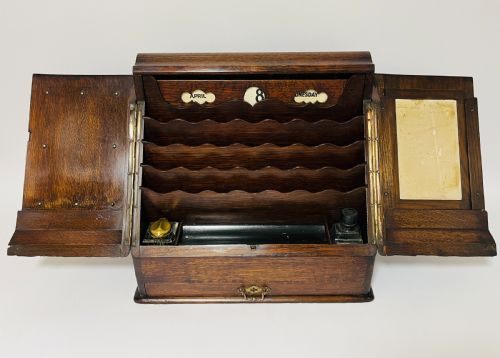
A victorian oak inkwell is a functional desk accessory designed to hold writing fluid, most frequently encountered here as part of larger stands, stationery cabinets, and letter racks.
The pieces on this page span the nineteenth century and the early twentieth century, showing a clear preference for solid timber construction combined with glass inserts.
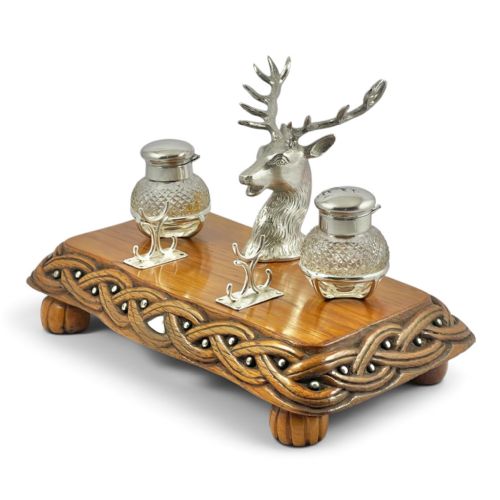
Desks from this era often utilised these items alongside brass mounts and silver details, reflecting the varied tastes of the period from Gothic Revival to Scottish Baronial.
Materials and construction
Makers utilised solid oak alongside contrasting materials such as cut glass, brass, horn, and silver, anchoring the timber frames with metal hinges and collars.
Carving and joinery defined the production, producing figural shapes like owls and St Bernard dogs alongside straightforward stationary boxes and stands.
One unfortunate jockey cap evidently lost its horse along the way.
Judging quality
Quality rests upon the crispness of the hand carving and the integrity of the fitted materials, distinguishing heavily ornamented figural pieces from plain utility boxes.
The integration of precious mounts like silver or unusual elements such as antler and hoof separates standard desk tidies from more ambitious commission work.
The Victorian Oak Inkwell Glossary
- Standish
- A desk stand designed to hold inkwells, pens, and wafers. This term was frequently used interchangeably with inkstand during the period.
- Stationery cabinet
- A box fitted with internal dividers and pigeon holes for writing paper and envelopes. These often incorporated a matching inkstand base.
- Scottish Baronial
- An architectural and decorative style drawing on medieval Scottish castles. It appears here in carved oak pieces with regional silver mounts.
- Cut glass
- Glass decorated by abrasive cutting on a wheel to create geometric facets. These formed the heavy removable wells that sat inside the oak stands.
- Black Forest
- A style of wood carving associated with the Swiss mountain region. Pieces feature naturalistic animal forms such as dogs and birds.
Victorian Oak Inkwell: Frequently Asked Questions
What is a standish?
A standish is simply another name for an inkstand or desk tidy that holds inkwells and writing implements together in one unit.
These pieces sat centrally on a writing desk to keep the desk tidy and the ink close to hand.
How do I care for antique oak?
Keep oak desk accessories away from direct sunlight and radiators to prevent the timber from drying out and splitting over time.
A light application of traditional wax polish helps maintain the finish and protects the wood grain.
Were these used for letters?
Many examples include integrated letter racks, stationery boxes, or sloping compartments specifically designed to hold correspondence.
They served as miniature filing systems for the Victorian writing desk before the widespread use of fountain pens.
How are periods identified?
Periods are identified through the combination of timber selection, construction methods, decorative styles, and metal mounts.
Stylistic markers like Gothic Revival or Scottish Baronial point directly to the prevailing tastes of the nineteenth century.