




Oak Wall Instrument
An oak wall instrument brings precision and architectural warmth to a room, offering barometers and clocks designed to hang securely.
Oak Wall Instrument
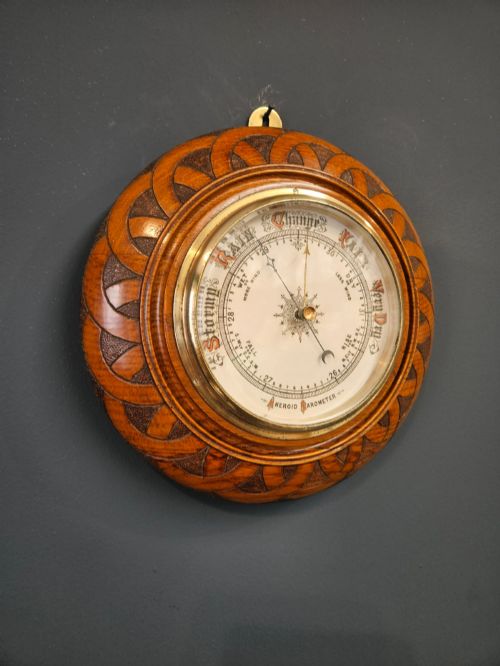
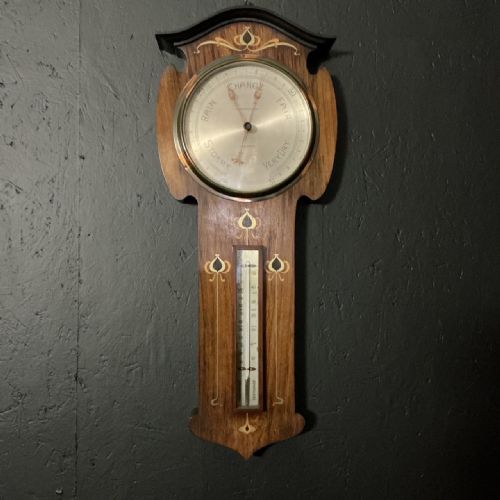
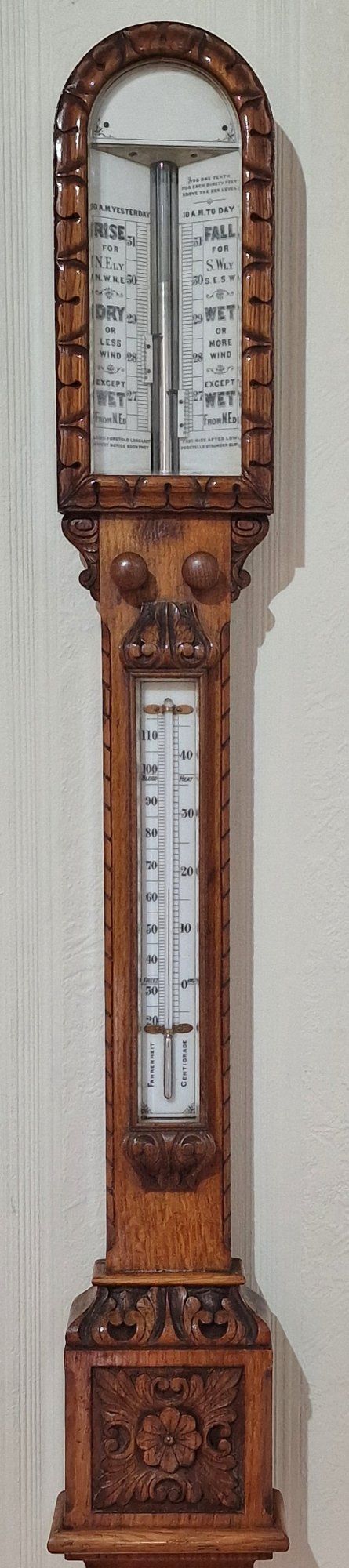
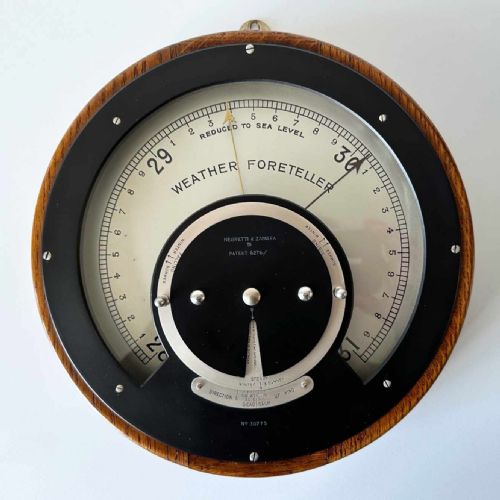
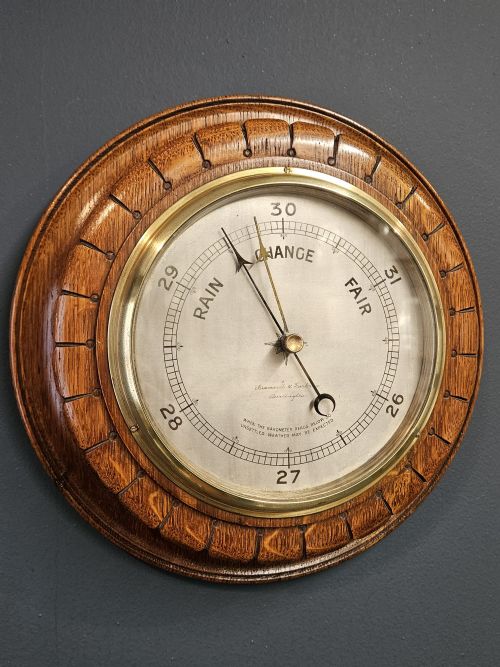
An oak wall instrument encompasses barometers, weather foretellers and wall clocks housed in timber cases designed for interior hanging. When exploring this selection, buyers encounter aneroid and mercury stick barometers, banjo shapes, and maritime timepieces mounted directly onto walls.
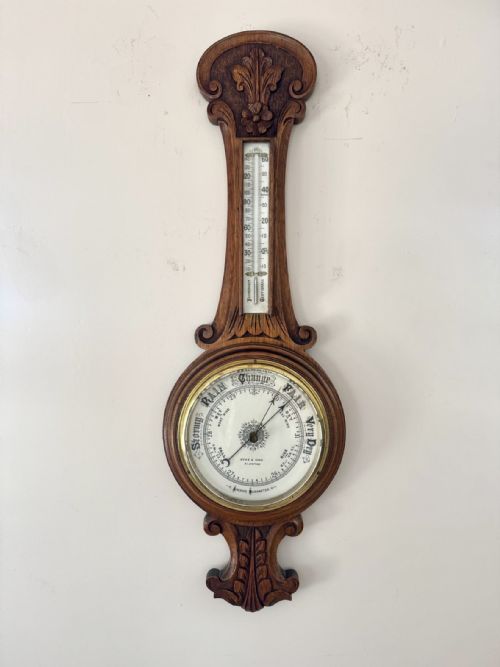
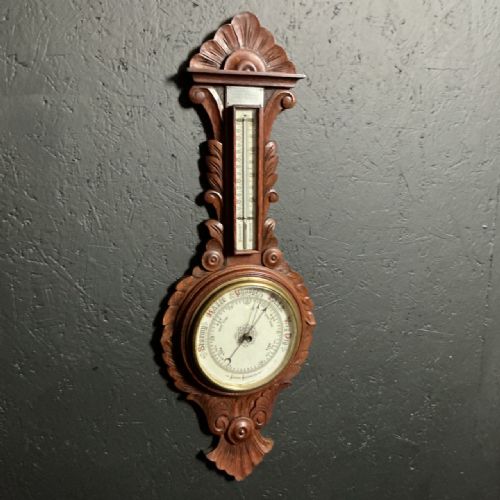
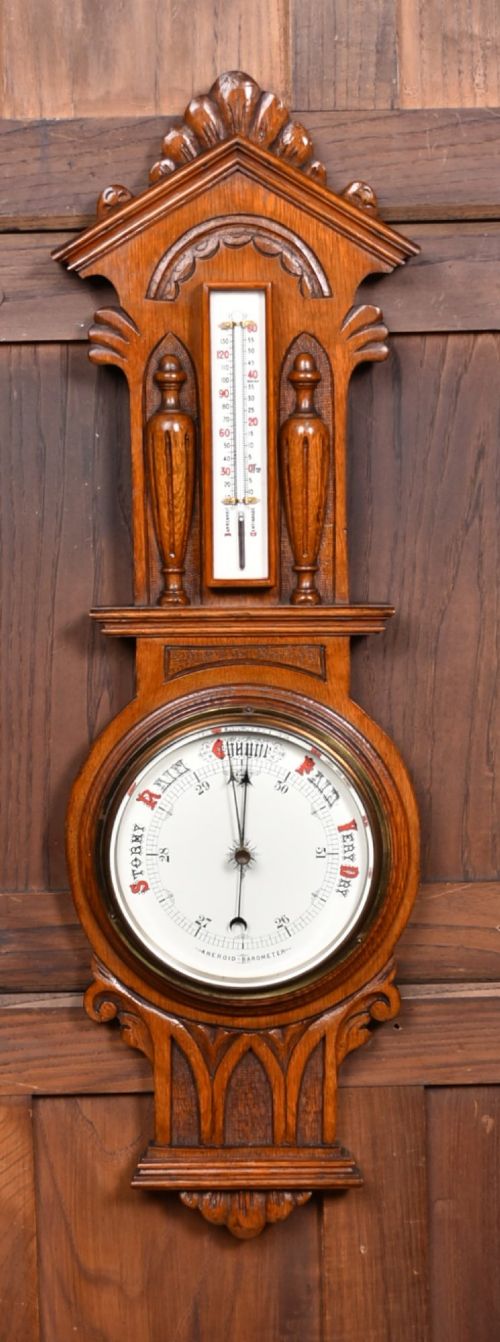
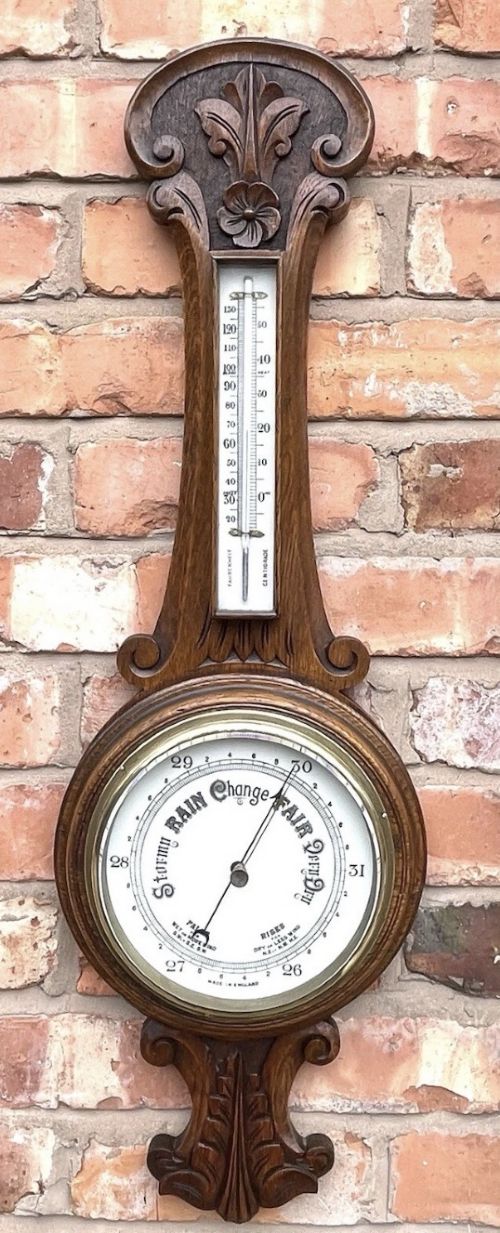
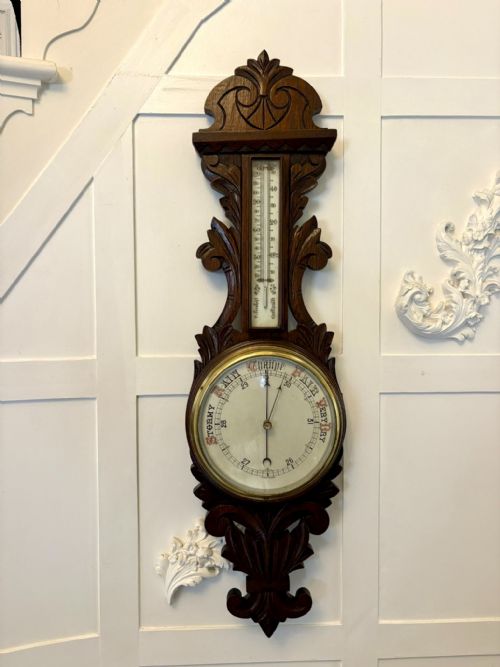
The objects span from the mid-nineteenth century through the Edwardian era, incorporating Victorian Gothic Revival, Arts and Crafts, and Black Forest design movements. The most frequent discoveries are Victorian and Edwardian carved oak banjo barometers featuring integrated glass thermometers and silvered dials.
Materials and construction
Makers utilised solid oak, often deeply carved with foliage, birds, or geometric patterns, alongside walnut and mahogany accents. Cases house delicate internal mechanisms, mercury tubes, or aneroid capsules, protected behind brass bezels and glass dials.
Surfaces exhibit hand-carved relief work, turned wooden bezels, and applied ceramic or silvered metal indicator plates. Maritime and stick variants utilise brass fittings and gimbal mounts designed to withstand movement on ships or domestic walls.
Judging quality in wall instruments
The distinction between standard production and superior craftsmanship rests in the depth and crispness of the wood carving, the legibility of the engraved dial, and the integrity of the maker's signature. Master makers such as Negretti and Zambra or J Hicks maintained rigorous precision in their meteorological movements, distinguishing them from unsigned commercial workshop pieces.
Condition of the original glass, the retention of the mercury column or working aneroid mechanism, and untouched patination on the timber elevate an example. Pieces displaying specialised motifs, such as Black Forest fauna or commemorative carvings, represent the more ambitious output of the period.
Hyde & Sons Sleaford·Negretti & Zambra·Bramwell & Harbron of Darlington·W Watson & Sons·J Hughes London·Maple & Co·Aitchison·J Hicks of London
The Oak Wall Instrument Glossary
- Aneroid barometer
- A barometer that measures atmospheric pressure by the expansion and contraction of a flexible metal capsule, avoiding liquid mercury. This design became standard for domestic wall instruments from the mid-nineteenth century onwards.
- Stick barometer
- A tall, vertical barometer utilising a mercury-filled glass tube against a graduated scale to display atmospheric changes. These traditional instruments often include vernier scales for precise reading.
- Banjo barometer
- A wall barometer housed in a symmetrical, curved wooden case resembling a banjo, typically combining a dial at the base with a thermometer shaft above. This form dominated Victorian domestic interiors.
- Silvered dial
- A metal dial plate treated to achieve a brushed silver finish, onto which calibrations and maker inscriptions are engraved and blackened. They provide high contrast and durability for reading meteorological scales.
- Admiral Fitzroy barometer
- A storm glass and barometer combination designed to give weather predictions based on chemical changes in a sealed tube alongside atmospheric pressure. Admiral Robert Fitzroy popularised these for coastal and farming communities.
Oak Wall Instrument: Frequently Asked Questions
How do aneroid barometers work?
An aneroid barometer measures changes in atmospheric pressure through a sealed, flexible metal box called an aneroid capsule. As pressure fluctuates, the capsule expands or contracts, moving internal levers linked to the pointer on the dial.
This mechanical system eliminated the need for fragile liquid mercury columns, making barometers safer and more practical for everyday domestic wall hanging.
Where should I hang a wall instrument?
Choose an interior wall that remains free from direct sunlight, extreme temperature fluctuations, and heavy vibrations. Hallways and studies provide stable environments that help preserve both the wooden case and the internal mechanism.
Ensure the wall fixing is secure, particularly with heavier carved oak and mercury-filled stick barometers, which require robust support.
Are these barometers still accurate?
Many vintage aneroid barometers continue to register atmospheric changes accurately once calibrated against local meteorological readings. Adjustment screws located on the rear or through the dial face allow for setting to current barometric pressure.
Mercury stick barometers generally retain high accuracy, though historical instruments serve best as functional antiques rather than precision scientific equipment.
How do I identify a Black Forest barometer?
Black Forest barometers feature deeply carved wooden frames depicting naturalistic motifs such as leaves, vines, birds, and game animals. The carving is typically executed in oak or walnut with high relief and expressive detail.
Originating from the Black Forest region of Germany during the nineteenth century, these pieces showcase exceptional woodland craftsmanship distinct from standard British cabinetmaking.