
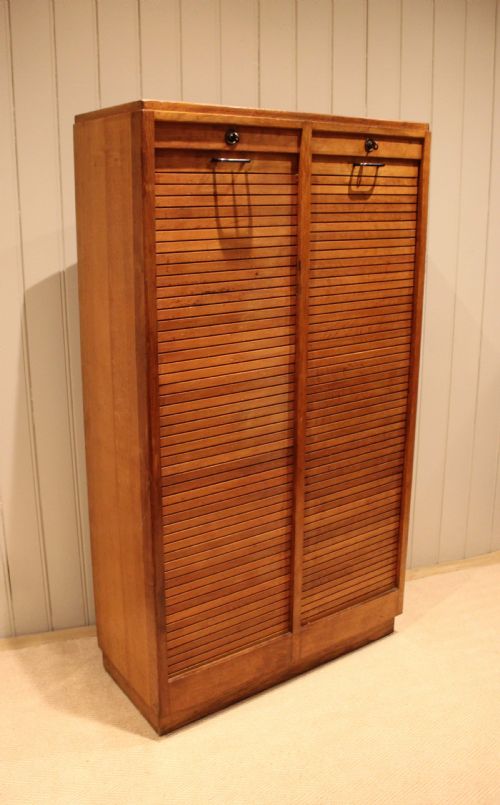


Oak Shutter Filing Cabinet
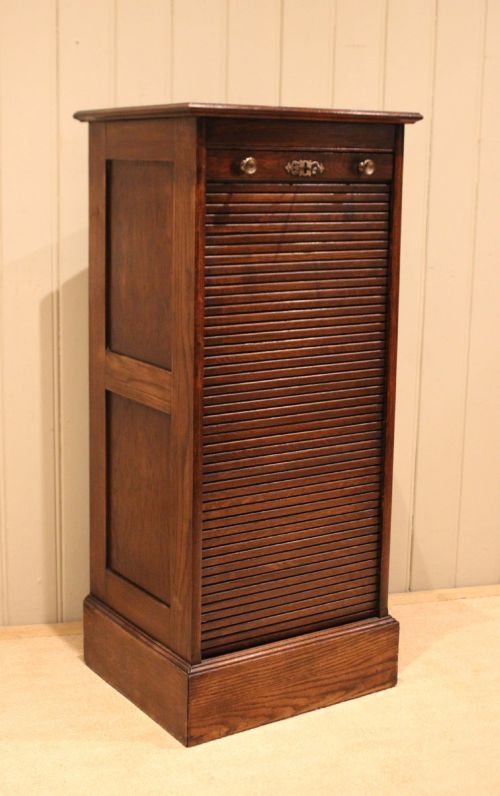
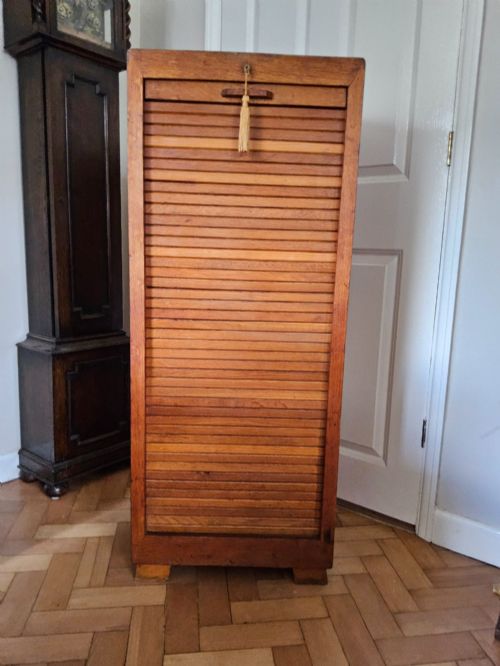
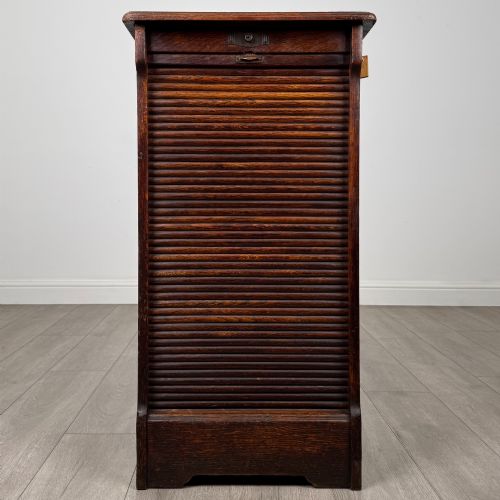
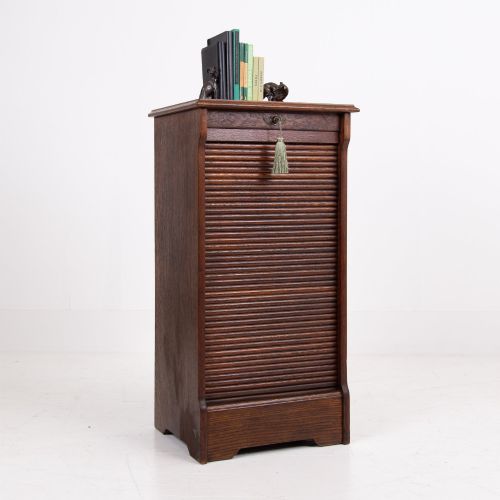
These oak shutter filing cabinets conceal office paperwork behind sliding slats, offering both practical storage and period character for a study.
Oak Shutter Filing Cabinet
An oak shutter filing cabinet provides enclosed office storage utilising flexible sliding wooden slats known as tambour doors. These pieces serve as functional furniture designed to organise documents while maintaining a tidy exterior.
The versions most commonly met on this page date from the Edwardian era through to the 1940s, spanning styles such as Edwardian, Art Deco, and French Utility. They appear in single and double tambour configurations, ranging from small proportioned examples to larger office cabinets.
How they were made
Cabinet makers constructed the primary carcase and sliding slats from oak, frequently pairing the timber with brass and metal internal components or hardware. Selected pieces incorporate canvas elements within their construction.
The signature tambour shutter relies on individual narrow wooden slats fixed to a flexible backing fabric, allowing the door to curve smoothly around tracks into the body of the cabinet.
Listings on this site span the Edwardian period, 1910, 1915, 1920, 1930, and 1940, featuring oak, brass, metal, canvas, and steel.
What varies in quality
Quality shows in the smoothness of the tambour mechanism and the precision with which the sliding wooden slats operate within their tracks. Superior examples exhibit seamless movement without binding or sticking.
The depth of colour in the timber and the choice of grain selection distinguish finer cabinets from standard office furniture. Construction details like sturdy joints and intact brass hardware further elevate the standing of a piece.
The Oak Shutter Filing Cabinet Glossary
- Tambour
- A flexible door made of narrow wooden slats attached to a fabric backing, designed to slide around a curved track. This mechanism allows the shutter to disappear into the sides of the cabinet.
- Edwardian
- A stylistic period spanning the reign of King Edward VII, often associated with refined woodwork and traditional office furnishings. Pieces from this era display classic proportions and quality oak construction.
- Art Deco
- A design style emerging in the early twentieth century characterised by sleek lines and geometric forms. In these cabinets, the style influences the overall silhouette and hardware choices.
- French Utility
- A functional design movement originating in France during the mid-twentieth century focused on practical, sturdy construction. Cabinets from this category prioritise straightforward utility alongside traditional materials.
Oak Shutter Filing Cabinet: Frequently Asked Questions
How do tambour doors work?
Tambour doors consist of narrow strips of oak glued to a flexible canvas or fabric backing. This construction allows the shutter to bend around a tight internal curve and slide smoothly into the sides of the cabinet.
The mechanism keeps the front open without doors swinging outward into the room. This makes them particularly useful in compact studies or busy offices where floor space is limited.
What periods do these cabinets date from?
The examples available here date from the Edwardian period through to the 1940s. This includes pieces made around 1910, 1915, 1920, 1930, and the Art Deco era.
Design details and hardware often reflect the specific decade of production. French Utility pieces also appear alongside traditional English office cabinets from the early twentieth century.
Are these cabinets suitable for modern homes?
These cabinets fit well into contemporary studies, living rooms, or hallways as practical storage. Their enclosed shelving hides modern paperwork and supplies while adding warm oak tones to an interior.
Single and double configurations offer different storage capacities depending on available space. The sliding shutter ensures the cabinet functions efficiently in tight layouts.
What materials are used in these cabinets?
Oak forms the primary material for both the outer carcase and the sliding shutters. Manufacturers incorporated brass and metal for handles, locks, and internal mechanisms.
Canvas backing frequently supports the wooden slats of the tambour doors. This combination of robust timber and metal hardware ensures long-term durability.