

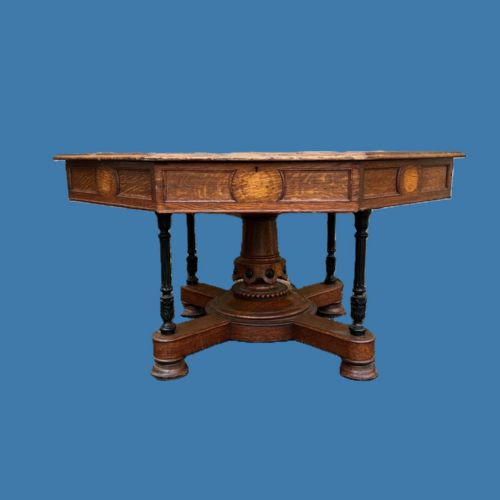


Oak Centre Hall Table
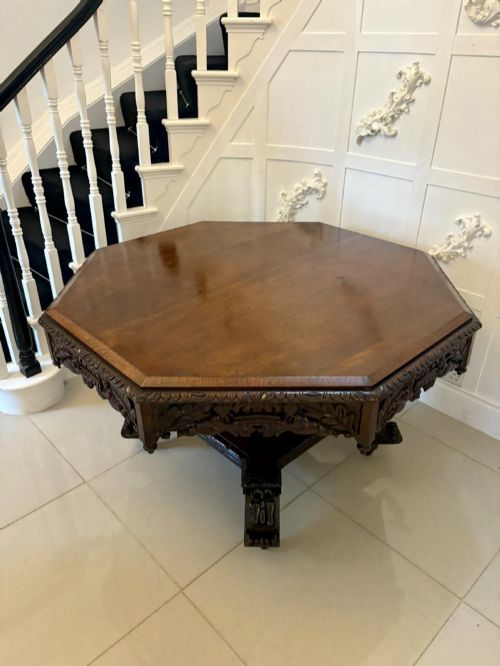
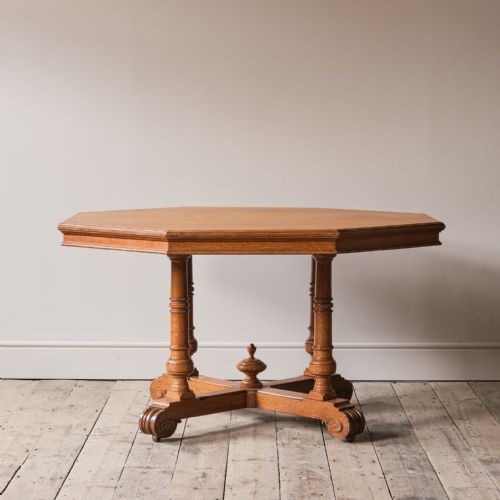
An oak centre hall table anchors a room with solid timber and proportion, offering a freestanding surface designed to sit proudly in open spaces.
Oak Centre Hall Table
When you search for an oak centre hall table, you encounter freestanding furniture designed to be viewed from all sides rather than pushed against a wall. The pieces appearing here span centuries of craftsmanship, from seventeenth-century joined examples to Victorian gothic revivals and twentieth-century arts and crafts designs.
Most items you meet on this page date from the nineteenth century, reflecting the Victorian appetite for heavy carved oak and architectural revival styles. These tables often double as library or occasional surfaces, serving grand hallways, studies, and principal reception rooms where a central focal point is required.
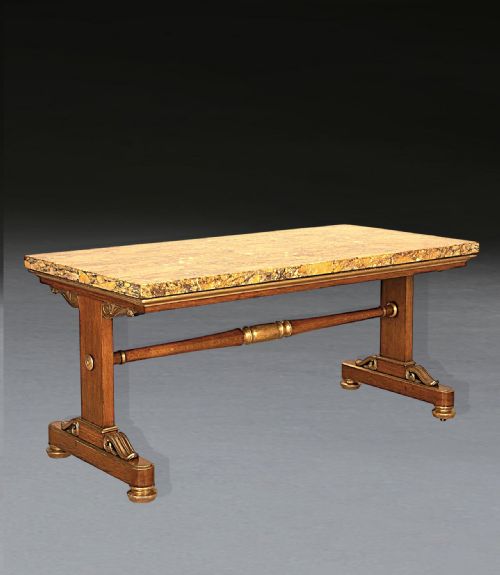
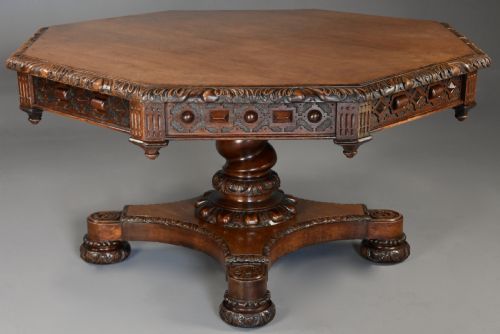
Makers and workshops utilised various forms, including octagonal shapes, refectory styles, and stretcher tables supported by turned legs or end supports. The timber selection ranges from plain English oak to burr, pollard, and bleached variants, sometimes incorporating contrasting materials like brass, iron, or marble.
Judging Quality and Execution
The distinction between ordinary and exceptional examples lies in the crispness of the hand carving and the selection of the timber figures. Tables displaying lively burr or pollard oak grain patterns, deep relief carving, and robust structural integrity represent the upper tier of production.
Proportion and scale dictate the success of a piece, with superior tables maintaining harmonious balance across octagonal or extended rectangular tops. The integration of secondary materials, such as well-fitted marble inserts or quality leather panels, further separates standard utilitarian workshop output from commissioned cabinet work.
Several Victorian oak tables stare back at visitors through spirited Green Man carvings nestled among the foliage.
James Winter and Sons·Gillows
The Oak Centre Hall Table Glossary
- Centre table
- A freestanding table designed to stand away from walls so that it can be approached from all sides. These pieces often occupy the middle of a grand hall, library, or drawing room.
- Pollard oak
- Timber taken from trees that have been pollarded, producing a dense, highly figured grain pattern prized for decorative cabinet work. This wood was frequently utilised during the Regency and Victorian periods.
- Parquetry
- Geometric mosaic woodwork used for decorative floors and table tops. Pieces employ contrasting timbers arranged in precise patterns to create visual depth.
- Stretcher table
- A table featuring horizontal wooden beams connecting the legs to provide structural stability. This traditional method strengthens the underframe while often supporting ornate turning.
- Gothic Revival
- An architectural and decorative style popular during the nineteenth century that revived medieval forms. Tables in this taste often incorporate tracery, pointed arches, and heavy carved oak.
Oak Centre Hall Table: Frequently Asked Questions
Where should I place an oak centre table?
These tables belong in open spaces where they can be appreciated from every angle, such as the middle of a spacious entrance hall or a large library.
Because they are finished on all sides, they function effectively as central display surfaces rather than pushed against room boundaries.
How do I distinguish Victorian gothic oak from earlier periods?
Victorian gothic revival pieces tend to feature heavy, dramatic carving, often including motifs like Green Men or architectural tracery executed with machine-assisted precision.
Seventeenth-century and earlier examples display simpler, heavier joined construction with hand-cut peg joints and patination developed over centuries of use.
What is the difference between a hall table and a centre table?
A traditional hall table often sits flat against a wall with a finished front and plain back, designed for narrow spaces.
A centre table is built to be fully freestanding with decorative detail on all four sides or an octagonal plan for central room placement.
How do I care for antique oak furniture?
Maintain oak surfaces by dusting with a dry, soft cloth and occasionally applying traditional beeswax to nourish the timber grain.
Avoid placing antique tables near direct heat sources or in fluctuating humidity to prevent the solid wood from splitting or warping.