
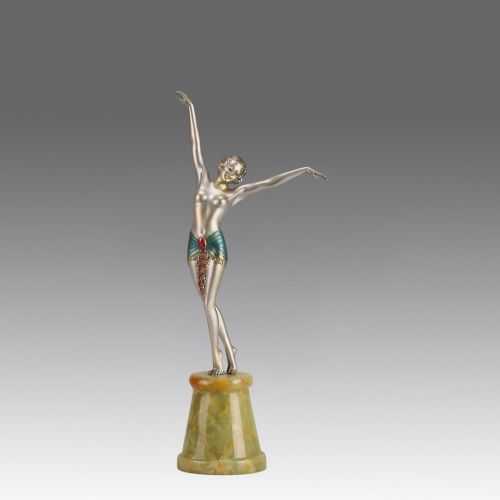


Nude Dancer Statue
A nude dancer statue captures kinetic grace in bronze and marble, bringing the spirit of the twentieth century directly into a room.
Nude Dancer Statue
A nude dancer statue is typically encountered in the form of a table lamp or a freestanding sculpture, capturing movement through sculpted figures. These pieces emerge predominantly from the Art Deco period, alongside earlier Neoclassical and Art Nouveau expressions.
The materials span patinated and silvered bronze, cold-painted bronze, and mixed media incorporating marble, onyx, frosted glass, and enamel. English, French, Austrian, and American makers shape these diverse materials into distinctive representations of dancers.
Collectors frequently encounter figures posed with hoops, scarves, or outstretched arms, reflecting the performance styles of the early twentieth century. These works range from substantial mantel sculptures to illuminated lamp bases that integrate functional lighting with figural art.
Assessing quality and execution
Quality rests upon the crispness of the casting and the precision of the chiselling visible across the dancer's form and drapery. Superior examples retain their original surface finishes, whether patinated, silvered, or cold-painted, without significant loss or over-painting.
The integration of the figure with its mounting base demonstrates the maker's intent, where tight tolerances and stable construction distinguish finer productions from standard commercial pieces.
Several dancers balance perilously on one toe, trusting entirely to the strength of a marble or onyx base.
Josef Lorenzl·Maurice Guiraud Riviere·Pierre Le Faguays·Claire Jeanne Roberte Colinet·Jean Jacques Pradier·Mario Korbel
The Nude Dancer Statue Glossary
- Patinated metal
- A metal surface treated with chemical solutions to produce a specific coloration or aged finish. This process protects the underlying metal while defining the contours of the sculpture.
- Cold-painted bronze
- Bronze that has been painted with oil or enamel paints after casting, rather than fired in a kiln. Such finishes require gentle handling to prevent flaking.
- Silvered bronze
- Bronze coated with a thin layer of silver or a silver-like alloy to provide a bright, reflective surface. This finish was favoured by Art Deco makers to emulate modern materials.
- Onyx
- A banded variety of chalcedony quartz frequently used for sculptural bases. Its translucent quality contrasts effectively with heavy metal figures.
- Frosted glass
- Glass treated by acid-etching or sandblasting to diffuse light evenly. It appears widely in lamp components associated with these figures.
Nude Dancer Statue: Frequently Asked Questions
What periods do these statues come from?
The majority of these pieces originate from the 1920s and 1930s, aligning with the height of the Art Deco movement. Earlier examples stretch back into the nineteenth century under Neoclassical influences.
Dates are typically identified through stylistic markers, costume details, and foundry signatures inscribed directly into the metal or stone bases.
How were lamp versions used originally?
These pieces functioned as decorative table lamps that illuminated rooms while displaying sculptural figures. The lighting element was integrated alongside the dancer, often incorporating frosted glass shades.
Today, they serve a dual purpose as both functional lighting and prominent decorative focal points within an interior space.
How do I care for cold-painted bronze?
Cold-painted surfaces require dusting with a soft, dry cloth and protection from direct sunlight and moisture. Because the paint is applied after casting, aggressive cleaning agents will damage the pigment.
Maintaining a stable indoor climate helps preserve the fragile painted details on the metal surface over the long term.
How do I distinguish bronze from patinated metal?
Bronze possesses a heavier weight and a distinct metallic grain visible beneath worn areas of the patina. Patinated metal often utilises a base alloy that reacts differently to age and wear.
Examining the underside or unexposed areas of the sculpture often reveals the underlying composition of the material used by the foundry.