

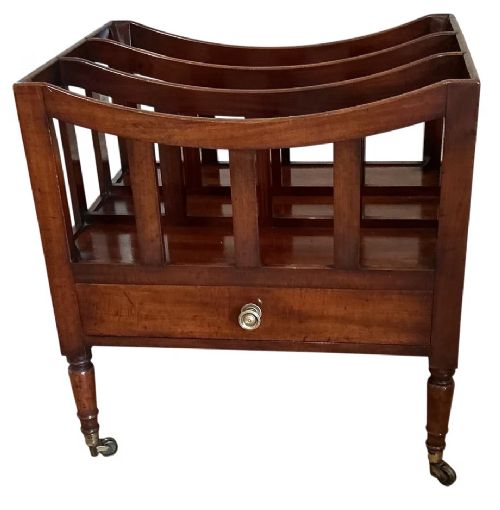


Nineteenth Century Music Rack
A nineteenth century music rack brings timeless utility and timber craftsmanship to the room, offering a dedicated spot for sheets and volumes.
Nineteenth Century Music Rack
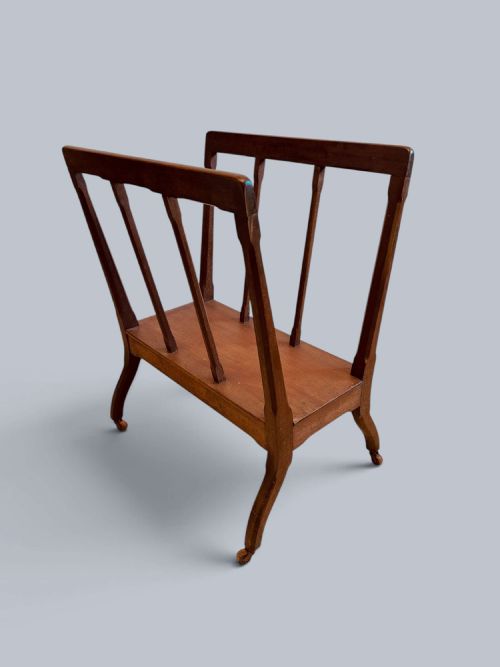
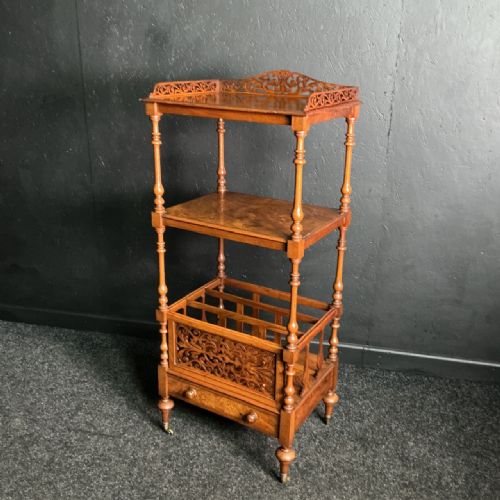
A nineteenth century music rack spans multiple periods including Regency, Victorian, William IV, and Georgian eras, appearing in forms such as canterburys, music stands, and whatnots. These pieces serve primarily to hold folios, magazines, and newspapers in domestic settings.
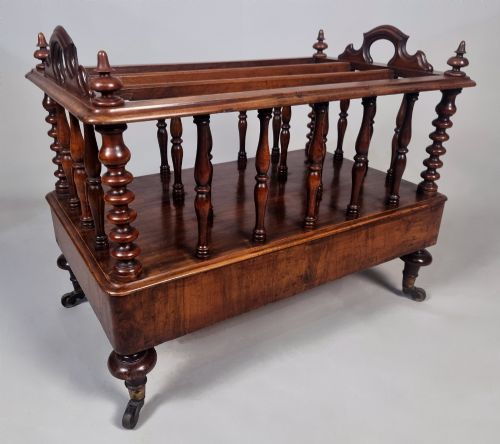
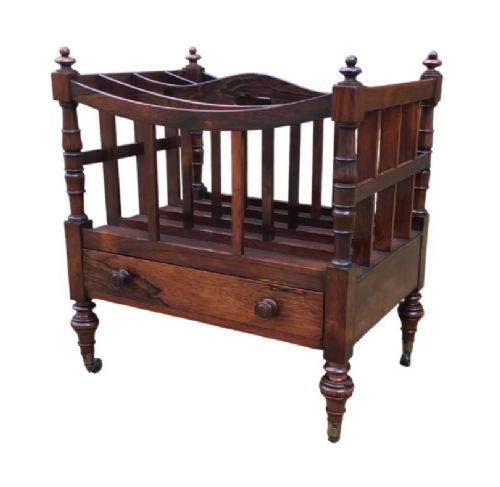
The version most commonly met on this page is the canterbury, often fashioned with division slats and occasionally mounted on castors for mobility. Alongside these stand dedicated music stands and multi-tiered whatnots designed for similar household storage tasks.
How they were made
Cabinet makers utilised dense hardwoods such as mahogany, rosewood, walnut, and burr walnut to construct the main framework and slatted divisions of each rack. Carpenters frequently employed decorative inlay and carved details to elevate the visual appeal of the timber surfaces.
Metalwork played a structural and decorative role, with brass fixtures integrated into designs alongside painted wood finishes on specific variants. Joinery techniques ensured sturdy partitions capable of supporting heavy folios and bound volumes.
Nineteenth Century Music Rack Retail Price Guide 2026
Typical asking prices for nineteenth century music rack among the pieces listed under this phrase on Sellingantiques today, from the lower quarter to the upper quarter. They describe what is for sale here now, not the wider market.
Some nineteenth-century makers mounted these music stands on tiny brass wheels so musicians could chase their sheet music across the rug.
What varies in quality
The choice of timber grain and the complexity of the cabinet work determine the upper tier of execution, particularly where burr walnut or figured mahogany is selected. Finer examples display meticulous carving and attributed workshop provenance rather than plain construction.
Proportion and functional division dictate the distinction between standard items and superior pieces, such as four-division frames or boat-shaped silhouettes. The integration of quality castors and intact decorative inlay further separates exceptional specimens from simpler utilitarian stands.
Edwards and Roberts·Gillows of Lancaster
The Nineteenth Century Music Rack Glossary
- Canterbury
- A low stand with partitioned vertical sections, originally designed for holding music sheets and folios. These pieces often feature carrying handles and small wheels.
- Whatnot
- An open set of multiple shelves used for displaying or storing small household objects. They frequently appear in walnut and mahogany across the Victorian period.
- Regency
- A style period spanning the early nineteenth century defined by classical restraint and neoclassical motifs. Furniture from this era often utilises dark mahogany and rosewood.
- William IV
- A transitional design phase during the 1830s characterised by robust proportions and heavy carved details. Rosewood and mahogany remain predominant woods in this period.
- Burr Walnut
- A specialised wood veneer taken from the growth excrescences of walnut trees, prized for its swirling pattern. It appears on finer Victorian cabinets and stands.
Nineteenth Century Music Rack: Frequently Asked Questions
What is a canterbury?
A canterbury is a low compartmentalised stand designed specifically for holding sheet music, folios, and periodicals. They often feature slatted divisions to keep volumes upright.
Many examples include small castors on the feet, allowing the stand to be moved easily across the floor of a parlour or music room.
How do I date a music rack?
Dating relies on identifying stylistic markers associated with specific periods, such as Regency classical lines or heavy William IV carved rosewood. Timber choice also offers clues, as burr walnut becomes particularly popular during the Victorian era.
Construction methods and hardware types further help narrow down the decade of manufacture when combined with overall design characteristics.
Where were these stands used?
These pieces were placed in nineteenth-century drawing rooms, parlours, and music rooms where instruments were played and literature was read. They kept scores close to the piano or music stand.
Over time, many adapted to hold general magazines and newspapers as domestic reading habits shifted in the later Victorian period.
Are music racks and whatnots the same?
Music racks and canterburys focus specifically on vertical compartments for holding sheets and folios, whereas whatnots feature open shelves for general display and storage. Some hybrid pieces combine shelving with partitioned compartments.
Both forms utilise similar timbers like mahogany and walnut, reflecting the prevailing interior styles of their respective decades.