

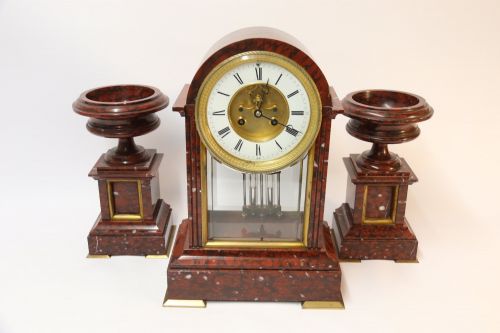


Nineteenth Century Garniture
Nineteenth century garniture sets bring symmetry and balance to a room, pairing central mantel clocks with matching candelabra or vases.

Nineteenth Century Garniture
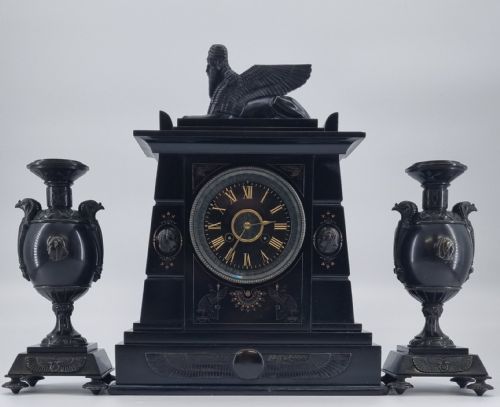
A nineteenth century garniture typically comprises a central mantel clock flanked by a matching pair of vases, candelabra, or urns designed to sit on a fireplace mantel or console table. These decorative ensembles emerge from periods spanning the Regency era through to the late Victorian epoch, drawing heavily upon French Rococo Revival, Empire, and Louis XVI styles.
The most common configurations found here pair porcelain or marble bodies with gilt bronze and ormolu mounts, often arranged as three-piece sets. Buyers encounter both complete clock garnitures and matched pairs of vases or candlesticks intended to create architectural harmony on a chimney piece.
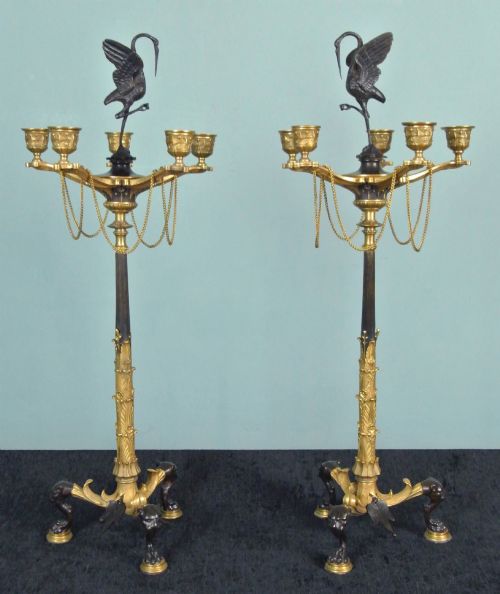
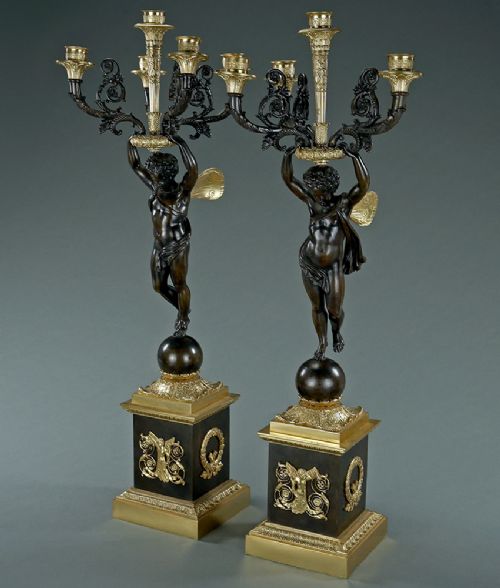
Origins lean strongly toward French workshops and English potteries, with makers utilising traditional forms like amphora urns, lidded vases, and figural candelabra. Each piece in the set shares decorative motifs, ensuring the composition reads as a unified whole rather than disparate ornaments.
Materials and construction
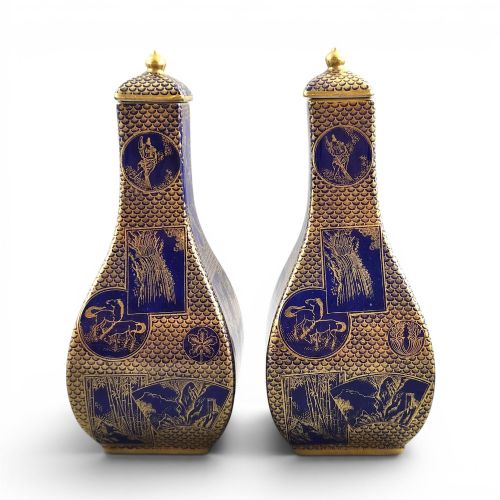
Craftsmen built these sets using mixed media, combining cast bronze and ormolu with natural stones such as white marble, siena marble, onyx, and block marble. Gilt bronze mounts were hand-chased and fire-gilded, providing a rich contrast against patinated bronze figures or deep blue porcelain grounds.
Ceramic bodies utilise ironstone, earthenware, and fine porcelain, decorated with hand-painted enamel scenes, Chinoiserie patterns, or commemorative portraits. Stoneware and porcelain elements often feature applied gilt highlights and cast metal collars or handles secured with threaded pins.
Clock movements house mechanical brass gears driven by pendulum regulation, mounted behind enamel dials that sometimes include complications like moon phase indicators. Timber frames appear in specific regional variations, such as carved Black Forest woodworks.
Standards of execution
Quality rests primarily in the crispness of the bronze casting and the depth of the subsequent chasing work. Finer sets exhibit sharp relief on acanthus leaves and figural mounts, whereas lesser examples show smoothed details from worn moulds.
The integration of materials dictates the upper tier of production, where heavy marble bases support substantial ormolu mounts and hand-painted porcelain panels without wobbling or visible gaps. Clock movements signed by established makers or Paris medals indicate superior mechanical reliability.
Hand-painted decoration on porcelain components separates mass output from exhibition pieces, with master painters rendering intricate polychrome scenes and gilding that retains its full burnished brilliance.
Barbedienne·Samuel Marti·Mason·H Luppens Paris·Vincenti of Paris
The Nineteenth Century Garniture Glossary
- Garniture
- A set of matching decorative ornaments, typically three pieces, designed to be displayed together on a mantelpiece.
- Ormolu
- Finely ground high-carat gold applied to a bronze object through a mercury gilding process. This technique produces a durable, warm metallic finish common in French decorative arts.
- Chinoiserie
- European decorative style reflecting Chinese artistic influences. It appears on ceramics and furniture through fantastical landscapes and stylized motifs.
- Ironstone
- A heavy, durable type of feldspathic earthenware patented in the nineteenth century. It resists chipping and serves as a robust base for transfer-printed and hand-painted designs.
- Patinated bronze
- Bronze treated with chemicals or heat to alter its surface colour. This process produces deep brown, green, or near-black tones that highlight cast details.
Nineteenth Century Garniture: Frequently Asked Questions
How do I style a garniture?
Place the central clock or tall urn in the exact centre of a mantelpiece or sideboard. Flank it with the matching candelabra or smaller vases to achieve balanced symmetry.
Keep the surrounding space uncluttered so the matched set remains the focal point of the room.
What is a clock garniture?
A clock garniture is a three-piece ensemble consisting of a working mantel clock and two matching side pieces, such as urns or candelabra. All three items share identical materials, styles, and decorative motifs.
This format became widespread across nineteenth-century European drawing rooms to unify interior decoration.
How do I care for ormolu?
Dust ormolu mounts gently with a soft, dry brush to prevent dirt accumulation in the recessed chasings. Avoid abrasive cleaners or commercial polishes that strip away the thin gold layer.
Handle pieces by their solid stone or ceramic bases rather than delicate gilt handles.
Are these clocks still working?
Many nineteenth-century mantel clocks retain their original mechanical brass movements and pendulums. They typically require a flat surface and occasional professional servicing to keep accurate time.
Some buyers purchase them purely as decorative sculptural objects rather than reliable timekeepers.