


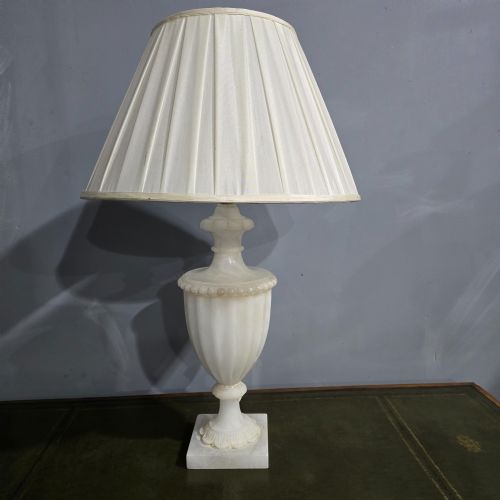


Neoclassical Marble Urn Lamps
Neoclassical marble urn lamps bring classical form and warm illumination together, transforming carved stone vessels into stately table lighting.
Neoclassical Marble Urn Lamps
When you search for neoclassical marble urn lamps, you find table lights built from carved stone vessels that draw directly on classical antiquity and the French Louis XVI style. These pieces adapt decorative urns and cassolettes into functional lamps, often standing on classical bases with metal mounts.
You are most likely to meet 19th-century French examples on this page, alongside Edwardian and early 20th-century English or Italian adaptations. The forms range from amphora shapes to classical vases, executed in various stones and mounted with gilt bronze or ormolu.
The aesthetic looks back to ancient Greece and Rome through the lens of later revivals, bringing a monumental architectural presence into domestic interiors. They serve as sculptural focal points on sideboards, desks, and side tables while providing layered ambient light.
Materials and construction
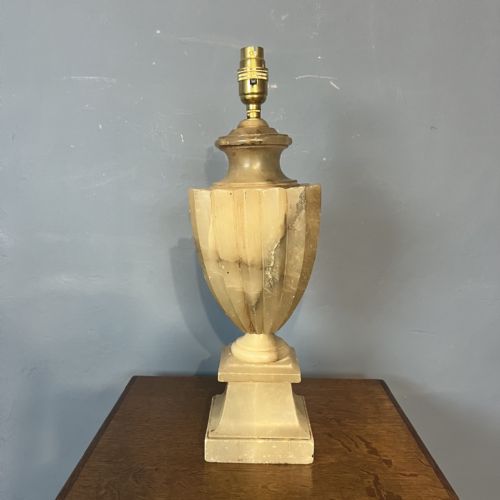
Carvers shaped white, rouge, Siena, and green marble, alongside alabaster and onyx, into hollow urn bodies on lathes or by hand. These stone bodies were then fitted for electrical wiring during conversion, or adapted from earlier decorative vases.
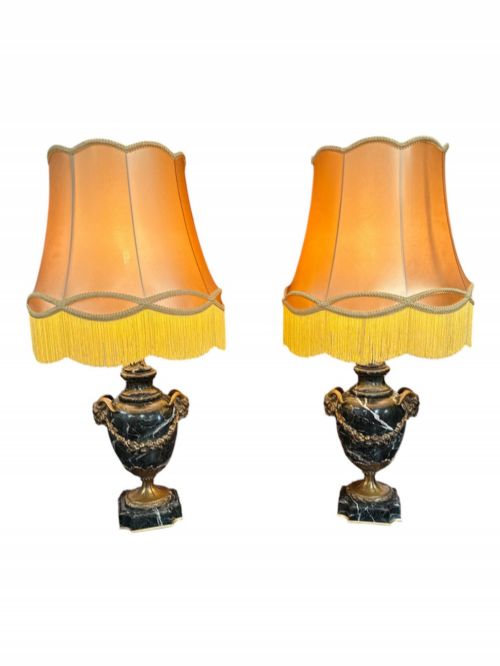
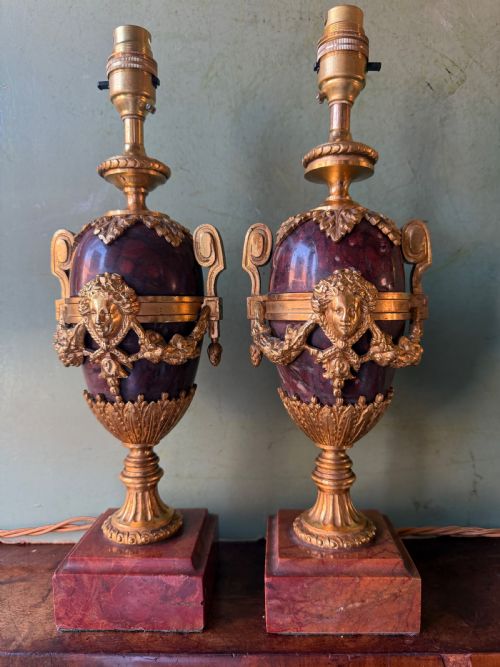
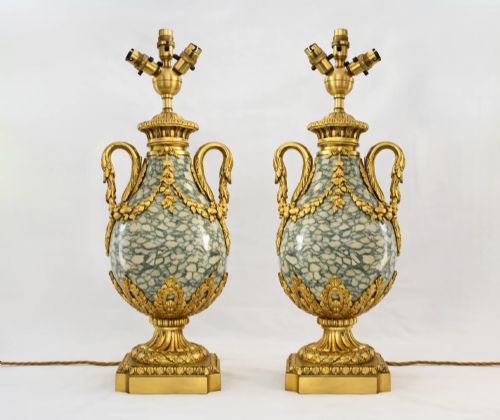
Metalworkers added cast brass, gilt bronze, and ormolu mounts, including paw feet, handles, rims, and classical collars, which were attached to the stone with pins, screws, or adhesives. Fabric shades typically complete the upper structure, resting on standard lamp fittings.
Several heavy marble urns stand firmly upon cast metal paw feet, ready to pounce across the mahogany sideboard.
Judging the quality
The distinction between standard production and the finest work lies in the choice and handling of the materials. Dense, richly figured marbles and translucent alabaster paired with heavily chased, fire-gilded ormolu represent the upper tier of execution.
Proportion and the integration of the metal mounts dictate the visual success of the piece. Superior examples display crisp casting details on the bronze elements and a harmonious balance between the stone vessel and its structural base.
The Neoclassical Marble Urn Lamps Glossary
- Cassolette
- A decorative vessel featuring a reversible lid that can function as a burner or a solid vase. In lamp form, these retain the characteristic pierced or solid cover design.
- Ormolu
- Finely chopped gold leaf amalgamated with mercury and applied to bronze through heat gilding. This technique creates a deep, warm metallic lustre found on finer 19th-century mounts.
- Alabaster
- A fine-grained, translucent stone often used for carved urns and vases. Its natural light-permeability allows it to glow softly when illuminated.
- Amphora
- A two-handled ancient jar shape with a narrow neck, frequently referenced in neoclassical urn designs. These vessels provide a symmetrical profile suited for conversion into table lamps.
- Siena marble
- A distinctive yellow Italian marble featuring dark grey and purple veining. It was highly prized for decorative objects during the neoclassical revivals.
Neoclassical Marble Urn Lamps: Frequently Asked Questions
Are these lamps converted from old vases?
Many lamps in this category began life as decorative 19th-century mantel ornaments, garniture vases, or cassolettes. Artisans later drilled the stone and added electrical components to repurpose them for modern lighting.
This method of conversion preserves the original antique body while adapting the object for domestic use. The quality of the mountings usually indicates whether the vessel was made as a lamp base or converted later.
How do I date a marble urn lamp?
Dating relies on examining the characteristics of the stone cutting, the style of the metal mounts, and the wiring hardware. 19th-century French pieces often display high-relief ormolu casting and rich patination on the bronze.
Early 20th-century examples tend to show simpler turned stone profiles and different assembly methods. Comparing the proportions to documented Louis XVI period pieces helps clarify the revival style era.
Can these lamps support heavy fabric shades?
The substantial weight of marble and alabaster urn bases provides a stable foundation for standard lampshades. However, the exact weight capacity depends on the width of the base and the internal rod construction.
Ensure the harp and finial are securely fastened to the central spindle. A balanced shade prevents tipping while maintaining the classical proportions of the urn.