




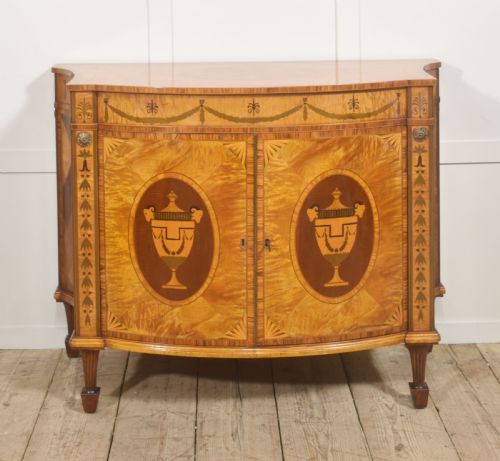


Neoclassical Commode Cabinet
A neoclassical commode cabinet brings architectural symmetry and refined proportion to a room, offering sophisticated storage rooted in eighteenth and nineteenth-century design.
Neoclassical Commode Cabinet
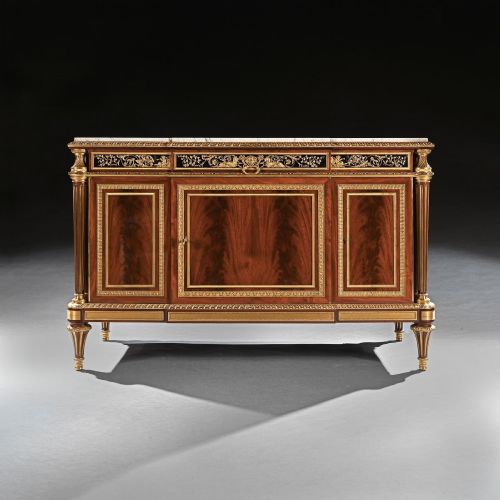
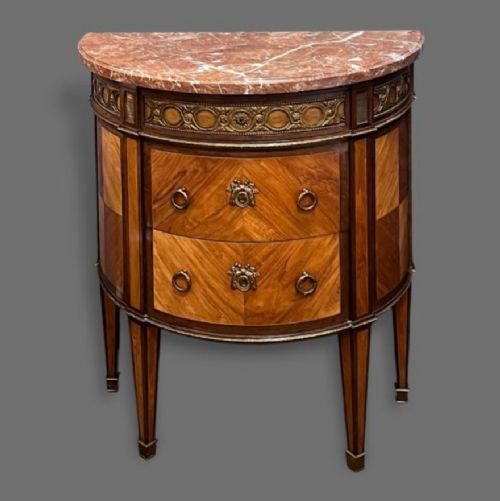
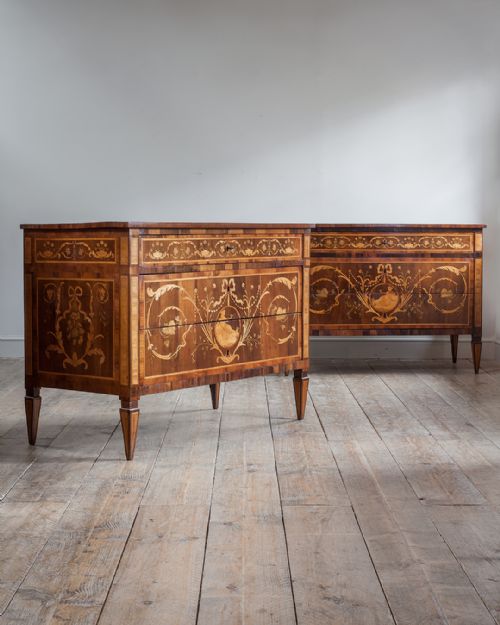
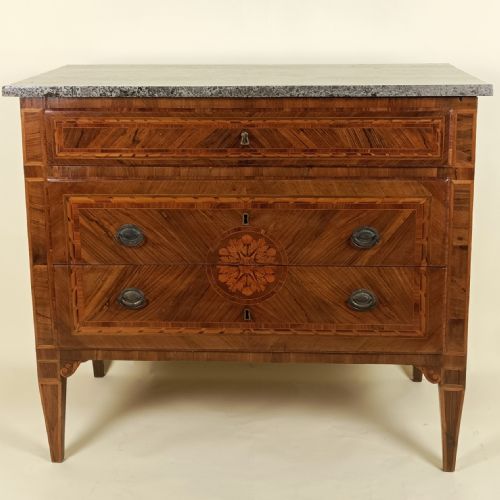
A neoclassical commode cabinet serves as a formal storage piece, encompassing side cabinets, chests of drawers, and commodes shaped by continental and British revivals. The selection leans heavily toward eighteenth-century origins and nineteenth-century interpretations, featuring distinct stylistic currents such as Louis XVI, Gustavian, Sheraton Revival, and Italian Neoclassical. Formats range from straight-fronted chests to demi-lune side cabinets and breakfront designs.
Most examples encountered here date from the nineteenth and early twentieth centuries, reflecting sustained enthusiasm for classical antiquity and marquetry decoration. Swedish, French, and Italian workshops dominate the available forms, often pairing restrained geometric carcases with sophisticated surface ornament. Buyers frequently select these pieces for reception rooms and hallways where decorative presence and surface display matter as much as utility.
Materials and Construction
Cabinet makers utilised dense native and exotic timbers, laying down carcases of mahogany, walnut, and satinwood to receive intricate marquetry and parquetry patterns. Surfaces often display contrasting veneers of burr elm, kingwood, and painted satinwood arranged in geometric or floral motifs. Ormolu mounts and cast brass details punctuate corners, aprons, and key escutcheons.
Heavy slabs of white, grey, or variegated marble crown the top surfaces of many continental and French variants, providing a cool, resilient finish. French and Italian pieces frequently employ parcel gilding and black paintwork to accentuate carved mouldings and fluted pilasters. Joinery relies on traditional dovetailing and frame-and-panel construction to accommodate seasonal timber movement.
Listings span periods from the eighteenth century through the 1930s, featuring walnut, satinwood, and mahogany alongside marble and ormolu.
Differentiating Quality
The division between standard production and exceptional exhibition pieces rests upon the precision of the marquetry and the crispness of the gilt bronze mounts. Master workshops employed meticulous hand-cut veneers where grain direction and tonal contrast create genuine depth, whereas lesser examples rely on repetitive stencilled or simpler inlaid patterns. The weight and hand-chasing of ormolu mounts signal whether a cabinet emerged from a prominent atelier or a regional workshop.
Structural integrity of the carcase and the original integration of marble tops dictate lasting value. Superior pieces maintain drawer linings of secondary timbers with tight, hand-cut dovetails that operate smoothly within their apertures. Finish and patination also divide the range, with untouched surfaces retaining a softer, warmer glow compared to heavily stripped or over-polished carcases.
Henry Dasson·James Hicks·Pietro Ferrario·Edmond Poteau
The Neoclassical Commode Cabinet Glossary
- Marquetry
- The art of forming decorative patterns by fitting together small pieces of veneer into wooden carcases. This technique creates pictorial or geometric surface designs using contrasting timbers.
- Ormolu
- Gilt bronze ornamentation applied to furniture mounts, feet, and handles during the eighteenth and nineteenth centuries. The process involves coating cast bronze in a mixture of mercury and gold.
- Demi-lune
- A half-moon shape describing furniture with a curved front and flat back designed to stand flush against a wall. Such silhouettes appear frequently in satinwood side cabinets.
- Parquetry
- A geometric mosaic of wood veneers used to cover floors or furniture surfaces. It differs from marquetry through its strict adherence to repeating angles and geometric grids.
- Breakfront
- A cabinet design where the central section projects forward from the flanking wings. This architectural arrangement creates shadow and depth across the front elevation.
Neoclassical Commode Cabinet: Frequently Asked Questions
Where should I place a neoclassical commode cabinet?
These cabinets suit reception rooms, formal hallways, and dining spaces where their architectural lines enhance the interior. Demi-lune versions fit neatly against flat walls in narrower corridors or beneath large mirrors.
The surface provides an ideal staging area for lamps, clocks, or decorative objects, while internal drawers and cupboards conceal tableware, linens, or papers.
How do I care for a marble top?
Marble requires gentle cleaning with warm water and a soft cloth, avoiding acidic substances like lemon juice or vinegar that etch the polished surface. Placing felt pads under heavy decorative items prevents scratching.
Periodic waxing is unnecessary for the stone itself, but care should be taken to protect the surrounding wooden carcase from moisture spills.
What is the difference between a commode and a chest of drawers?
Historically, a commode refers to a low, decorative cabinet with drawers or doors, originating in France as a refined evolution of the chest. While many commodes function primarily for storage, their design emphasises high-status aesthetics through marquetry and gilt mounts.
A standard chest of drawers focuses more strictly on stacked storage capacity with simpler elevations.
How do I distinguish French provincial from English neoclassical pieces?
French provincial and continental examples often feature painted or gilded finishes, shaped aprons, and thick marble slabs inset into the timber top. Woods like walnut and fruitwoods predominate in regional continental workshops.
English interpretations, particularly during the Sheraton Revival or Adam periods, favour finely figured satinwood, mahogany, and strict geometric stringing without marble tops.