
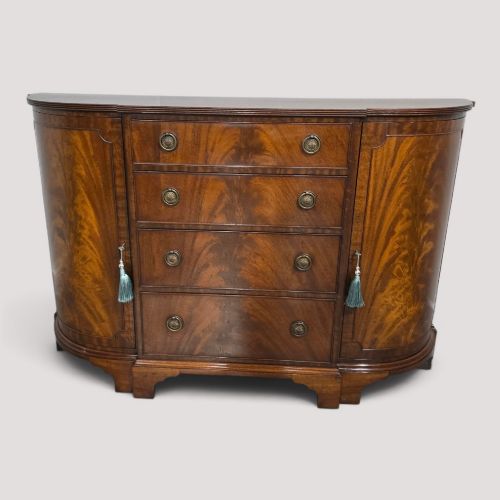

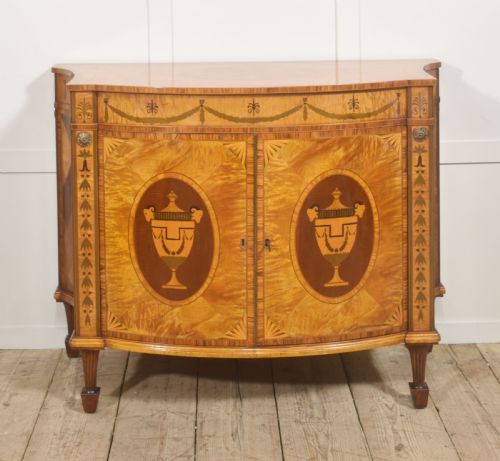


Curved Front Side Cabinet
These curved front side cabinet pieces bring polished timber, marquetry and brass mounts into a room, offering both display surface and enclosed storage.
Curved Front Side Cabinet
When you search for a curved front side cabinet, you are looking at items designed to fit tight spaces while providing surface display and interior storage.
The versions you are most likely to meet on this page span the Victorian, Edwardian, and mid-twentieth-century periods, taking the form of credenzas, display cabinets, and sideboards.
These pieces utilise shapes such as bow fronts, demi-lune profiles, and serpentine curves, often finished with glass doors or open shelving.
Materials and Construction
Cabinet makers utilised foundational timbers such as mahogany and oak, applying decorative veneers like burr walnut, burr yew, and satinwood across the curved surfaces.
Detailing involves marquetry inlay, brass hardware, and parcel gilt elements, while some pieces incorporate glazed doors and ormolu mounts.
The listings here feature items incorporating mahogany, burr walnut, satinwood, and ebonised wood across the nineteenth and twentieth centuries.
Assessing Quality
The distinction between tiers of these cabinets rests on the precision of the marquetry and the choice of burl veneers used across the curved facade.
Higher quality examples display integrated brass mounts, careful ebonising, and refined timber selection that complement the underlying serpentine or bow form.
The Curved Front Side Cabinet Glossary
- Bow front
- A convex curved cabinet front that projects outward. This shape softens the corners of a room.
- Demi-lune
- A half-moon shape characteristic of side cabinets and console tables. It allows the furniture to sit flush against a wall.
- Marquetry
- Decorative patterns formed by fitting together contrasting veneer pieces. It often depicts floral or geometric motifs on cabinet doors.
- Ormolu
- Gilded bronze mounts applied to furniture for decoration. These metal details accent the timber frame.
- Serpentine
- A curved line that is convex in the centre and concave at the sides. This profile adds movement to large credenzas.
Curved Front Side Cabinet: Frequently Asked Questions
What is a curved front side cabinet used for?
These cabinets serve as practical storage furniture while providing a display surface for decorative objects in a dining room or hallway.
Interior shelving holds tableware, books, or linens, keeping items out of sight behind wooden or glazed doors.
How do I date a Victorian cabinet?
Dating relies on identifying timber choices like burr walnut alongside characteristic decorative techniques such as brass inlay and ormolu mounts.
Consulting the period markers in the listing details helps establish whether a piece originates from the nineteenth century or later revival eras.
Where should I place a demi-lune cabinet?
The flat back of a demi-lune shape allows it to rest securely against a wall in narrow spaces like hallways or reception rooms.
Its curved front softens linear room layouts while offering a surface for lamps or ornaments.
What maintenance do veneered cabinets need?
Veneered surfaces require protection from direct sunlight and excessive moisture to prevent timber drying and veneer lifting.
Regular dusting with a soft, dry cloth preserves the polished finish of mahogany, satinwood, and walnut.