
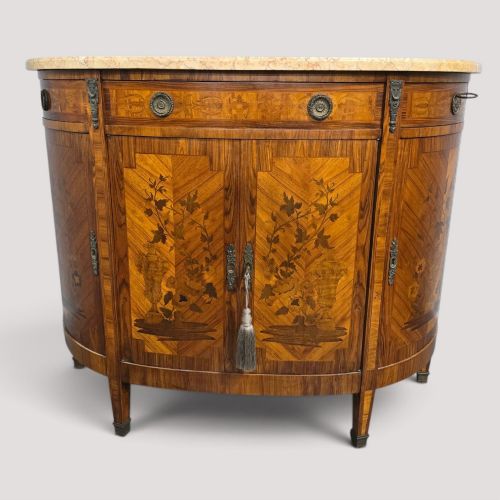
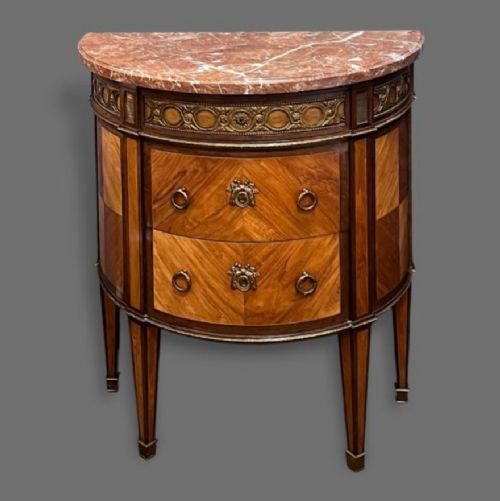


Marble Top Demi Lune
These marble top demi lune tables and cabinets bring graceful half-round shapes and stone surfaces to hallways and drawing rooms.
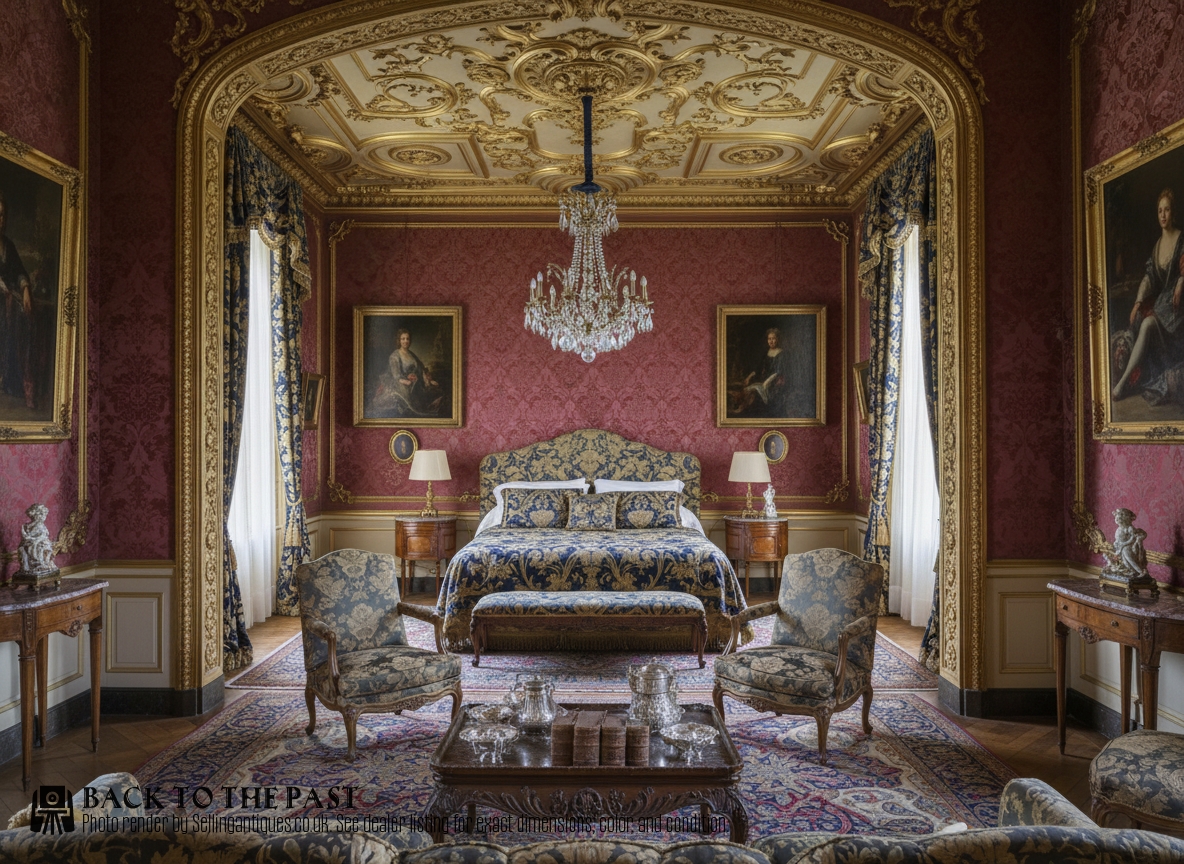
Marble Top Demi Lune
A marble top demi lune is a half-moon shaped piece of furniture designed to sit flush against a wall in a hallway, parlour or drawing room. The form appears primarily as console tables, bedside chests, side cabinets and washstands spanning the nineteenth century through the 1930s.
French pieces dominate the selection, frequently taking the form of Louis XVI revival consoles or marquetry cabinets with fitted stone slabs. English and continental variations also emerge, utilising mahogany, walnut and painted finishes alongside the signature shaped marble.
Buyers encounter freestanding console tables and cabinets alongside smaller bedside commodes and wall-mounted brackets. The combination of a flat rear edge and a curved front allows these items to occupy narrow spaces while providing a useful display surface.
Materials and construction
Makers shaped dense hardwoods including mahogany, walnut and specialised timber for the carcase, often applying marquetry inlay, giltwood or painted finishes to the exterior surfaces. The foundational structure requires precise curved joinery to support the heavy stone slab resting above.
The defining characteristic is the fitted marble top, cut to follow the half-round perimeter of the wooden base. White Carrara and rouge marble varieties provide a durable, cool surface that contrasts with the warm tones of polished wood or gilded gesso.
Some nineteenth century washstands traded their original basins for dry marble tops, finding a second life holding cocktail trays instead of washbowls.
Assessing quality
Quality rests in the precision of the curved woodworking and the integration of the stone top. Superior examples display tight joints in the half-round frame, crisply executed marquetry or carving, and marble that follows the exact contour of the timber without overhang or gaps.
The character of the materials dictates the standing of the piece, from finely figured burr walnut and mahogany to rich giltwood and hand-painted surfaces. Heavier, well-finished marble slabs and robust structural framing separate standard utility pieces from sophisticated revival tables.
The Marble Top Demi Lune Glossary
- Demi-lune
- A half-moon shape used for tables and cabinets designed to stand flat against a wall. This profile saves floor space while offering a curved display surface.
- Console table
- A table supported by wall brackets or legs, designed to stand against a vertical surface. These often feature decorative legs and heavy marble tops.
- Marquetry
- The art of applying pieces of veneer to a structure to form decorative patterns. Makers utilise different coloured woods to create pictorial or geometric designs.
- Commode
- A low chest of drawers or cabinet. French petite commodes frequently adopt the half-round format with a fitted stone slab.
Marble Top Demi Lune: Frequently Asked Questions
Where should I place a demi lune table?
These half-round pieces suit narrow hallways, entryways and alcoves where a full round table would obstruct movement. Their flat back sits flush against the wall while the curved front softens the geometry of a room.
They also function effectively as bedside tables or side cabinets in living spaces, providing a compact surface for lamps and decorative objects without dominating the floor plan.
How do I care for the marble top?
Marble requires gentle cleaning with a soft cloth and warm water, avoiding acidic or abrasive household cleaners that can etch or dull the polished surface. Using coasters under glasses prevents moisture rings and staining on porous stone varieties.
Periodic waxing of the wooden base helps maintain the finish, keeping the timber conditioned without affecting the stone insert.
How do I identify French revival pieces?
French revival pieces from the nineteenth and early twentieth centuries often incorporate neoclassical motifs, fluted tapered legs, or intricate floral marquetry. Makers frequently employed giltwood, paint, or fine veneers to emulate earlier royal styles.
The construction methods, such as specific dovetailing and wood preparation, point to continental European workshops of the period.
Are these tables heavy?
The weight depends largely on the thickness and type of the stone slab fitted to the top. While the wooden frames are relatively light, the marble insert adds considerable weight and stability to the piece.
Most freestanding versions remain manageable to position with two people, though wall-mounted console variations require secure fixings into structural brick or studwork.