


Needlepoint Bench Seat
A needlepoint bench seat brings tactile warmth and period character to a room, offering practical seating worked in durable wool and tapestry.
Needlepoint Bench Seat
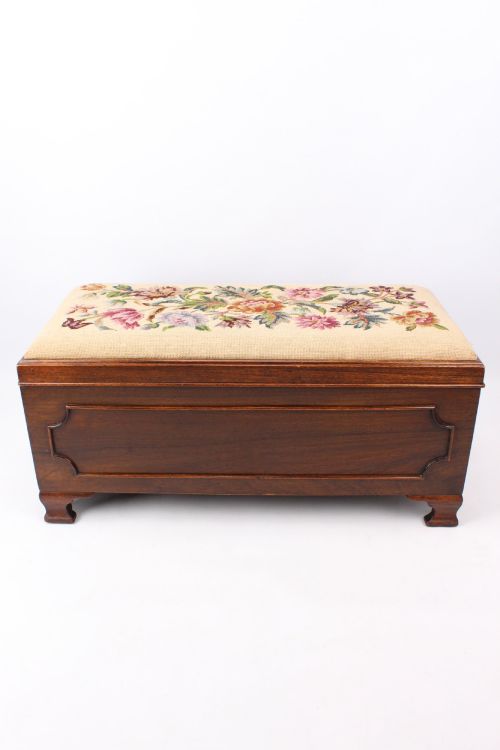
A needlepoint bench seat combines a sturdy wooden frame with a hand-worked textile top, taking forms such as dressing table stools, piano stools, ottomans, and window seats. These pieces range from Victorian examples to later Edwardian and 1930s designs, reflecting shifting domestic fashions across the nineteenth and twentieth centuries.
The wooden frames appear in mahogany, walnut, and oak, often shaped in revival idioms including Queen Anne style, Georgian revival, and French provincial. You are most likely to encounter Edwardian and 1920s mahogany or walnut stools featuring detailed tapestry or wool upholstery.
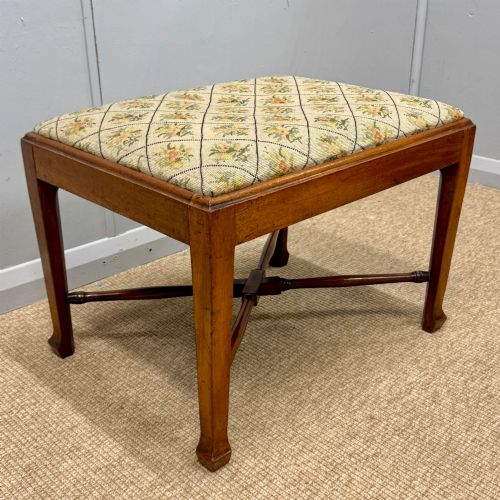
Makers and workshops utilised specific structural details like cross stretchers and barley twist supports to add stability to these low seats. Whether functioning as piano stools or hall benches, the combination of timber framing and textile covers defines the category.
How they were made
Makers constructed the timber foundations using dense hardwoods such as mahogany and walnut, shaping frames with cabriole legs, cross stretchers, or turned supports. Joinery techniques ensured the small frames could bear daily weight while supporting decorative elements like brass detailing or lacquered finishes.
The characteristic tops are worked in wool and tapestry textiles, stitched directly onto canvas foundations before being secured to the wooden frames. This needlepoint work involved dense tent stitch or cross stitch patterns, providing a hard-wearing surface designed to withstand regular use.
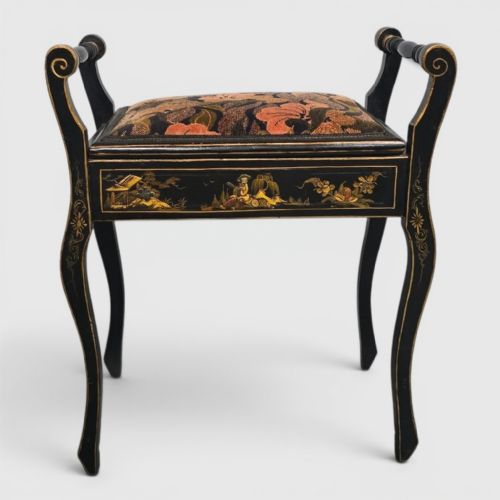
Piano stools from the early twentieth century often hid sheet music beneath their needlepoint lids, serving a dual purpose in the Victorian parlour.
What varies in quality
The distinction between standard production and finer pieces lies in the crispness of the timber carving and the density of the needlepoint stitching. Superior frames display well-defined proportions and carefully turned components, whereas simpler examples rely on plain turned legs without ornamentation.
Stitching quality separates ordinary covers from exceptional ones, with finer wool work showing intricate colour shading and tight, even tension across the seat. The choice of timber also influences overall character, with figured walnut and rich mahogany commanding greater visual presence than plain oak.
Jas Shoolbred
The Needlepoint Bench Seat Glossary
- Cross stretcher
- Wooden rails connecting the legs near the base to provide structural rigidity and prevent wobble. They frequently feature turned details or central finials.
- Needlepoint
- A form of counted-thread embroidery stitched onto an open-weave canvas foundation. It creates a flat, durable surface traditionally worked in wool.
- Tapestry
- A heavy woven or stitched textile used for upholstery. In these pieces, it denotes the patterned wool cover applied to the seat frame.
- Cabriole leg
- A furniture leg that curves outward and then tapers inward, ending in a pad or foot. This form is common on Queen Anne style frames.
Needlepoint Bench Seat: Frequently Asked Questions
Where should I place a needlepoint bench seat?
These compact pieces fit well at the foot of a bed, beneath a dressing table, or beside a piano. Their low profile also suits narrow hallways and window recesses.
Because they take up minimal floor space, they provide flexible seating that can be moved easily between rooms as needed.
How do I care for the wool upholstery?
Regular gentle vacuuming using a low suction brush attachment helps remove dust from the wool fibres. Keep the textile away from direct sunlight to prevent the colours from fading.
If spills occur, blot them immediately with a clean, dry cloth rather than rubbing, which can damage the delicate stitches.
How can I tell the period of the frame?
Examine the timber finish, joinery methods, and the style of the carved details. Victorian pieces often use heavy walnut, while Edwardian and 1920s examples frequently feature lighter mahogany frames.
Revival styles like Queen Anne borrow earlier silhouettes but can usually be dated by the machining marks and secondary woods used inside the frame.
What is the difference between a stool and an ottoman?
Stools generally feature an open wooden frame with legs, designed primarily for sitting at a dressing table or piano. Ottomans often provide enclosed storage beneath the upholstered top or take a larger rectangular form.
Both share the same needlepoint upholstery technique, but their internal construction and intended domestic functions differ.