
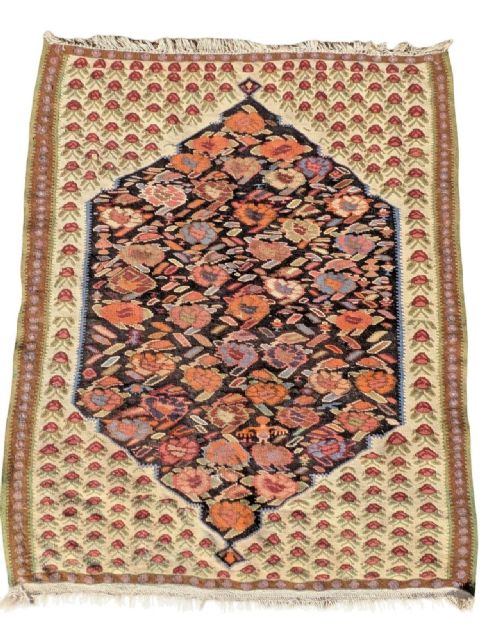


Navy Flatweave Carpet
These navy flatweave carpet pieces are woven textiles valued for their tribal designs and practical flat structures.
Navy Flatweave Carpet
When you search for a navy flatweave carpet, you encounter flat textiles and kelims originating from Persian, Caucasian, Turkmen, Uzbek, and Balkan regions. These pieces span periods from the late nineteenth century through to the early twentieth century, including items dated around 1870, 1880, 1890, 1900, 1910, 1920, and 1930.
The inventory on this page consists of flatweaves, Soumaks, runners, kilims, saddle bag faces, and rugs rather than standard pile carpets. You will find items such as Bidjar kelims, Uzbek gajeri kilims, Caucasian Soumaks, Afshar pieces, Senneh Bijar runners, Baluch kilims, Yomut Turkmen palas Soumaks, Shahsavan bag faces, Bakhtiari or Luri tribal items, Shirvan kilims, and Balkan Sharkoy kilims.
These items serve as functional floor coverings, runners, and decorative wall hangings. Their formats range from small sizes and narrow runners to large surface areas suitable for substantial rooms.
How they were made
The makers utilised wool, cotton, and hand-spun wool as the primary foundations for these flatwoven textiles. These natural fibres provide both structural strength and a flat profile without a raised pile.
Weavers applied vegetable dyes and natural dyes to achieve the deep tones and patterned motifs characteristic of tribal and nomadic production. Techniques such as Soumak wrapping and slit-tapestry weaving created the intricate geometric patterns and banded designs seen across the regions.
Listings feature pieces spanning several decades from 1870 to 1930, utilising wool, cotton, hand-spun wool, vegetable dyes, and natural dyes.
What varies in quality
The standard of a piece depends on the fineness of the weave and the precision of the geometric or tribal motifs. Tightly packed structures and cleanly executed banded designs indicate skilled regional craftsmanship.
Material selection also defines the tier of a textile, particularly the use of hand-spun wool and well-fixed natural or vegetable dyes. The crispness of the colour contrast and the integrity of the flat structure separate standard domestic items from finer tribal examples.
The Navy Flatweave Carpet Glossary
- Kilim
- A flatwoven carpet or rug produced without a pile using a slit-tapestry weaving technique. This method creates sharp geometric patterns and a lightweight structure.
- Soumak
- A brocade-like flatweaving technique where pattern threads are wrapped over the warp threads before being bound. This method adds durability and texture to the reverse side.
- Warp
- The stationary vertical threads stretched upon a loom that form the structural foundation of the carpet. Weft threads are passed through these warp foundations to create the fabric.
Navy Flatweave Carpet: Frequently Asked Questions
What is a flatweave carpet?
A flatweave carpet is a textile constructed without any raised pile surface, woven entirely on a loom through interlacing warp and weft threads.
These pieces rely on techniques like tapestry weaving or Soumak wrapping to display their patterns, resulting in a thin and portable floor covering.
How do I care for an antique flatweave?
Maintain your flatweave by vacuuming gently without a rotating brush and using a suitable rug underlay to prevent sliding and friction.
Keep the textile out of direct sunlight to protect the natural and vegetable dyes from fading over time.
Where were these tribal rugs made?
These textiles originate from various traditional weaving regions including Persia, the Caucasus, Central Asia, and the Balkans.
Specific tribal groups and areas such as the Afshar, Baluch, Yomut Turkmen, Shahsavan, and Bidjar produced these distinct regional designs.
How do I date an antique flatweave?
Dating relies on identifying specific structural characteristics, regional dye palettes, and traditional tribal motifs typical of the nineteenth and early twentieth centuries.
Analysing the use of hand-spun wool and natural colourants helps place pieces within periods like the 1870s or 1930s.