
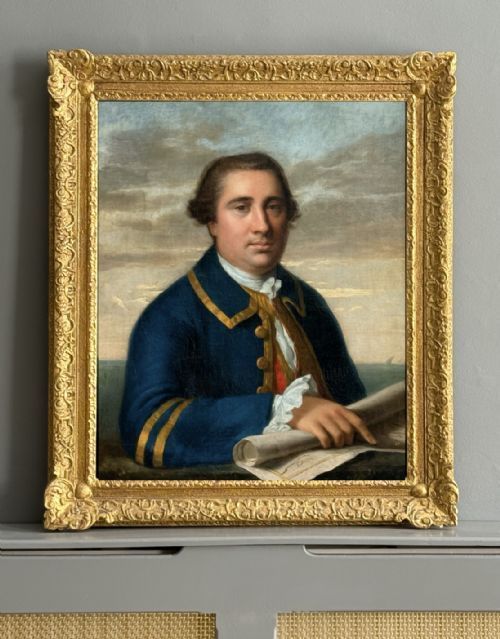


Naval Officer Oil Portrait
A naval officer oil portrait captures seafaring authority on canvas, offering a direct link to maritime history that collectors prize for its dignity and detail.
Naval Officer Oil Portrait
A naval officer oil portrait depicts commanders, captains, and admirals in formal uniform, recording centuries of maritime service on canvas and panel. These works range from seventeenth-century depictions of explorers to twentieth-century representations of royalty and fleet admirals.
The version most commonly met on this page is the nineteenth-century canvas, alongside significant eighteenth-century examples showing subjects in Georgian and Regency dress. These paintings frequently capture senior officers decorated with orders and medals, preserving their likeness and rank.
Materials and technique
These works are executed in oil paint upon canvas or wood panel, utilising traditional ground layers to support the pigment. Artists applied rich oil colours to render the heavy wools of naval jackets, gold braid, and brass buttons with tactile precision.
Many of the surviving canvases sit within their original giltwood and gesso frames, which utilise carved wooden mouldings finished with gold leaf. The combination of oil paint on canvas and ornate wooden framing defines the physical structure of these historic artworks.
Certain sitters brought the sea indoors, posing firmly in full naval regalia while pretending not to notice the cannon smoke behind them.
Judging quality
Quality rests upon the artist's ability to render the subject's likeness and psychological presence, moving beyond a standard uniform template to capture individual character. Master portraitists handle facial modelling, light, and shadow with a sureness that elevates the piece.
The preservation of the paint surface and the integrity of the canvas also dictate standing. Works that retain their original impasto, unblemished glazes, and period giltwood frames command greater regard among collectors.
Lemuel Francis Abbott·John Simmons·Sir Thomas Lawrence·George Frederick Clarke·Henry L Gates·Samuel Lane·John Laviers Wheatley·Maurice Codner·Robert Ker Porter·Richard Hall·Ambrosini Jerome·Armand Pallière
The Naval Officer Oil Portrait Glossary
- Oil on canvas
- A painting medium where pigments bound in drying oil are applied to stretched fabric. This combination provides durability and allows for subtle blending of tones.
- Giltwood
- Wood that has been decorated with gold leaf or gold paint. It frequently forms the ornate outer border of historic picture frames.
- Gesso
- A paint mixture consisting of a neutral binder mixed with chalk, gypsum, or pigment. It serves as a prepared surface for wood panels or frames before gilding.
- Regency
- A British historical period spanning the early nineteenth century. Portraits from this era often display specific military tailoring and distinctive civilian fashions.
- Canvas
- A heavy woven fabric used as a surface for oil painting. It is typically stretched over a wooden frame to maintain tension.
Naval Officer Oil Portrait: Frequently Asked Questions
What periods do these portraits cover?
The available works span from the seventeenth century through the Victorian era up to the mid-twentieth century. They reflect the shifting styles of portraiture across distinct historical reigns.
Earlier pieces often present formal Elizabethan or Georgian compositions, while later examples embrace nineteenth-century realism and mid-century uniform standards.
How were these portraits used historically?
Naval portraits were commissioned by families, institutions, or the officers themselves to document rank, naval victories, and status. They hung in country houses, state rooms, and maritime headquarters.
Serving as visual records of service and lineage, these paintings celebrated prominent commanders and their participation in naval history.
How do I identify the rank of the subject?
Rank is generally indicated through uniform details such as lace, epaulettes, and the specific cut of the naval jacket. Insignia and medals worn on the chest further identify senior positions like admiral or captain.
Artists frequently included background elements, such as shipping or coastal smoke, to hint at naval engagement and authority.
How should I care for an oil portrait?
Keep the painting away from direct sunlight and dramatic fluctuations in temperature and humidity to protect the canvas and oil paint. Gentle dusting with a soft, dry brush maintains the surface.
Avoid using liquid cleaners on the paint or the giltwood frame, and consult a professional conservator for any structural repairs.