


Nautical Bulkhead Clock
These nautical bulkhead clock examples bring heavy marine engineering into domestic rooms, offering solid brass cases and traditional dial layouts.
Nautical Bulkhead Clock
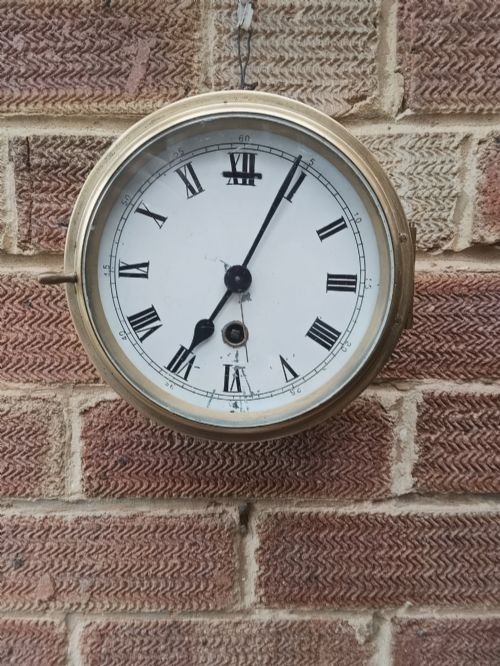
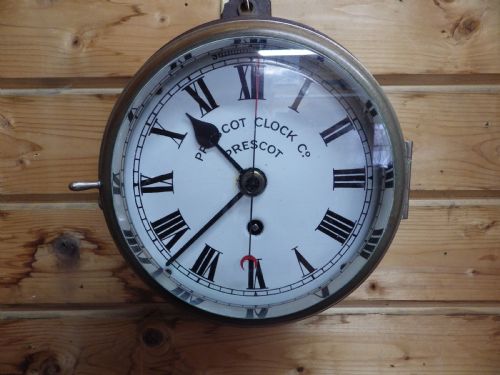
A nautical bulkhead clock is a robust marine timekeeper designed to be mounted directly to the wall of a ship's cabin or wheelhouse. These pieces draw interest from collectors of maritime instruments who want functional items with a genuine historical connection to the sea.
The selections available here span multiple eras, stretching from mid-nineteenth century fusee movements to mid-century examples by makers such as Schatz and Smiths Empire. Brass cases dominate the selection, often accompanied by heavy bevelled glass covers and clear enamel dials.
Most entries belong to broad stylistic categories including Victorian Maritime, Industrial Maritime, and Mid-Century Maritime. Wall clocks and engine room variants appear frequently, showing how utilitarian design evolved across different decades of marine travel.
Materials and construction
Construction relies heavily on thick brass, nickel-plated brass, and chrome housings designed to withstand damp marine environments without corroding. Metal bezels secure heavy glass panes over enamel dials, protecting the delicate internal mechanics from sea spray.
Many older items utilise chain fusee movements to maintain even tension and accurate timekeeping despite the constant rolling of a vessel. Later mid-century pieces incorporate specialised dial markings, such as red and green radio room segments for maritime communication.
Some clocks feature winding holes placed discreetly on the dial face, needing a steady hand and a matching key to keep time moving.
Assessing quality in marine timepieces
Quality separates simple mass-produced bulkhead clocks from precision instruments made by specialist clockmakers. Heavy cast brass cases and chain fusee movements represent a higher standard of engineering than basic spring-driven mechanisms.
The legibility and condition of the enamel dial heavily influence the character of the piece. Crisp lettering, undamaged chapter rings, and original winding keys or chains distinguish superior examples within the field.
Prescot Clock Co·Kelvin White and Hutton London·Schatz of Germany·Smiths Empire
The Nautical Bulkhead Clock Glossary
- Fusee movement
- A conical pulley connected to the mainspring by a chain, designed to equalise the torque as the spring unwinds. This mechanism improves timekeeping accuracy over the duration of the wind.
- Bulkhead
- An upright partition dividing the compartments within a ship's hull. Clocks designed for these positions feature secure mounting flanges to prevent displacement.
- Enamel dial
- A metal face coated with fused glass powder to create a smooth, durable white surface. Numbers and markings are typically fired onto the glaze.
- Radio room clock
- A specialised marine clock featuring coloured sector markings on the dial. These segments indicate mandatory silent periods for listening to distress frequencies.
Nautical Bulkhead Clock: Frequently Asked Questions
What is a nautical bulkhead clock?
A nautical bulkhead clock is a heavy-duty timepiece built specifically for mounting on the walls of a ship's cabin, bridge, or engine room. These instruments were engineered to endure constant vibration and moisture while keeping accurate time at sea.
Today, they are repurposed as decorative wall clocks in homes and offices. Their distinctive industrial aesthetic and brass housings make them a popular choice for maritime enthusiasts.
How do fusee movements work?
A fusee movement uses a conical drum and a fine chain to regulate the pull of the mainspring. As the spring loses tension, the chain moves to a wider part of the cone to maintain consistent power.
This clever mechanical system ensures the clock runs accurately through the entire duration of the wind. It is a hallmark of traditional craftsmanship found in nineteenth-century marine pieces.
Why do some dials have coloured segments?
Certain marine clocks feature red and green sectors on the dial face to mark international radio silence periods. Radio operators used these intervals to listen for faint distress signals without interference.
Such details reflect the practical working life of a shipboard instrument. They add a layer of functional history that collectors look for in mid-century examples.