



Nautical Brass Timepiece
These pieces of nautical brass timepiece furniture anchor a room with heavy metal bezels, maritime presence and mechanical precision.
Nautical Brass Timepiece
A nautical brass timepiece brings functional maritime engineering into domestic interiors through wall clocks, mantel clocks, desk clocks and marine chronometers. When buyers search this phrase, they find heavy brass instruments designed for life at sea alongside later variations adapted for land use.
The pieces listed on this page span the nineteenth century, the Victorian era, the Edwardian period, and mid-century decades. Most examples take the form of robust bulkhead clocks, ships clocks, or decorative industrial series timepieces incorporating wheels, lighthouses, and four-glass cases.
Origins range from British makers and retailers to French industrial workshops and German factories. Buyers are most likely to meet heavy brass bulkhead clocks fitted with fusee movements or traditional bell-striking mechanisms alongside polished desk variants.
How they were made
Makers constructed these clocks using heavy cast brass for housings, bezels, and structural framing, paired with bevelled glass to protect delicate dials. Silvered metal and enamel serve for chapter rings and faceplates, offering high contrast in maritime conditions.
Movements rely on precision mechanical engineering, notably chain fusee systems designed to equalise the pull of the mainspring as it unwinds. Secondary materials such as marble, mahogany, slate, and gilt brass provide heavy supporting bases and decorative surrounds for desk and mantel models.
Nautical Brass Timepiece Retail Price Guide 2026
Typical asking prices for nautical brass timepiece among the pieces listed under this phrase on Sellingantiques today, from the lower quarter to the upper quarter. They describe what is for sale here now, not the wider market.
What varies in quality
Quality in a nautical brass timepiece rests upon the complexity and finish of the internal movement. Fusee movements and signed mechanisms by established makers represent the upper tier of construction, requiring skilled hand-adjustment and durable gear-cutting.
Casting weight and finishing also separate standard commercial production from fine workshop pieces. Heavy cast brass bezels with tight tolerances, clean silvered dials, and robust mounting points distinguish superior examples from simpler mass-produced clocks.
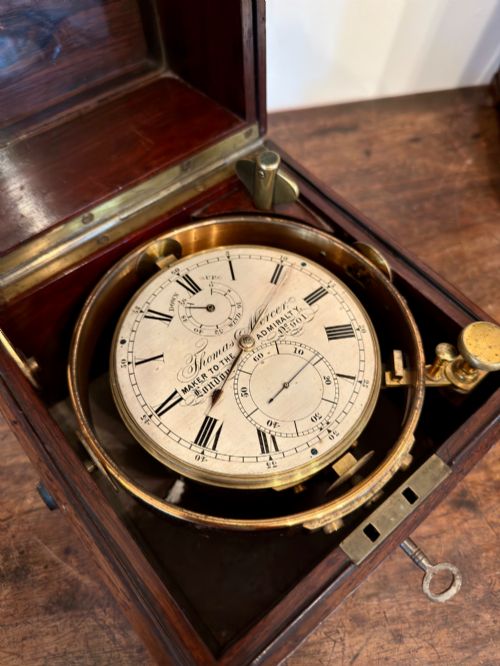
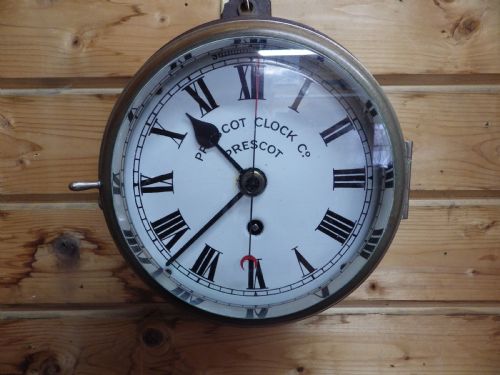
Mercer of London·Prescot Clock Co·Schatz of Germany·Smiths Empire·Gay Vicarino
The Nautical Brass Timepiece Glossary
- Fusee
- A conical pulley used in mechanical clocks to maintain even tension on the chain as the mainspring unwinds. This mechanism improves timekeeping accuracy across the power reserve.
- Bulkhead clock
- A heavy timepiece designed to be screwed directly to the wall of a ship cabin or office. These clocks feature waterproof or secure gasketed housings to withstand marine environments.
- Silvered metal
- A brass or copper dial treated with a silver solution to create a bright, matte metallic finish. Graduations and numbers are typically engraved and filled with black wax for legibility.
- Marine chronometer
- A highly accurate portable timekeeper used at sea for determining longitude. These instruments are traditionally gimbal-mounted to remain level despite ship movement.
- Chapter ring
- The outer ring on a clock dial that bears the hour and minute numerals. On maritime clocks, these rings are often bold and clear for rapid reading in poor light.
Nautical Brass Timepiece: Frequently Asked Questions
How do I mount a bulkhead clock?
Bulkhead clocks secure directly to walls through pre-drilled screw holes in the outer brass flange or hinged bezel ring. Ensure the fixings match the weight of the heavy brass housing and solid backplate.
Position the clock at eye level where the dial remains easily readable. Solid wood backing or proper wall anchors are essential to support the substantial weight of these metal instruments.
What is a fusee movement?
A fusee movement uses a conical pulley connected to the mainspring via a fine chain to regulate power delivery. As the spring loses tension, the chain pulls on a wider radius of the cone to maintain constant torque.
This sophisticated mechanism ensures consistent amplitude in the escapement, which improves the overall accuracy of the timepiece. It remains a hallmark of high-grade nineteenth-century horology.
How do eight-bell clocks work?
Eight-bell ships clocks strike the bell in pairs to mark the traditional four-hour naval watches. One strike sounds for the first half-hour, two strikes for the first hour, up to eight strikes for four hours.
The striking sequence resets at four, eight, and twelve o'clock. This acoustic system allowed sailors to track time below deck without relying on visual checks.
How should I clean brass clock cases?
Clean brass cases gently with a soft, dry microfibre cloth to remove dust and airborne grease. Avoid harsh chemical polishes that can strip patination or damage delicate engraved dial markings.
If the brass requires deeper cleaning, use a mild, non-abrasive metal cleaner applied sparingly with a cotton swab. Keep all cleaning products away from the glass face and internal mechanical components.
Where were desk chronometers used?
Desk chronometers served in navigation rooms, shipping offices, and captains' quarters to calculate precise longitudinal coordinates. They provided an accurate home port time reference for maritime navigation.
Later Victorian and Edwardian examples transitioned into executive offices and domestic studies as decorative indicators of maritime trade and exploration.