





Narrow French Drawers
Narrow french drawers bring slender vertical storage and classic continental charm to compact rooms.
Narrow French Drawers
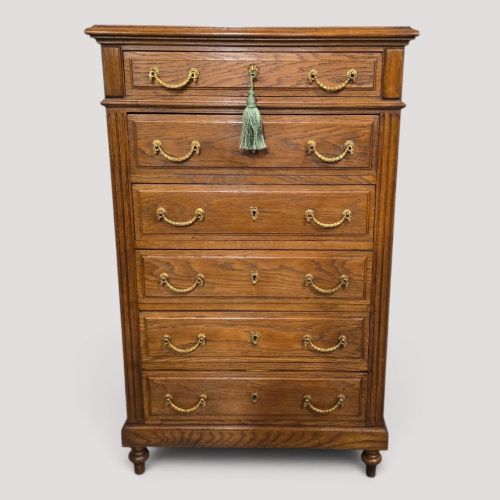
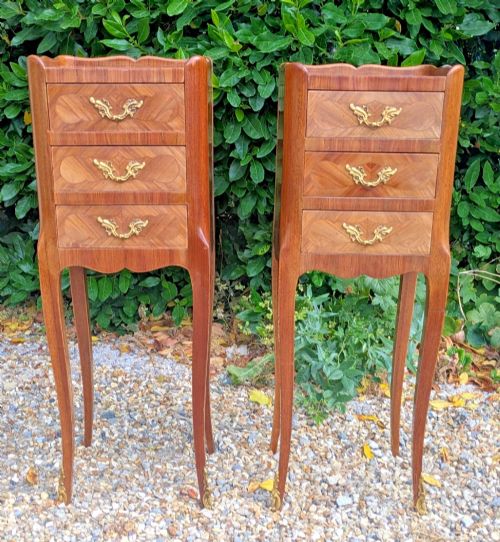
When you search for narrow french drawers, you encounter a specialised form of antique storage designed to maximise floor space through vertical height rather than width. These pieces primarily manifest as semainiers, tall chests, bedside cabinets, and Wellington chests dating from the nineteenth century into the early twentieth century. Most examples originate from French workshops, embracing provincial designs alongside revival styles like Louis XV and French Empire.
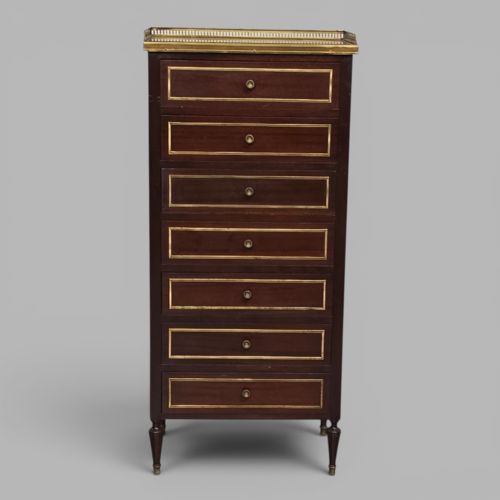
The layout typically involves stacked rows of slender drawers, often numbering seven to match the days of the week in traditional semainier forms. Alongside these, buyers frequently discover pairs of bedside cabinets and tall chests of neat proportions suited to smaller modern interiors. The overarching characteristic remains a restricted footprint combined with refined proportions and decorative timber surfaces.
Materials and construction methods
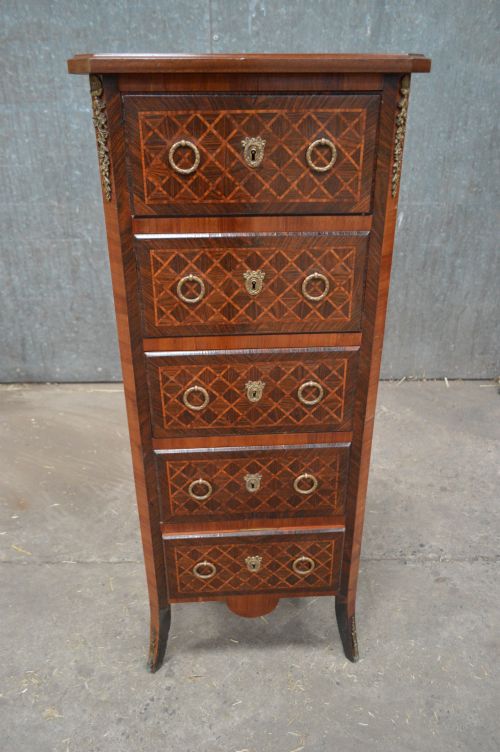
Cabinetmakers constructed these pieces using dense hardwoods and exotic veneers over sturdy carcases. Walnut, mahogany, rosewood, and oak form the structural foundation, frequently embellished with intricate parquetry, marquetry, and contrasting veneers such as kingwood and tulipwood.
Surface detailing often incorporates contrasting elements like brass inlays and cast ormolu mounts. Many tall chests and semainiers feature fitted marble tops, providing a durable and decorative working surface that sits above the primary drawer tiers.
Some narrow chests have seven drawers simply so you could lose your Monday socks without ruining Tuesday.
Indicators of superior execution
Quality in these pieces rests upon the precision of the cabinetmaking and the selection of decorative veneers. Superior examples display seamless matching of wood grain across drawer fronts and crisp execution of parquetry or marquetry patterns.
Hardware integration also separates tiers of production, seen in the clean fit of brass mounts, smooth operation of narrow drawer runners, and the heavy integrity of fitted marble slabs. The crispness of carved wooden details or the subtlety of painted finishes further elevates the standing of an individual piece.
The Narrow French Drawers Glossary
- Semainier
- A tall, narrow chest traditionally containing seven drawers, one for each day of the week. This form originated in France and is frequently encountered in walnut and rosewood.
- Wellington chest
- A tall, narrow chest of drawers secured by a hinged locking side stile that fastens with a key. These pieces typically feature six or seven slender drawers.
- Parquetry
- A geometric mosaic of wood pieces used for decorative surfaces on furniture. Cabinetmakers applied this technique to drawer fronts and tabletops.
- Ormolu
- Gilded bronze mounts applied to furniture for decorative accent. These metal elements were cast and chased before being fixed to the timber frame.
- Marquetry
- Elaborate patterns created by fitting thin slices of wood veneer into a background panel. Floral and pictorial motifs are common in nineteenth-century French examples.
Narrow French Drawers: Frequently Asked Questions
What is a semainier?
A semainier is a tall, narrow chest of drawers designed with seven tiers. The term derives from the French word for week.
Historically, each drawer held daily garments or accessories. Today, they serve as excellent vertical storage in bedrooms.
How do I style a tall chest in a small room?
Their slender footprint allows these chests to fit tight wall spaces where standard furniture fails. They draw the eye upward, enhancing ceiling height.
Pair them with simple surroundings to let the timber grain and marquetry remain the focal point.
Are marble tops original?
Many nineteenth-century French tall chests and bedside cabinets were manufactured with fitted marble tops. These provided a durable surface resistant to daily wear.
Check that the marble sits flush within the wooden gallery and matches the period of the base.