




Napoleon III Porcelain Urns
Napoleon iii porcelain urns bring opulent French design into a room, combining rich porcelain bodies with gleaming ormolu mounts.
Napoleon III Porcelain Urns
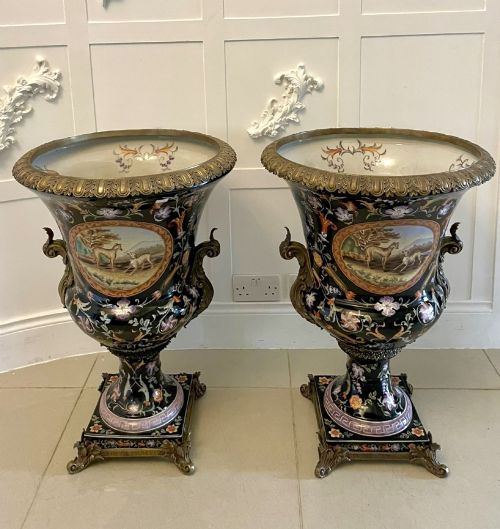
Napoleon iii porcelain urns encompass decorative lidded vases, cassolettes, and monumental pairs designed in the grand nineteenth-century French tradition. These pieces frequently appear alongside mantel clocks in garniture sets or stand independently as table lamps and jardiniere urns.
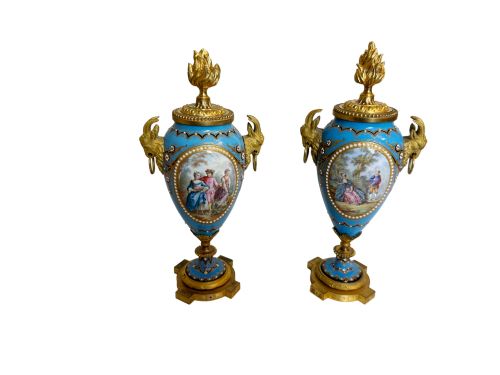
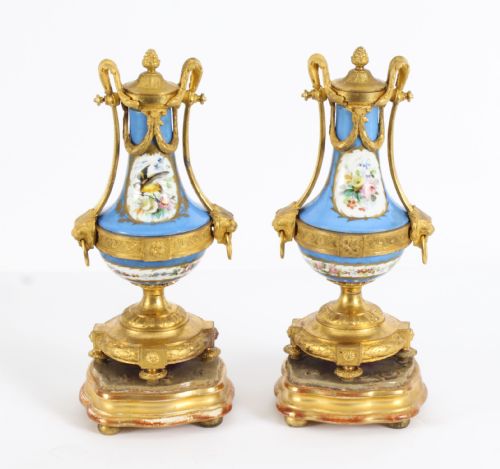
The dominant aesthetic draws heavily on French rococo revival and Louis xvi style influences, reflecting the decorative tastes of the period. Buyers will frequently encounter vibrant colour palettes including turquoise blue, bleu celeste, and bleu royale.
The inventory on this page spans the nineteenth century, with specific examples dated around eighteen sixty, eighteen seventy, eighteen eighty, and eighteen ninety. These objects served primarily as formal mantel ornaments and centrepieces in nineteenth-century salons.
Materials and construction
Mounts in gilt bronze or ormolu secure the rims, bases, and handles of the vases, while glass domes occasionally accompany larger garniture sets. Wood components also appear in the supporting bases of related mantel clocks.
Some nineteenth-century cassolettes flip over to reveal hidden candle sockets, turning a dignified vase into a functional light source.
Assessing quality
Quality rests in the crispness of the gilt bronze or ormolu casting and the depth of the porcelain glaze colour. Finer examples display meticulous hand-painted enamel work and robust, well-fitted metal mounts that complement the ceramic body without obscuring its form.
The overall scale and ambition of the piece define the upper tier, particularly monumental pairs and complete clock garniture sets. Balance between the porcelain body and the metal mounts indicates superior nineteenth-century workshop production.
Japy Frers
The Napoleon III Porcelain Urns Glossary
- Cassolette
- A reversible vase featuring a dual design, often functioning as both a decorative urn and a candle holder. These pieces demonstrate clever nineteenth-century mechanical and aesthetic versatility.
- Ormolu
- Gilt bronze mounts applied to the rims, handles, and bases of porcelain vessels. This technique provided a bright golden contrast to the coloured glazes beneath.
- Garniture set
- A matched group of three or more ornamental objects, typically comprising a central mantel clock flanked by matching urns or cassolettes. They created symmetry on nineteenth-century fireplace mantels.
- Bleu celeste
- A pale, bright sky-blue porcelain ground colour popular in nineteenth-century French ceramics. It often served as a backdrop for gilt highlights and enamel decoration.
- Jardiniere
- A decorative container designed to hold plants or flowers, frequently mounted in brass or bronze. These vessels formed part of elaborate interior display schemes.
Napoleon III Porcelain Urns: Frequently Asked Questions
What are napoleon iii porcelain urns?
These pieces are nineteenth-century decorative ceramic vessels created in France during the Napoleon III period and the broader Victorian era. They combine glazed porcelain bodies with ornate metal mounts in styles inspired by earlier French royal courts.
Such objects functioned as formal interior ornaments, frequently displayed on mantelpieces or console tables within grand salons.
How were these urns used originally?
Nineteenth-century households placed these urns on mantelpieces, often as part of balanced garniture sets flanking a matching clock. Certain variations like cassolettes served dual purposes as decorative vases and candle holders.
Their primary function was visual display, demonstrating the wealth and refined taste of the owner through French artistic design.
How do I style these urns today?
Display these pieces on sturdy surfaces such as mantelpieces, sideboards, or large tables where their height and rich colour can be fully appreciated. Pairing them with complementary nineteenth-century French objects helps anchor their historic aesthetic in a modern room.
Ensure they sit safely away from heavy foot traffic to protect the delicate porcelain bodies and projecting gilt bronze mounts.
How can I tell the period?
Dating relies on identifying the characteristic material combinations, such as Sevres-style porcelain paired with cast gilt bronze or ormolu mounts. The presence of nineteenth-century French stylistic revivals, like Louis XVI and Rococo Revival, points directly to this era.
Maker marks, specific glaze colours like bleu celeste, and construction methods of the metal mounts further confirm nineteenth-century origin.