
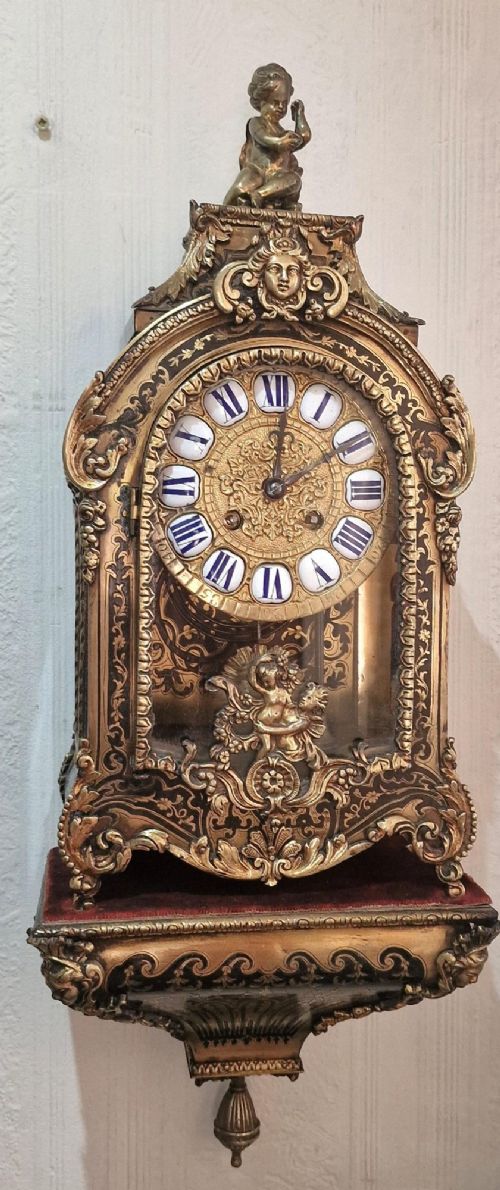


Napoleon III Boulle Clock
These Napoleon iii boulle clock pieces combine tortoiseshell and brass marquetry with gilt bronze mounts to anchor a room.

Napoleon III Boulle Clock
A napoleon iii boulle clock brings together the opulent revival styles of nineteenth century France, taking form primarily as mantel clocks, bracket clocks with matching wall brackets or pedestals, and occasionally taller longcase examples. You will most frequently meet mantel clocks dated from around eighteen sixty to eighteen eighty, housed in ebonised wood cases decorated with elaborate brass and tortoiseshell inlay.
The aesthetic draws heavily on French Louis revival movements, particularly Rococo and Louis XIV styles, reflecting the historicism favoured during the Napoleon III period. These timepieces served both practical domestic functions and grandiose decorative roles in fashionable nineteenth century interiors, often incorporating enamel dial numerals and glazed bezels.
Beyond the standard mantel format, you may encounter pieces accompanied by matching pedestals or wall brackets that elevate the overall presence of the clock. The corpus bridges Victorian production and continental craftsmanship, uniting decorative tortoiseshell surfaces with cast ormolu mounts.
How they were made
The distinctive appearance of these clocks relies on Boulle marquetry, a technique of cutting interlocking patterns from sheets of brass and tortoiseshell laid together, creating contrasting positive and negative designs across the ebonised wood carcase. This meticulous inlay work covers the surfaces, requiring steady handcrafting to fit the metal and shell precisely into the wooden matrix.
Gilt bronze and ormolu mounts provide structural punctuation and sculptural relief, cast in floral, scroll or architectural motifs typical of French revivalism. Enamel dials, often featuring individual cartouches for numerals, fit behind glazed glass doors while eight-day mechanical movements drive the interior timekeeping.
Listings feature items spanning the Victorian period, eighteen sixty to nineteen hundred, utilising tortoiseshell, brass, ormolu, and ebonised wood.
What varies in quality
The refinement of the brass and tortoiseshell marquetry distinguishes the upper tier from more standard examples, where tighter cutter work and sharper contrast define the better pieces. Finer specimens display harmonious alignment between the inlay patterns and the ebonised wooden carcase without visible gaps or rough joins.
Cast mounts also separate the levels of production, with crisper chasing and heavier gilding on ormolu elements indicating superior workmanship. Maker attribution matters significantly, as movements signed by established Parisian makers like Vincenti, Japy Freres or A.D. Mougin carry greater substance than unsigned equivalents.
A.D. Mougin·Vincenti·Japy Freres
The Napoleon III Boulle Clock Glossary
- Boulle marquetry
- A decorative technique of inlaying brass and tortoiseshell together onto a wooden carcase. This method was perfected in seventeenth-century France and revived during the nineteenth century.
- Ormolu
- Gilt bronze mounts applied to furniture and clock cases. The process involves coating cast bronze with a mercury and gold amalgam.
- Ebonised wood
- Timber treated to resemble ebony, providing a dark contrasting background for brass and tortoiseshell inlay. It forms the primary structural carcase for many nineteenth-century French clocks.
- Bracket clock
- A portable clock designed to sit upon a matching wall bracket or furniture surface. Many examples include the original bracket intended to display the piece.
- Enamel dial
- A clock face formed by fusing powdered glass to a metal substrate at high heat. Individual numeral cartouches are frequently applied to the finished surface.
Napoleon III Boulle Clock: Frequently Asked Questions
What periods do these clocks date from?
The pieces span the nineteenth century, with the majority falling between eighteen sixty and eighteen eighty during the Victorian and Napoleon III eras.
Production extended into nineteen hundred, maintaining revivalist styles influenced by earlier French reigns.
How do mantel and bracket clocks differ?
Mantel clocks are designed to stand directly on flat surfaces like fireplace mantels or sideboards.
Bracket clocks traditionally sit upon dedicated wall brackets or matching pedestals to showcase their vertical proportions.
What materials make up the case?
Cases consist of an ebonised wood carcase veneered with tortoiseshell and brass marquetry in contrasting tones.
Cast ormolu and gilt bronze mounts frame the corners, feet, and bezels while glass protects the enamel dial.
Are movements usually marked?
Many movements bear the stamps or signatures of prominent nineteenth-century French clockmakers on the backplate.
Unsigned examples remain common, representing standard workshop production of the period.