




Muted Tone Wall Art
Muted tone wall art brings quiet depth to a room, offering historic paintings and watercolours that rely on subtle palettes.
Muted Tone Wall Art
Muted tone wall art encompasses framed oil paintings, watercolours, and pastel works spanning from the Victorian period through to the mid-twentieth century. These pieces capture quiet landscapes, marine scenes, and architectural views with restrained colour harmonies.
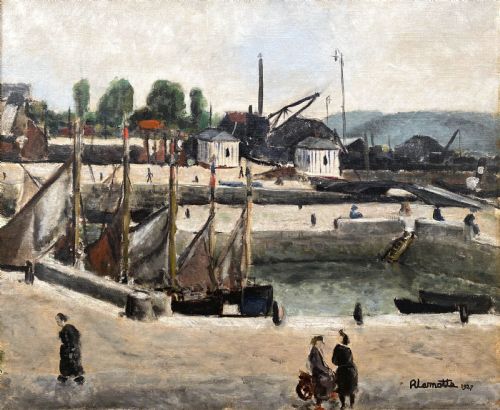
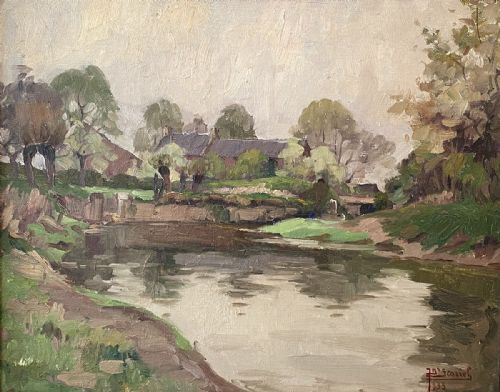
The selections available here lean heavily towards British and French schools, featuring harbour views, rustic barns, and winter rooftops. Works range from nineteenth-century watercolours to mid-century modernist interpretations on canvas or paper.
Buyers seeking this aesthetic find works executed in subdued pigments that create atmosphere rather than visual noise. The focus rests on tonal nuance, whether through an Edwardian street scene or a post-impressionist coastal port.
How they were made
These works rely on traditional application methods, predominantly oil paint on canvas or board, and watercolour pigment on paper. Artists built up their compositions using restrained palettes that allowed earth tones and weathered hues to dominate.
Support materials include aged canvas stretched over wooden frames, alongside heavy water-colour paper housed within period framing. The physical build reflects the standard studio practices of the nineteenth and twentieth centuries.
Current listings feature works from the Victorian era up to 1960, utilising canvas, paper, oil paint, and watercolour pigment.
What varies in quality
Quality rests upon the artist's command over tone and the preservation of the pigment surface. Works that successfully balance atmospheric depth with confident brushwork stand apart from simpler decorative output.
The integrity of the original paper or canvas support, alongside the sympathetic pairing with period frames, determines the overall standing of an individual piece.
Gyrth Russell·Rowland Henry Hill·Fred Stead·Edward Killingworth Johnson·Frederick Thomas Baynes·Thomas Swift Hutton·Owen Bowen·Cuthbert Crossley·Bernard Meninsky·Augustus William Ennes·Charles Edward Wilson·Alfred Leyman
The Muted Tone Wall Art Glossary
- Watercolour pigment
- Ground colour mixed with a water-soluble binder, applied to paper to achieve translucent washes and soft tonal shifts.
- Post-Impressionism
- A late nineteenth and early twentieth-century style that builds upon impressionist light while placing greater emphasis on symbolic content and structural form.
- Oil on canvas
- Pigment suspended in drying oil, applied to a woven fabric stretched across a wooden frame, allowing for rich texture and blending.
- Modernism
- A twentieth-century artistic movement characterised by a deliberate departure from traditional academic styles in favour of experimental form and simplified depiction.
Muted Tone Wall Art: Frequently Asked Questions
How do I hang heavy framed oil paintings safely?
Ensure your wall fixings match the weight of the wooden frame and canvas. Use picture wire rated well above the object's actual mass.
Anchor directly into wall studs or utilise appropriate masonry plugs to keep the piece secure over time.
Can I place these watercolours in direct sunlight?
Paper and watercolour pigments are sensitive to ultraviolet light. Extended exposure causes fading and degradation of the underlying fibres.
Position these works away from south-facing windows or utilise glass with UV-filtering properties.
How do I clean antique canvas surfaces?
Dust accumulation should be managed gently with a dry, soft artist brush. Avoid applying moisture or chemical cleaning agents to the paint layer.
Professional conservators should handle any deeper grime or varnish discolouration to prevent permanent damage.
What defines a post-impressionist landscape?
These works move beyond strict optical realism to express emotional response through colour and form. Artists of this type prioritise structural brushwork over minute detail.
The resulting image captures the essence of a harbour or street scene through simplified planes and atmospheric pigment.