
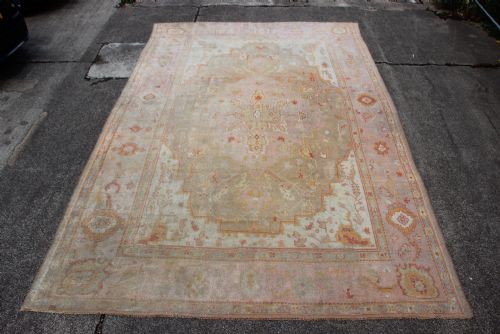


Muted Floral Rug
A muted floral rug brings subdued tones and traditional botanical motifs to a floor, grounding a room with centuries-old craftsmanship.
Muted Floral Rug
When you search for a muted floral rug, you are looking at antique floor coverings woven between 1880 and 1900 in regions such as Persia and Anatolia. These pieces present floral patterns rendered in softened, weathered palettes rather than bright, saturated dyes.
The most common forms you will encounter on this page are carpets, rugs, and runners attributed to weaving traditions like Ushak, Ziegler, Mahal, Bidjar, and Hamadan. They range from room-sized carpets down to narrower runner formats.
How they were made
These textiles are constructed primarily using wool for the pile and foundation, supplemented by cotton for structural warps and wefts in many examples. The materials were hand-spun and hand-knotted to create dense, durable surfaces designed for heavy domestic use.
Weavers utilised natural dyes that mellowed over decades of exposure and washing, producing the characteristic muted tones seen across these nineteenth-century floor coverings.
Some nineteenth-century weavers hid tiny intentional errors in their floral symmetry to ward off the evil eye.
What varies in quality
Quality in these carpets and rugs rests upon the fineness of the knot density and the precision of the botanical drawing. Tightly packed knots allow intricate floral curves to hold their shape clearly rather than appearing pixelated or blurred.
The integrity of the wool foundation and the balance of the faded colour palette also distinguish finer examples. A harmonious, even fading across the surface elevates the visual weight of the piece compared to uneven or harsh wear.
The Muted Floral Rug Glossary
- Pile
- The upright yarn loops that form the usable surface of a rug. It is sheared to a uniform height during finishing.
- Warp
- The vertical threads stretched lengthwise on a loom that carry the structural tension. The pile knots are tied around them.
- Weft
- The horizontal threads inserted across the warps after each row of knots to lock them securely in place. Cotton is frequently used for this purpose in nineteenth-century workshops.
- Runner
- A long, narrow carpet format designed specifically for hallways, corridors, or alongside beds. These items maintain a stretched rectangular proportion.
Muted Floral Rug: Frequently Asked Questions
Where should I place a muted floral rug?
These pieces suit spaces where you want pattern without overwhelming visual noise, such as living rooms, bedrooms, or hallways. Their subdued palettes pair easily with both traditional and contemporary interiors.
Because many examples come in generous dimensions or narrow runner formats, measure your floor space carefully to ensure the piece frames the room correctly.
How do I care for an antique rug?
Regular gentle vacuuming without a rotating brush roll helps keep dust from settling deep into the wool pile. Professional cleaning by a specialist familiar with antique textiles is recommended when deeper maintenance is required.
Keeping the piece out of direct, harsh sunlight preserves the muted tones and prevents uneven fading across the surface.
What is the difference between a carpet and a rug?
In historical manufacturing terms, carpets generally refer to larger room-scale floor coverings, whereas rugs indicate smaller formats. Both utilise the same hand-knotted wool construction methods.
On this page, the terms often overlap depending on the specific dimensions recorded in the listing titles.
How do I identify a Ziegler carpet?
Ziegler pieces produced in the late nineteenth century typically feature subdued, large-scale floral motifs adapted for Western markets. They are known for softer pastel or neutral dye lots.
Look for open fields and generous floral sprays that distinguish them from denser village weaves.