
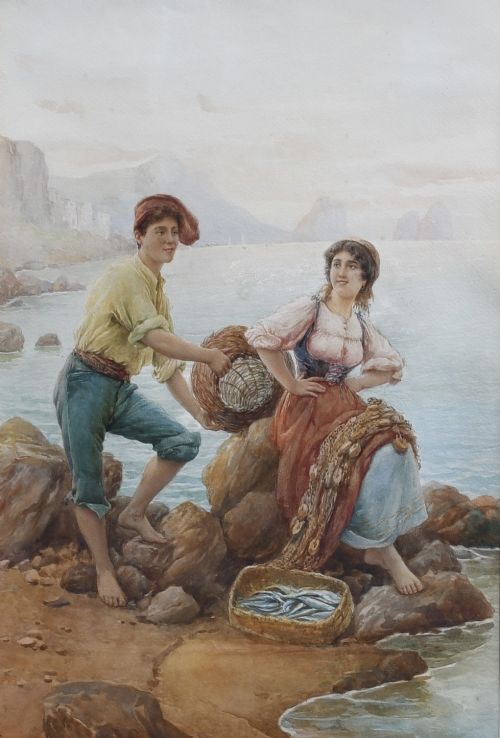


Muted Blue Coastal Painting
A muted blue coastal painting captures sea and shore with subdued tones, offering tranquil maritime scenes for the home.
Muted Blue Coastal Painting
A muted blue coastal painting brings maritime views into focus through depictions of harbours, cliffs, and fisherfolk along British and European shores. These works span the nineteenth century through the mid twentieth century, reflecting shifting artistic approaches to light and atmosphere.
Most examples encountered here are works on paper or canvas capturing seaside settlements from Cornwall to Scotland. Subjects range from busy fishing ports to quiet tidal flats rendered in subdued palettes.
The pieces connect collectors to historical coastal communities through the eyes of regional painters and British Impressionists. Each composition records specific shorelines, harbours, and coastal activities using period pigments.
Materials and methods
Artists relied primarily on watercolour pigment on paper or oil paint on canvas to build these coastal scenes. Watercolour allows for translucent washes that suit the pale skies and open water of maritime environments, whilst oil paint builds heavier texture on canvas or wood supports.
Framing typically involves wood surrounds, often protecting works behind glass in the case of watercolours and pastels. These traditional mountings preserve the paper supports and pigment layers from environmental moisture.
Regional British art schools from the Victorian era to the mid twentieth century supply the majority of these coastal views.
Assessing quality and execution
Quality rests upon the artist's handling of light, atmosphere, and spatial depth within the coastal composition. Stronger works demonstrate confident brushwork and a balanced integration of the muted palette across water, land, and sky.
Provenance and documentation also distinguish individual pieces, particularly when signed by known members of regional art schools or British Impressionist circles. The precision of the location recording adds historical weight to the artistic execution.
Carlo Ferranti·Gyrth Russell·Sir Thomas Newenham Dean·Tom Clough·James Watson·Frederick William Hattersley·John Mitchell·Kate E Booth·Ernest F Hill·Stephen John Batchelder·Owen Bowen·Hirst Walker·William Lee Hankey·William Collins·Fred Lawson·GM de L Aubiniere·Carleton Grant·Fred Stead·Joseph West
The Muted Blue Coastal Painting Glossary
- Watercolour
- A paint consisting of colour pigments suspended in a water-soluble vehicle, traditionally applied to paper supports. It is valued for its luminous washes and transparency.
- Canvas
- A closely woven fabric used as a surface for oil painting, typically stretched across a wooden frame. It provides a durable ground for textured pigment application.
- Impressionism
- An art movement focusing on transient effects of light and ordinary subject matter through visible brushstrokes. In British painting, it often translates to soft coastal atmospheres.
- Pastel
- A medium consisting of powdered pigment and a binder rolled into a stick. It creates velvety coloured marks on paper, frequently requiring glass protection.
Muted Blue Coastal Painting: Frequently Asked Questions
What periods do these paintings cover?
The selection spans from the nineteenth century through to the mid twentieth century. Works encompass Victorian and Edwardian periods alongside British Impressionist movements.
Dates are supported by artist lifespans and stylistic evidence recorded within the titles.
How should I frame and protect a watercolour?
Watercolours require framing behind glass with a mount that keeps the paper from touching the glazing. This prevents moisture accumulation and protects the pigment from degradation.
Keep them away from direct sunlight to preserve the muted blue tones.
Where do these coastal scenes typically depict?
Locations focus heavily on British coastal spots such as Yorkshire, Norfolk, Cornwall, and Scotland, alongside occasional European scenes. Harbours, fishing villages, and tidal estuaries feature prominently.
Many titles name the exact harbour or shoreline rendered by the artist.
What is the difference between oil and watercolour here?
Watercolours are painted on paper supports using water-soluble pigments, resulting in lighter, translucent effects. Oils are worked on canvas or wood using oil-based paints, offering richer textures and heavier pigment.
Both mediums capture coastal light but use different physical layers.