



Moorland Landscape Artwork
Moorland landscape artwork captures wide horizons and wild terrain, offering buyers a evocative window into British regional scenery.
Moorland Landscape Artwork
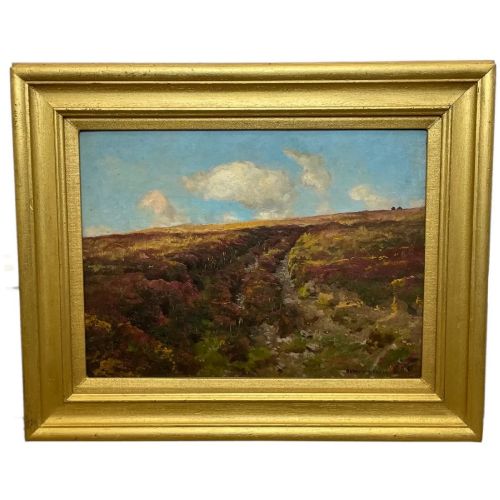
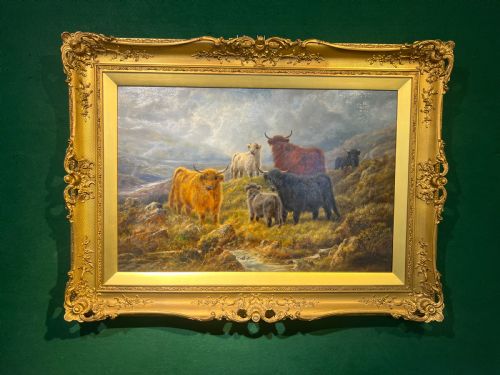
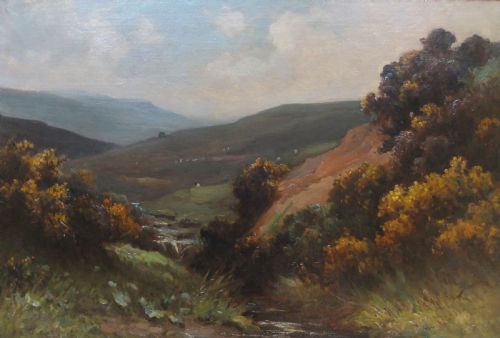
Moorland landscape artwork encompasses framed paintings and watercolours depicting wild expanses such as Exmoor, Dartmoor, and the Scottish Highlands. Buyers encounter works executed across the Victorian era, the Edwardian period, and into the nineteen-thirties.
The compositions frequently incorporate animals or figures within the terrain, including sheep, deer, ponies, and sporting dogs. Works range from intimate watercolours on paper to large oil paintings on wood panel and canvas.
Regional scenes dominate the selection, highlighting specific locales from Yorkshire to the Isle of Man. These pieces reflect British artistic traditions spanning British Impressionism, the Scottish School, and Victorian realism.
Materials and methods
Artists utilised oil paint and watercolour as primary mediums, applying pigment to canvas, wood panel, or paper supports. Pastels and gouache also appear in large-scale depictions of rugged terrain.
Works are typically presented in frames, often incorporating gilt elements that complement the traditional subjects. The physical construction relies on period framing techniques and stretcher frames for canvases.
Several moorland scenes include loyal sporting dogs keeping a watchful eye over the vast, windswept terrain.
Judging quality
Quality rests in the handling of light across open skies and the atmospheric rendering of distant hills. Stronger examples display confident brushwork or precise watercolour control that conveys the damp air and vast scale of the moor.
Compositional balance also dictates distinction, where figures or animals integrate naturally into the topography rather than appearing secondary to the background. The preservation of the original surface and period frame further distinguishes the piece.
Tom Campbell·Arthur Wardle·Joseph Knight·F.J. Snell·Charles Walter Simpson·Owen Bowen·James Orrock·John A. Houston·Florence Hess·Colin Graeme Roe·Joseph Farquharson·John Charles Tunnard·Edmund Morris Wimperis·Ernest Higgins Rigg·Peter Jackson·Arthur H Enock·Frederick Richard Lee·Charles James Adams·Rowland Henry Hill·Robert Cleminson·Alfred Graham
The Moorland Landscape Artwork Glossary
- Oil on canvas
- Pigment suspended in drying oil applied to a woven fabric stretched across a wooden frame. This medium allowed artists to build rich textures and deep tones.
- Watercolour
- Pigments ground in a water-soluble binder, applied to paper to create translucent washes of colour. It requires swift precision from the artist.
- Wood panel
- A rigid wooden support used instead of canvas for painting. It provides a smooth, stable surface favoured in certain periods.
- Gilt frame
- A decorative wooden frame coated with gold leaf or metallic paint. It enhances the visual presence of traditional paintings.
Moorland Landscape Artwork: Frequently Asked Questions
What periods do these artworks cover?
The pieces span from the nineteenth century through the Victorian and Edwardian eras into the nineteen-thirties and nineteen-sixties.
This broad timeline reflects shifting British artistic movements, including realism and early impressionism.
Are these paintings usually framed?
Most works arrive in period frames, frequently featuring gilt details that suit nineteenth and early twentieth-century aesthetics.
These housings help protect the paper or canvas supports.
What subjects appear besides scenery?
Compositions frequently include livestock such as sheep and ponies, alongside deer, game birds, and sporting dogs.
Human figures like drovers and fishermen also traverse the open terrain.
Which regions are depicted?
Artists record specific British locations including Dartmoor, Exmoor, Danby Moor, and the Scottish Highlands.
Views from the Isle of Man and Lancashire also feature among the regional scenes.