


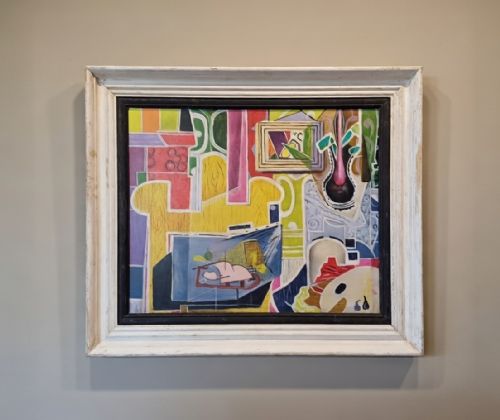


Modernist Still Life
Modernist still life paintings capture domestic objects and interiors through the experimental lenses of cubism, fauvism and mid-century abstraction.
Modernist Still Life
A modernist still life brings together everyday domestic subjects such as fruit, flowers, bowls and windows, rendered through the experimental visual languages of the twentieth century. These works range from early pieces created in the 1920s to mid-century compositions from the 1950s and 1960s.
French modernist and mid-century French examples dominate the selection, often focusing on domestic interiors, kitchen geometry and floral arrangements by the window. Alongside these French works appear pieces linked to British artistic circles and American modernist output.
The objects represented are approached not through strict academic realism, but through abstraction, flattened perspective and bold colour relationships. Common motifs include teapots, soup tureens, fruit on tables and botanical studies.
Materials and methods
Oil paint applied to canvas, board or wood forms the primary medium for these compositions, supported by occasional uses of gouache and conté crayon on paper. Artists worked with brushwork that varied from smooth linear definition to visible, textured layers.
Support materials reflect the working methods of the period, utilising stretched canvas, wooden panels and thick board substrates. Some compositions incorporate additional elements such as gold leaf or textured encaustic preparations to build surface depth.
Distinctions in quality
Quality rests upon the strength of the compositional structure and the confidence with which the artist handles space and form. Superior works maintain a dynamic tension between the flat surface of the picture plane and the three-dimensional objects depicted.
The cohesion of colour relationships and the originality of the abstraction separate standard decorative output from works by accomplished artists with documented exhibition histories or professional associations.
Edward Carter Preston·Girieud·Jean Francois Laglenne·Simone Herman·Tschacbasov
The Modernist Still Life Glossary
- Cubism
- An early twentieth-century artistic movement that broke down subjects into geometric shapes and multiple simultaneous viewpoints. This approach appears frequently in depictions of tables, fruit and kitchenware.
- Fauvism
- A style characterised by strong, non-naturalistic use of colour and bold brushwork. Practitioners prioritised painterly qualities and subjective colour over realistic representation.
- Gouache
- An opaque water-based medium that dries to a matte finish. It allows for flat areas of dense colour on paper or board supports.
- Encaustic
- A painting technique involving heated beeswax mixed with coloured pigments. The resulting mixture is applied to a surface to build tactile, durable layers.
- Constructivist
- An abstract style originating in the early twentieth century that emphasises structural form, geometric rigour and industrial materials.
Modernist Still Life: Frequently Asked Questions
What subjects appear in modernist still life?
Paintings in this category focus on everyday household items, including flowers in pots or coffee pots, fruit on tables, soup tureens and interior window views. These subjects serve as vehicles for formal experiments in colour and shape.
Artists frequently reduced these domestic elements to their essential geometric components, moving away from traditional academic perspective in favour of flattened or multiple viewpoints.
How do I date a modernist still life painting?
Dating relies on stylistic markers, materials, and documented exhibition histories or signatures. Pieces from the 1920s often show early cubist or avant-garde influences, while 1950s and 1960s works tend toward mid-century abstraction and looser brushwork.
Support materials also offer clues, as board, stretched canvas, and paper were utilised in distinct ways across different decades of the twentieth century.
Where were these modernist paintings produced?
A significant proportion of these works originate from France, reflecting the central role of French modernism and regional centres like Lyons. Other pieces emerge from British networks such as the St Ives School, as well as American studios.
This geographic spread demonstrates how modernist painting techniques spread across international artistic communities during the interwar and mid-century periods.
How should I display a modernist still life?
These works suit both contemporary and traditional interiors, where their strong colour palettes and geometric compositions can act as focal points. Proper framing helps protect canvases and boards from environmental moisture.
Placement should avoid direct sunlight to preserve the integrity of oil paints, gouache, and paper supports over time.