


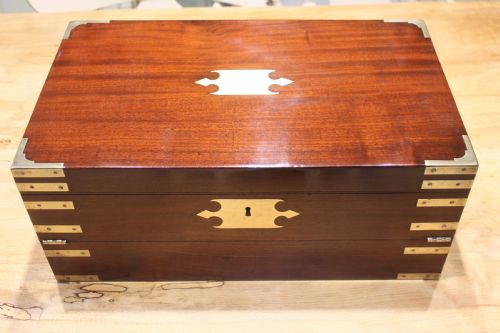


Military Writing Box
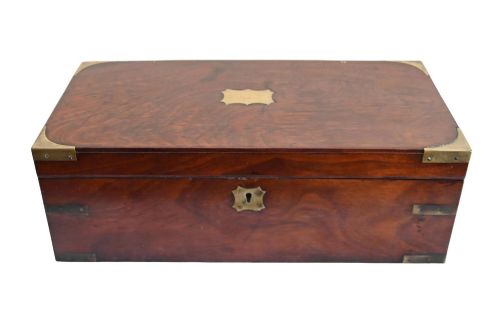
A military writing box is a portable desk built for officers on the move, combining sturdy timber with protective brass corners to survive campaign life.
Military Writing Box
A military writing box brings together portable engineering and domestic comfort, designed for officers on campaign in the nineteenth century. These items appear as folding slopes, lap desks, and correspondence boxes that open to reveal fitted stationery compartments.
Most examples found here date from the Georgian, Regency, and Victorian eras, spanning the wider nineteenth century. They include campaign styles in mahogany, rosewood, and camphor wood, often reinforced with brass strapping and flush carrying handles.
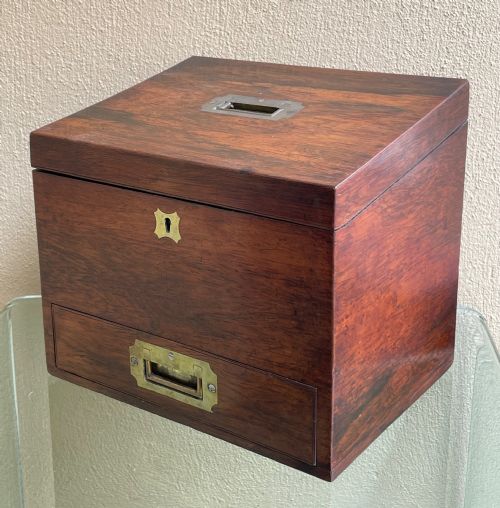
Makers built these pieces for service in the field or colonial outposts, leading to practical variations such as secret drawers, candle sconces, and metamorphic forms. The selection ranges from plain folding desks to substantial brass-bound boxes equipped with working keys and specialised storage.
Materials and construction
Cabinetmakers selected dense, stable hardwoods such as mahogany, rosewood, teak, and camphor wood to withstand tropical climates and rough transit. These timbers were often paired with solid brass corners, edge banding, and recessed lifting handles to absorb impacts.
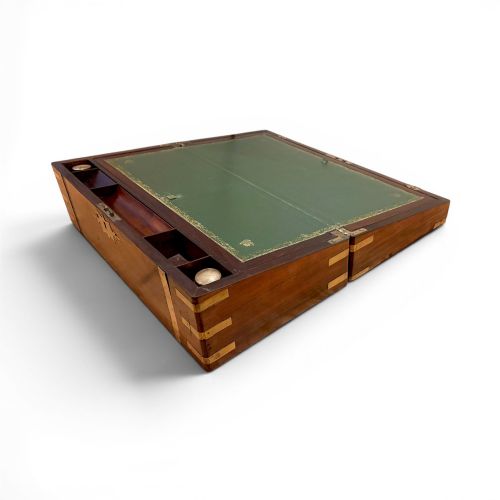
The interiors utilise fitted secondary woods to create secret compartments, pen trays, and slanted writing surfaces lined with leather. Brass pins, hinges, and flush-fitting locks secure the folding carcase while maintaining smooth external lines for packing.
Some officers required candle sconces and secret sovereign sections just to write a letter home after dark.
Distinctions in quality
Superior execution shows in the precision of the brass work and the tightness of the mitred joints, which ensured the timber withstood fluctuating temperatures without splitting. Finer boxes feature heavier gauge brass mounts, well-fitted interior lids, and clever concealed mechanisms that operate smoothly.
The choice of cabinet timber also defines the tier of the piece, with figured burr walnut, rich rosewood, and aromatic camphor wood indicating high-status commissions. Inferior examples rely on simpler carcase construction and thinner brass hardware lacking sophisticated internal locking systems.
The Military Writing Box Glossary
- Campaign style
- Furniture designed to dismantle or fold easily for military transport. These items utilise recessed hardware and robust timbers to survive long journeys.
- Brass bound
- The reinforcement of box edges and corners with heavy brass plates and straps. This technique protected the wood from knocks during rough handling on campaign.
- Secret drawers
- Concealed compartments hidden behind false panels or spring-loaded catches within the writing slope. Officers used these spaces to secure currency, maps, and private letters.
- Metamorphic
- Describing a box that transforms its configuration through folding sections, sliding trays, or adjustable writing surfaces. These clever mechanisms maximised utility in confined spaces.
- Lap desk
- A compact writing box placed directly on the user's knees rather than a stationary table. It provided a stable surface for correspondence in tents and temporary quarters.
Military Writing Box: Frequently Asked Questions
What is a military writing box?
A military writing box is a portable desk made for officers on campaign during the eighteenth and nineteenth centuries. These sturdy boxes folded shut to protect writing materials, ink, and personal documents during travel.
Inside, they featured slanted writing surfaces, inkwells, and compartments for paper. Many included secret drawers or specialised sections for sovereigns and correspondence.
How did officers use them?
Officers used these boxes to write dispatches, keep journals, and manage personal correspondence while stationed away from permanent headquarters. The portable design allowed them to set up a functional desk inside a tent or temporary lodging.
The sloping lid provided an ergonomic writing angle, while internal compartments kept loose stationery from shifting during transport.
How do I date these pieces?
Dating relies on timber choices, brass hardware styles, and overall construction methods typical of the Georgian, Regency, and Victorian periods. Earlier Georgian and Regency boxes often display simpler brass straps and fine mahogany or rosewood veneers.
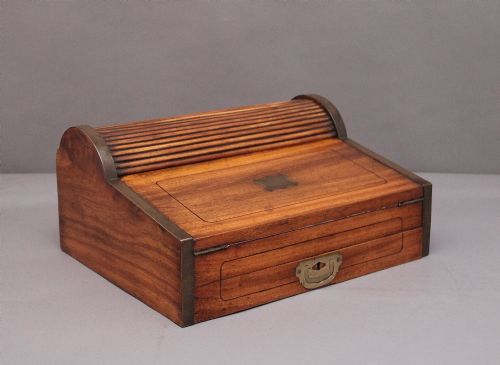
Later Victorian examples frequently incorporate camphor wood, heavier brass corners, and more complex internal mechanisms such as roll-tops or double-action folding surfaces.
How do I care for the wood?
Keep the wood conditioned by applying appropriate furniture wax sparingly to maintain the natural moisture of the timber. Avoid placing these boxes near direct heat sources or in areas with high humidity to prevent the wood from warping.
Protect the leather writing surfaces from sharp objects and clean brass hardware gently with a soft cloth to preserve the historical patina.