




Middle Eastern Landscape
These middle eastern landscape works capture desert vistas, ancient monuments and bustling street scenes through the eyes of European and regional artists.
Middle Eastern Landscape
Collectors seeking a middle eastern landscape encounter works spanning the eighteenth century to the mid-twentieth century, including the Victorian era and the nineteen-twenties. These depictions take the form of oil paintings on canvas or board, watercolours, gouache, coloured engravings and framed prints.
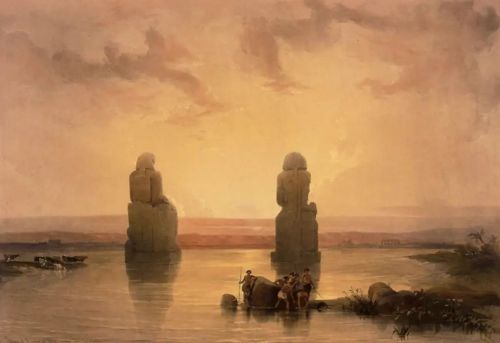
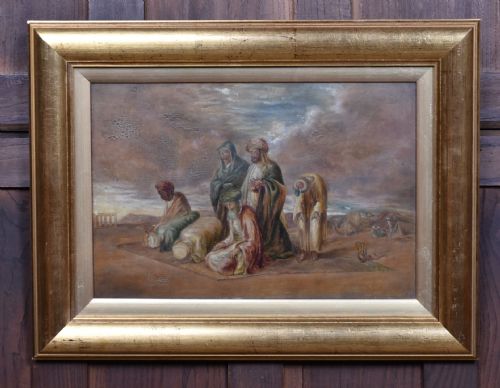
The subjects range widely across the region, showing scenes such as the pyramids at Gizeh, the Suez Canal, Egyptian buffalo with farmers, Bedouin tribesmen with camels, and Arabic seascapes. Pieces emerge from distinct movements including nineteenth-century Orientalism and modern Iraqi art.
Most examples meet on this page as framed watercolours, oil paintings, or prints executed by listed artists and anonymous hands alike. They record travel, topography and romanticised views of desert and urban life.
How they were made
Artists deployed oil paint and watercolour on various supports, including canvas, paper, board and gouache combinations. Many works retain their period framing, such as ebonised wooden surrounds or gilt mouldings incorporating gold leaf.
Engravings utilise printed lines and added colour to replicate original compositions, while paintings on canvas apply pigment directly to stretched textiles using traditional brushwork techniques.
Materials documented across these artworks include oil paint, watercolour, gouache, paper, canvas, wood, glass and gold leaf.
What varies in quality
The strength of a middle eastern landscape relies on the directness of the artist's observation and the handling of atmospheric light. Finer works demonstrate a confident command of pigment, whether capturing the blinding glare of desert sun or the subtle shadows across ancient stonework.
Support and medium contribute significantly to the character of each piece, from delicate watercolour and gouache washes on paper to robust oil paint layered thickly on canvas. The preservation of the original surface and the appropriateness of the framing further distinguish superior examples.
David Roberts·Edwin Lord Weeks·William James Muller·Otto Pilny·Hugo Vogel·Abdul Kadir Al Rassam·Richard Wilson·Edmund Aubrey Hunt·Frank Holme
The Middle Eastern Landscape Glossary
- Orientalism
- A nineteenth-century artistic movement focused on the subjects, people and landscapes of the Middle East and North Africa. Artists often travelled extensively to record these foreign scenes.
- Gouache
- An opaque water-based medium frequently combined with watercolour on paper to create solid areas of colour and bright highlights.
- Engraving
- A printmaking technique where an image is incised into a metal plate, which then holds ink for transfer to paper.
- Ebonised
- Wood treated to imitate ebony, commonly used for dark, polished nineteenth-century picture frames.
Middle Eastern Landscape: Frequently Asked Questions
How do I date a middle eastern landscape painting?
Dating relies on stylistic clues, framing materials, artist signatures and biographical records. Nineteenth-century works often reflect academic Orientalism, whereas later pieces lean towards impressionism or modern regional styles.
Examines the back of the canvas or board for old labels, stamps or inscriptions that might record exhibition history or precise execution dates.
Are these works original or prints?
The selection includes both unique handmade art, such as oil paintings and watercolours, and mass-produced or limited edition prints and engravings. Close inspection under magnification reveals whether pigment sits on the surface in brushstrokes or rests within a printed dot matrix.
Watercolours and oils on canvas or board represent direct creations by the artist's hand, while engravings and lithographs offer multiple impressions of a popular subject.
What subjects are most common in these artworks?
Common subjects include desert caravans with Bedouin tribesmen and camels, ancient architectural monuments like the pyramids, and busy Middle Eastern market streets. Coastal views and village town scenes also appear frequently across different decades.
These motifs reflect both the documentary impulses of travelling European painters and the personal viewpoints of regional artists depicting their own homelands.