





Mid Century Charcoal Sketch
A mid century charcoal sketch captures the raw immediacy of the artist's hand, offering a direct window into twentieth-century portraiture and landscape study.
Mid Century Charcoal Sketch
A mid century charcoal sketch encompasses original works on paper originating from the 1920s through to the 1960s. These pieces often take the form of framed original art, wall art, and fine art drawings.
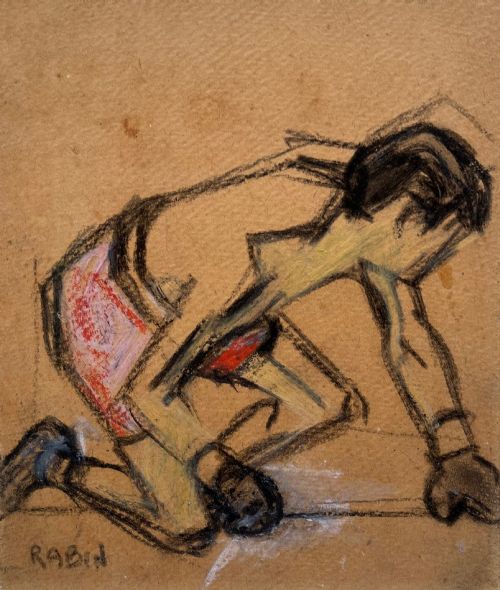
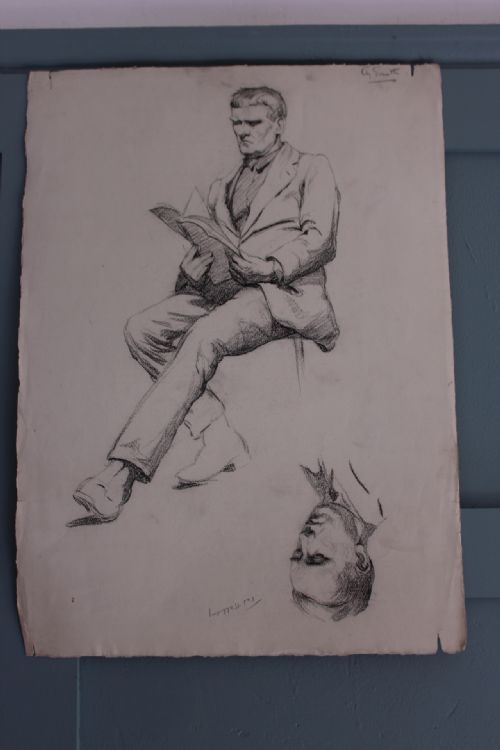
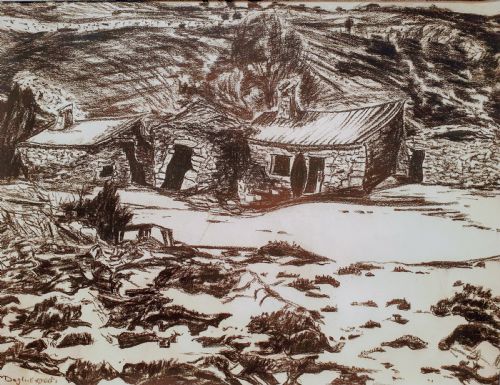
The selections on this page feature life studies, landscape studies, and striking character portraits. Buyers most frequently encounter expressive figure drawings and academic life studies alongside regional landscapes from British and French modernists.
Origins range from mid-century British and French studios to African school works and nineteenth-century academic precedents. The primary focus remains on works executed on paper utilising charcoal, graphite, chalk, and pastel.
Materials and technique
Artists working in this medium rely primarily on charcoal, graphite, and chalk applied directly to paper supports. Many pieces integrate pastel or pencil to build tonal depth and define contours within the drawing.
Framed presentation is common, often utilising wood and glass to protect fragile media. The technique prioritises rapid gesture and tonal shading over elaborate colour schemes, capturing subjects with swift lines.
Recorded periods range from the nineteenth century through the 1920s, 1930s, 1940s, 1950s, and 1960s.
Evaluating quality and execution
The strength of a drawing rests in the confidence of the line and the economy of the mark-making. Stronger examples demonstrate a sure grasp of anatomy or landscape perspective achieved with minimal correction.
Condition of the paper support and the stability of the charcoal media dictate longevity. Superior works maintain crisp contrast and strong compositional balance across the sheet.
Samuel Rabin·Arthur Todd·Frank Dobson·Juliet Pannett
The Mid Century Charcoal Sketch Glossary
- Charcoal sketch
- A rapid drawing executed with charred wood material on paper. It allows for deep blacks and broad tonal blending.
- Life study
- An artwork created by observing a live human model directly. These are foundational exercises in academic and modernist training.
- Graphite
- A form of crystalline carbon used as a drawing medium in pencil form. It produces fine grey lines distinct from the velvety black of charcoal.
- Academic Realism
- A style of painting and drawing produced under the influence of European academies of art. It emphasises precise anatomical accuracy and traditional techniques.
- Mid-Century Modern
- A design and art movement spanning roughly from the 1930s to the mid-1960s. It favours clean visual forms and modernist sensibilities.
Mid Century Charcoal Sketch: Frequently Asked Questions
How do I care for a mid century charcoal sketch?
Charcoal and pastel media remain extremely fragile because loose particles can detach from the paper surface over time. Keep framed works away from direct sunlight and high humidity to prevent paper degradation.
Ensure the drawing is glazed with glass that does not rest directly against the paper surface. Professional framing with acid-free backing boards protects the integrity of the sheet.
Are these sketches original artworks?
Every piece recorded in these listings represents an original hand-drawn work on paper rather than a reproduction or print. Artists applied charcoal, graphite, or chalk directly to create unique compositions.
Handmade studio drawings carry the distinct pressure marks and erasures of the creator. This individuality distinguishes them from mass-produced lithographs or offset prints.
How do I date a charcoal drawing?
Dating relies on stylistic markers, framing methods, and paper types consistent with the twentieth century. Many works carry explicit dates inscribed by the artist alongside signature notations.
Contextual clues such as subject attire, sitter identity, or studio stamps provide further chronological boundaries. Comparisons with documented periods like the 1950s or 1960s help narrow the creation window.
What is the difference between charcoal and graphite?
Charcoal produces a deep, velvety black mark that easily smudges for dramatic tonal effects. It is well-suited to expressive figure studies and bold landscape sketches.
Graphite yields a metallic grey line capable of sharp precision and fine detail work. Artists often combined both media on paper to achieve varied textures.