







Metal Mantle Clock
When you handle a metal mantle clock, you hold a heavy piece of domestic engineering dressed in gilt, bronze or marble.
Metal Mantle Clock
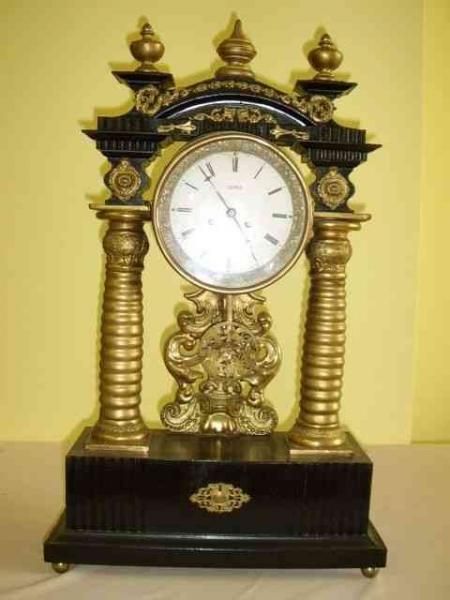
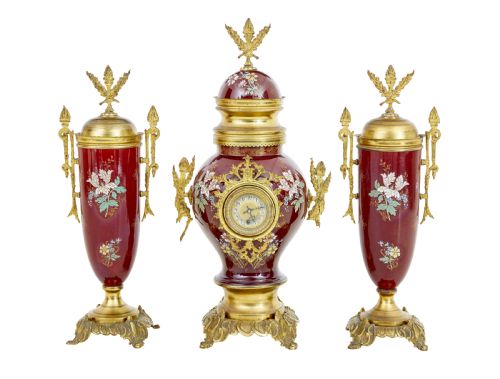
A metal mantle clock brings together heavy case work and precision movement, often arriving as part of a garniture set flanked by matching urns or candelabra. You meet pieces spanning the late eighteenth century through to the art deco period, with nineteenth-century French productions dominating the selection.
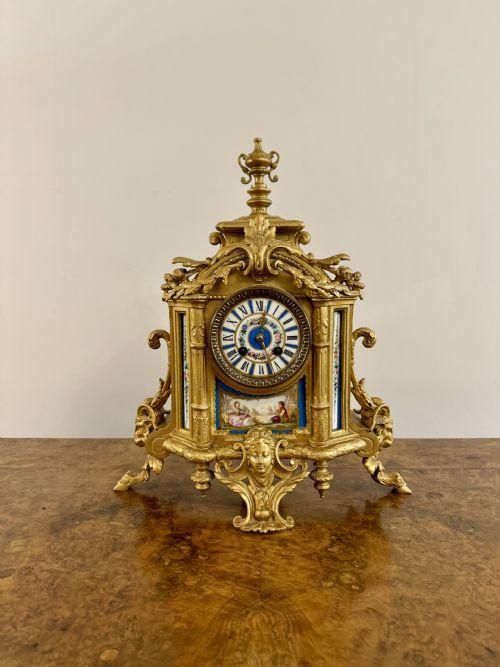
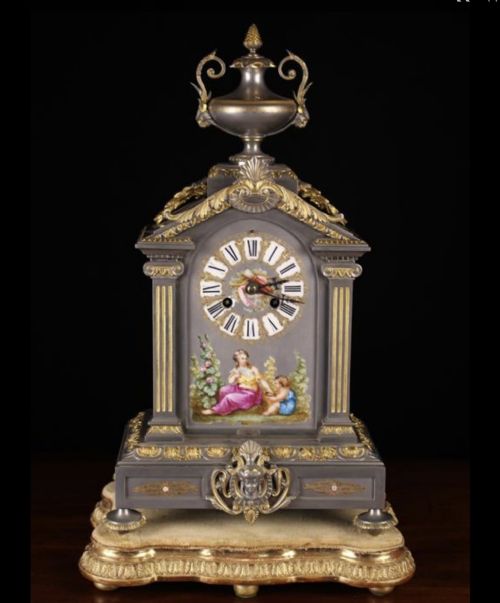
The forms range from grand portico designs and industrial mechanical subjects to compact boudoir pieces and architectural marble cases. Gilt metal and porcelain combinations appear frequently alongside patinated bronze, tôleware and polished brass.
Makers housed these movements in styles travelling from French rococo revival and louis xvi revival through to modernist chrome. Every example serves both as a reliable timekeeper and a central decorative anchor for a room.
Materials and Construction
Casework relies on cast gilt metal, ormolu, and heavy brass, frequently combined with painted porcelain plaques, white marble, and ebonised wood elements. Movement plates and dials utilise brass and white enamel, protected behind bevelled glass bezels.
Foundries cast the metal components in sections before applying fire-gilding, patination, or paint. Clockmakers then fitted eight-day movements, anchor escapements, and bell or gong striking trains into these substantial housings.
Judging Quality
Quality reveals itself in the crispness of the metal chasing and the depth of the original gilding or patination. Heavily cast bronze and ormolu retain sharp relief along foliage and figures, whereas lesser castings lose detail and rely on uniform surface plating.
The movement provides the other measure, seen in signed backplates, fine escapements, and substantial gear trains. Makers who invested in bell striking or quarter striking mechanisms paired them with robust cases finished with hand-painted porcelain panels.
Leroy & Fils·Mathias Bauerle·Andre Guilmet·P.H Mourey·Bayard·Jaeger Le Coultre·Wm. Gilbert U.S.A.·Blangy·Vincenti & Co.
The Metal Mantle Clock Glossary
- Garniture set
- A clock accompanied by matching side ornaments such as urns or vases designed to display together on a mantelpiece.
- Portico clock
- A monumental clock featuring architectural columns supporting the movement housing, popular during the empire and revival periods.
- Ormolu
- Finely chopped leaf gold amalgamated with mercury and applied to cast bronze through heat gilding.
- Fusee timepiece
- A clock mechanism using a conical pulley and chain to ensure even force to the movement as the mainspring unwinds.
- Escapement
- The mechanical linkage that regulates the release of power from the gear train to control the movement of the hands.
Metal Mantle Clock: Frequently Asked Questions
What is a clock garniture set?
A garniture set consists of a central mantle clock accompanied by two matching side pieces, such as decorative urns or candelabra. These groups were designed to create a balanced display across a fireplace mantle.
Matching materials like porcelain plaques and gilt metal link the pieces into a cohesive decorative scheme.
How do I date a French mantle clock?
Examine the style of the case, the signature on the movement backplate, and the materials used in construction. Louis XVI revival and empire pieces lean towards architectural symmetry, while rococo revival examples feature asymmetric scrolls.
Maker stamps and serial numbers on the brass movement often narrow down the production decade.
Where should I place a metal mantle clock?
Position your clock on a stable, level surface away from direct heat sources and damp environments. A heavy marble or metal case requires sturdy support to absorb the weight and vibration of the strike train.
Ensure the surface allows the pendulum to swing freely without catching against the case back.