


Mashrabiya Side Table
A mashrabiya side table brings intricate geometric lattice and rich inlay from the nineteenth century directly into your interior.
Mashrabiya Side Table
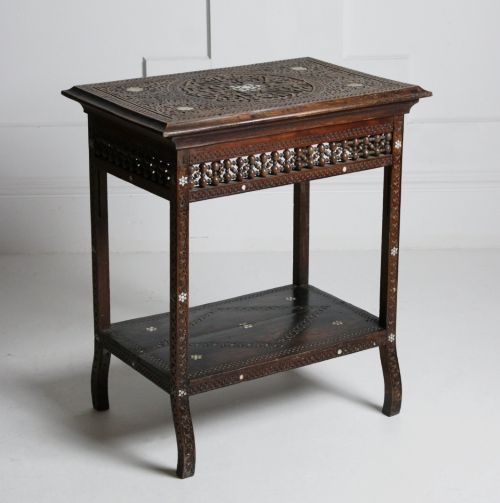
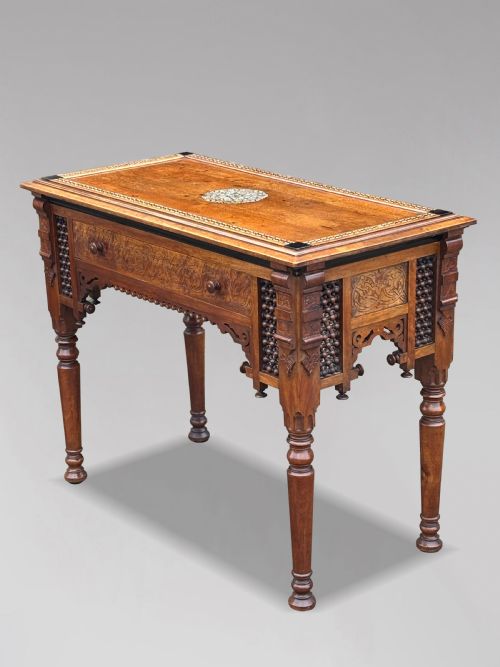
A mashrabiya side table is typically encountered as a nineteenth-century occasional piece, often taking an octagonal form or featuring two tiers designed for domestic use. These pieces emerge from Moorish Revival, Aesthetic Movement, and Anglo-Moorish traditions, reflecting a late Victorian fascination with Eastern design. You will find them constructed as side tables, games tables with chess boards, and drop-flap occasional tables.
The aesthetic vocabulary spans Syrian, Damascan, and North African origins, translated through British retailers such as Liberty & Co. into Anglo-Moresque furnishings. The common thread is the unmistakable architectural lineage of turned spindlework and dense surface decoration.
Most examples date firmly between 1880 and 1890, capturing the height of the Aesthetic and Moorish Revival movements. They serve as striking focal points in a room, traditionally utilised to display small objects or facilitate quiet games.
How they were made
Construction relies heavily on dense hardwoods, walnut, and mahogany, frequently subjected to ebonisation to achieve a dramatic black finish that contrasts with lighter decorative elements. Artisans assembled the frames using traditional joinery suited to complex polygonal shapes like octagons.
The distinctive surface ornamentation utilises intricate wood inlay combined with delicate pieces of bone and mother-of-pearl. Hand carving defines the structural components and the pierced wooden lattices that echo traditional window screens.
Listings show a strong concentration of pieces from the 1880s and 1890s, dominated by walnut, mahogany, and ebonised wood.
What varies in quality
The refinement of the hand carving and the precision of the geometric inlay establish the primary tier of craftsmanship in these pieces. Finer examples display tightly fitted mother-of-pearl and bone tesserae with minimal gaps, whereas simpler items rely more heavily on surface carving alone.
The ambition of the form also dictates distinction, moving from straightforward occasional tables to complex two-tier compositions or dedicated chess tables with integrated playing surfaces. The cohesion between structural integrity and decorative density separates standard production from exceptional artistry.
Liberty & Co.
The Mashrabiya Side Table Glossary
- Mashrabiya
- An architectural projecting window enclosed with carved wood lattice-work. In furniture, it translates to the intricate turned spindle panels characteristic of these tables.
- Anglo-Moorish
- A design style popular in late nineteenth-century Britain that combined traditional Islamic and Moorish motifs with domestic European furniture forms.
- Ebonisation
- A chemical or pigment finishing process applied to timber to imitate genuine ebony. It creates a deep black surface popular during the Aesthetic Movement.
- Tesserae
- Small blocks of stone, bone, or mother-of-pearl used in mosaic and inlay work. They form the intricate geometric patterns seen across the table tops.
Mashrabiya Side Table: Frequently Asked Questions
What is a mashrabiya side table?
A mashrabiya side table is a nineteenth-century occasional piece featuring intricate turned lattice-work and geometric inlay inspired by Islamic architecture.
These tables were produced during the height of the Moorish Revival and Aesthetic movements, often combining British retail frameworks with Eastern craftsmanship.
How were these tables used?
They functioned primarily as decorative occasional tables in late Victorian drawing rooms, designed to hold small lamps, ornaments, or tea services.
Some specialised versions incorporated folding drop flaps or integrated chess boards for domestic leisure and games.
How do I date a Moorish inlay table?
Dating relies on stylistic markers such as Aesthetic Movement ebonisation, retailer attribution, and construction methods typical of the late nineteenth century.
Most examples date between 1880 and 1890, aligning with the peak popularity of Anglo-Moorish and Syrian revival furniture in Britain.
What materials are used in these tables?
Construction typically involves hardwoods like walnut and mahogany, alongside ebonised wood frames that provide a dark, uniform background.
Surface decoration is achieved through hand carving, wood inlay, and detailed applications of bone and mother-of-pearl.
How do I care for inlaid wood furniture?
Protect the delicate bone and mother-of-pearl inlay by keeping the table away from direct sunlight and extreme fluctuations in household humidity.
Dust gently with a dry, soft cloth and avoid applying modern liquid polishes that might seep into the intricate lattice-work.