
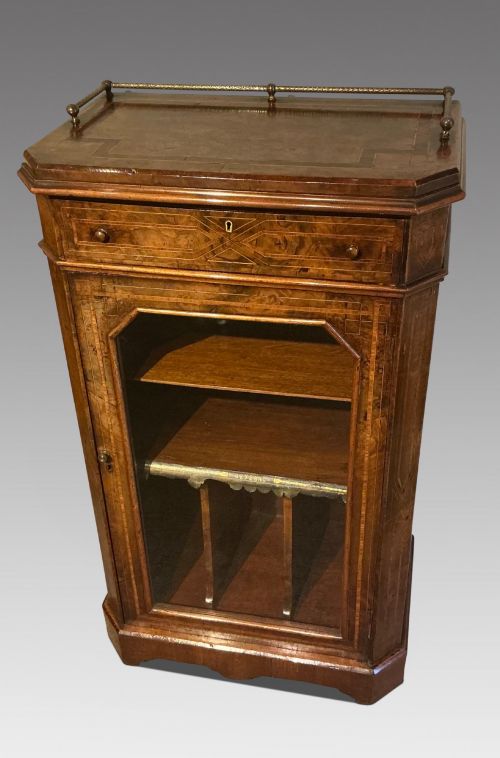


Marquetry Sheet Music Cabinet
These marquetry sheet music cabinet pieces offer refined storage for scores and sheet music, bringing distinct period character and intricate inlaid wood into the home.
Marquetry Sheet Music Cabinet
A marquetry sheet music cabinet is a dedicated piece of furniture designed to keep folios and scores organised. The pieces on this page span the Victorian and Edwardian eras, coming down from the nineteenth century into the early twentieth.
Most examples take the form of upright cabinets or music canterburys, sometimes functioning as magazine racks or occasional tables. They serve well in modern sitting rooms for storing papers, journals, or records.
The dominant forms employ traditional cabinet proportions with hinged doors, internal shelving, or vertical partitions. Walnut, mahogany, and rosewood form the structural carcases for these refined domestic items.
How they were made
Cabinet makers utilised dense hardwoods such as mahogany, walnut, and rosewood to build the foundational carcases. Burr walnut and burr yew wood frequently provide highly figured timber surfaces for the main body and doors.
Marquetry inlay and finer stringing in satinwood and brass adorn the exterior panels. Glazed doors occasionally appear, allowing visibility into the internal compartments whilst protecting the contents.
Listings feature periods spanning from Victorian and 1870 through to Edwardian and 1910.
What varies in quality
The refinement of the marquetry work separates standard production from finer cabinetmaking. Crispness in the floral and geometric inlays, alongside the selection of burr walnut or rosewood veneers, marks the distinction.
Keeble London
The Marquetry Sheet Music Cabinet Glossary
- Marquetry inlay
- Decorative woodwork where small pieces of veneer are fitted into a ground material to form pictures or patterns. It defines the surface enrichment seen across these cabinets.
- Music canterbury
- A low stand featuring vertical partitions specifically designed to hold sheet music or folios. This form often integrates drawer storage below the main rack.
- Burr walnut
- Timber taken from a tree growth featuring intricate, swirling grain patterns. Cabinet makers prized it for creating highly decorative door panels.
- Satinwood
- A pale, lustrous hardwood utilised for contrasting stringing and inlay details. It highlights borders and central motifs against darker rosewood or mahogany carcases.
Marquetry Sheet Music Cabinet: Frequently Asked Questions
What is a marquetry sheet music cabinet?
It is a specialised piece of nineteenth or early twentieth century furniture built to store sheet music and scores safely.
Cabinet makers constructed these pieces using fine timbers like walnut and mahogany, decorating the exterior with intricate wood inlays.
How were music cabinets used originally?
Musicians and households utilised them in parlours and drawing rooms to keep unbound sheet music organised and protected from dust.
The internal partitions and compartments allowed owners to sort scores by composer or instrument.
Can I use one for modern vinyl records?
Yes, many collectors adapt these cabinets for storing LP records and modern media.
The vertical divisions found in canterbury styles suit the dimensions of record sleeves well.
How do I date a Victorian music cabinet?
Dating relies on observing the primary timber, the style of inlay, and structural characteristics associated with the period.
Victorian examples frequently employ walnut and burr veneers, whereas Edwardian pieces often incorporate lighter mahogany or rosewood.