


Late Victorian Music Cabinet
These late victorian music cabinet pieces are compact repositories designed for sheet music, offering rich timber figuring and refined brass detailing for the home.
Late Victorian Music Cabinet
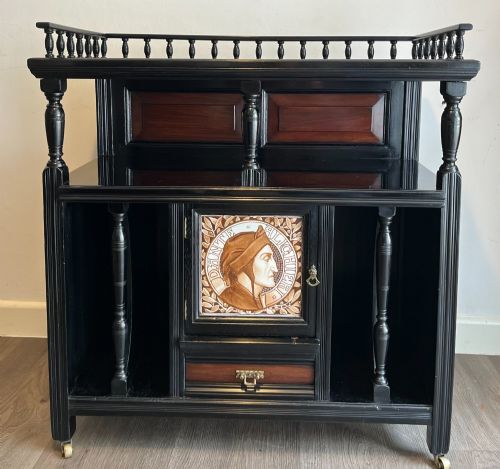
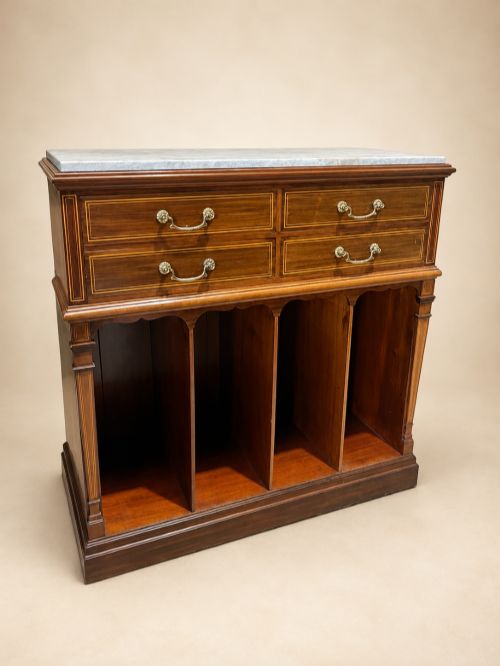
A late victorian music cabinet is a specialised domestic storage piece designed specifically to house sheet music and scores. Most examples date from the late nineteenth century, spanning the eighteen eighties and nineties, and frequently appear in mahogany, rosewood, walnut, or ebonised wood.
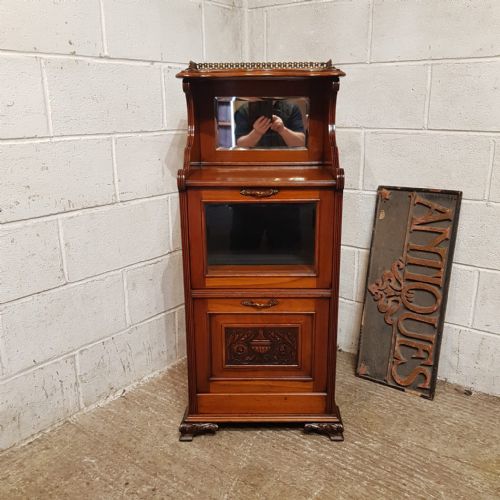
The form typically presents as a slim, upright cabinet fitted with internal shelves or drop-down drawers intended for filing folios. Alongside dedicated music cabinets, related forms in the evidence include side cabinets, parlor cabinets, and duet stools adapted for musical interiors.
Makers of the period applied diverse stylistic influences, ranging from Aesthetic Movement severity and Sheraton Revival inlay to early Art Nouveau curves. Buyers most frequently encounter mahogany and rosewood variants featuring marquetry or brass hardware.
Materials and construction
Makers constructed these cabinets using dense hardwoods such as mahogany, rosewood, walnut, and amboyna, often employing ebonised finishes for a dramatic dark surface. Timber panels were frequently embellished with marquetry inlay, ivory stringing, or contrasting veneers.
Functional metal components in brass, such as handles, hinges, and gallery rails, provide structural contrast to the polished timber bodies. Some variations incorporate mirrored backs, ceramic inserts, or glass doors to lighten the upright silhouette.
A duet stool sits quietly in the archive, proving that piano players occasionally needed somewhere to sit while the sheet music stayed neatly filed next door.
Factors of quality
Quality rests upon the choice of timber and the precision of the cabinetmaker's joinery rather than mere decorative elaboration. Dense, figured rosewood or finely grained mahogany commands greater appreciation than plain secondary woods.
The refinement of the marquetry inlay and the weight of the brass hardware distinguish superior workshops from standard commercial production. Interior arrangement, such as the smooth operation of specialised sheet music drawers, also marks the grade of the piece.
Henry Ogden and Son
The Late Victorian Music Cabinet Glossary
- Marquetry
- Decorative veneer work forming pictures or geometric patterns by assembling thin pieces of wood. This technique defines the surface ornamentation on many rosewood and mahogany pieces.
- Ebonised
- Wood treated to resemble ebony through staining or painting to achieve a deep black finish. This technique was popular in late nineteenth century design.
- Aesthetic Movement
- A design style emphasising visual beauty and artistic expression over strict historical revivalism. Pieces from this movement often feature clean lines and contrasting details.
- Sheraton Revival
- A late nineteenth century style drawing inspiration from the lighter neoclassical furniture of George Sheraton. It frequently utilises delicate satinwood and mahogany with symmetrical inlay.
- Gonçalo Alves
- A dense, exotic tropical hardwood displaying striking dark brown and golden figuring. It appears in select high end nineteenth century cabinetry.
Late Victorian Music Cabinet: Frequently Asked Questions
What fits inside these cabinets?
These cabinets were built to store sheet music, folios, and musical scores within specialised shallow drawers or vertical compartments. The internal dimensions suit paper collections rather than bulky books.
Today, owners utilise these compartments to organise contemporary paperwork, art supplies, or flat linens while maintaining the traditional aesthetic of the room.
Where were they placed originally?
Victorian households positioned these slim units in drawing rooms, music rooms, or parlours where upright pianos and other instruments stood. Their compact footprints allowed them to occupy narrow wall spaces.
Modern interiors accommodate them easily in hallways, studies, or living areas as auxiliary storage tables or display stands.
How do I spot an inlay?
Inlay involves setting contrasting woods or materials directly into recesses carved into the primary surface of the cabinet. Running your hand across the panel reveals slight textural variations where the different woods meet.
Late nineteenth century examples often employ floral or geometric marquetry alongside thin lines of contrasting timber or ivory.
Are all these pieces mahogany?
While mahogany is common, the listings demonstrate considerable variety including rosewood, walnut, amboyna, and ebonised wood. Each timber brings distinct grain patterns and colour variations to the furniture.
Cabinetmakers selected woods based on the prevailing style of the decade, shifting from dark ebonised finishes to figured rosewood and warm mahogany.