
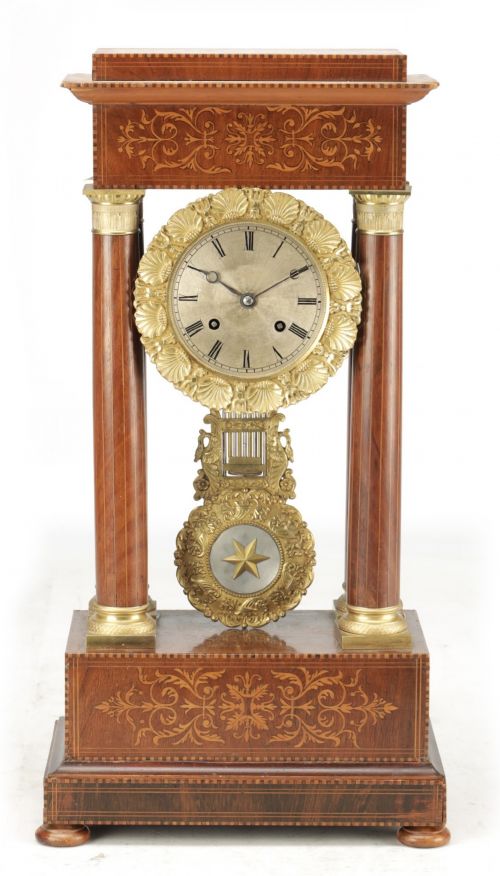

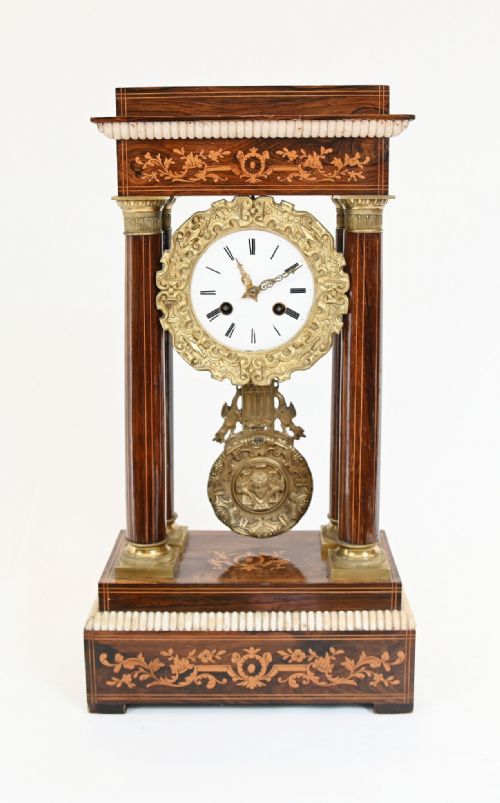


Marquetry Pendulum Clock
When you want a marquetry pendulum clock, you are looking at tall case clocks and mantel pieces wrapped in patterned wood veneers that tell time with a swinging weight.
Marquetry Pendulum Clock
A marquetry pendulum clock brings together traditional timekeeping and intricate wood-inlaid decoration across tall grandfather clock formats, wall-hung dials, and decorative mantel pieces. The pieces available here span from seventeenth-century walnut examples to nineteenth-century French and Edwardian mahogany designs.
Buyers will encounter several distinct formats when exploring this selection, ranging from imposing longcase and grandfather clocks to compact French portico and mantel timepieces. Rosewood, walnut, and mahogany form the primary timber bodies for these varied shapes.
Origins stretch across British workshops and continental makers, particularly French creators who utilised elaborate brass, tortoiseshell, and metal wire alongside their wooden inlays. Each regional style brings its own characteristic silhouette and decorative vocabulary to the mechanism housed inside.
How They Were Made
Craftsmen built these timepieces using sturdy foundation timbers like oak or pine, then applied fine surface veneers of mahogany, walnut, or rosewood. Intricate patterns were created by cutting contrasting woods, mother-of-pearl, and metal wire into precise interlocking shapes.
Clockmakers fitted brass movements - frequently featuring fusee or eight-day gear systems - behind enamelled dials and protective glass plates. Ormolu mounts and cast brass bezels were then added to accent the wooden cases and frame the swinging pendulums.
What Varies in Quality
Quality rests in the crispness of the wood cutting and the tightness of the veneer joints across the case. Superior examples display seamless integration where contrasting timbers meet without filler or visible gaps.
The sophistication of the internal movement and the reputation of the signing horologist elevate certain pieces above standard production. Original matching brackets, delicate ormolu castings, and untouched enamel dials further distinguish the finest specimens.
HENRI MARC OF PARIS·Thomas A Paris·Samuel Marti·Paul Philip Barraud·EDWARD EAST·William Warren·EDWARD STANTON·Savory & Fils A Paris·Dumont·HENRY MASSY
The Marquetry Pendulum Clock Glossary
- Marquetry
- Decorative veneer work formed by fitting pieces of wood, metal, or shell together to create pictorial or geometric patterns on furniture and clock cases. It differs from plain inlay by covering the entire surface in a mosaic design.
- Pendulum
- A suspended weight that swings back and forth to regulate the speed of a clock movement. Its steady oscillation governs the escapement mechanism inside.
- Fusee
- A conical pulley used in spring-driven clocks to maintain even power as the mainspring unwinds. This device ensures the movement receives consistent force throughout its running cycle.
- Portico clock
- A mantel clock designed with columns supporting a central housing, popular in nineteenth-century French design. These pieces often incorporate rich wood veneers and gilt bronze mounts.
- Boulle
- A style of marquetry using tortoiseshell and brass or copper inlay, named after the famous French cabinetmaker André-Charles Boulle. It creates a striking contrast of dark shell and gleaming metal.
Marquetry Pendulum Clock: Frequently Asked Questions
How do I wind a pendulum clock safely?
Open the glass door or case trunk carefully to access the dial or weights, then use the appropriate key or pull mechanism gently. Take care not to over-wind the mainspring or disrupt the delicate balance of the swinging pendulum.
Allow the clock to settle after adjusting, listening for an even tick that confirms the beat is correct. If the beat sounds uneven, a slight shift of the case or pendulum suspension may be necessary.
Where should I place a longcase clock?
Position your longcase clock against an interior wall away from direct sunlight, heating vents, and damp entryways. Wood veneers and internal brass gears react poorly to extreme temperature fluctuations and humidity.
Ensure the floor beneath the clock is firm and level so the case can be secured safely to the wall if needed. A stable foundation keeps the pendulum swinging truly and prevents unnecessary wear on the anchor mechanism.
How can I tell a French mantel clock from a British one?
French mantel clocks often feature rich rosewood, tortoiseshell, or ormolu mounts with sculptural elements like bovine cherubs or portico columns. Their movements frequently bear the names of Parisian makers and use distinct bell-striking arrangements.
British examples tend toward more restrained mahogany or walnut cases with traditional brass dial faces and engraved signatures. The architectural proportions and wood selections generally reflect distinct domestic cabinetmaking traditions.
What is a fusee movement?
A fusee is a conical pulley connected to the clock's mainspring by a fine chain or cord. As the spring loses tension, the chain moves to a wider part of the cone, evening out the power delivered to the gears.
This clever mechanical addition ensures the clock maintains consistent accuracy as it runs down between windings. You will often find fusee movements in better-quality British wall and bracket clocks.