


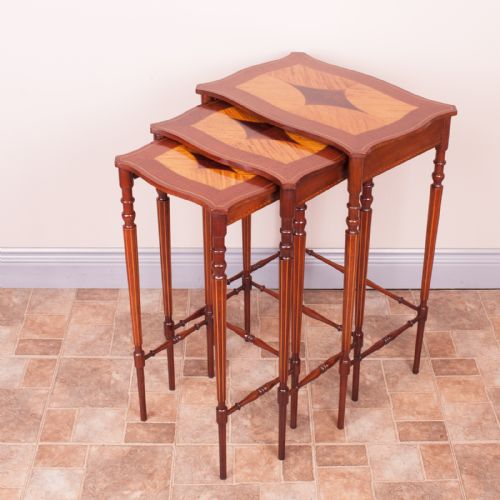

Marquetry Nesting Tables
Marquetry nesting tables combine ingenious space-saving design with exquisite decorative surface work, offering collectors both versatility and fine period craftsmanship.
Marquetry Nesting Tables
Marquetry nesting tables consist of sets of graduated tables designed to slide neatly beneath one another when not in use. When you examine these pieces, you encounter sets comprising three or four individual tables.
The selections span several distinct periods, with Edwardian and Victorian examples forming the backbone of the available pieces. Alongside British production, French provincial and Art Nouveau variations appear, showcasing diverse regional interpretations of the form.
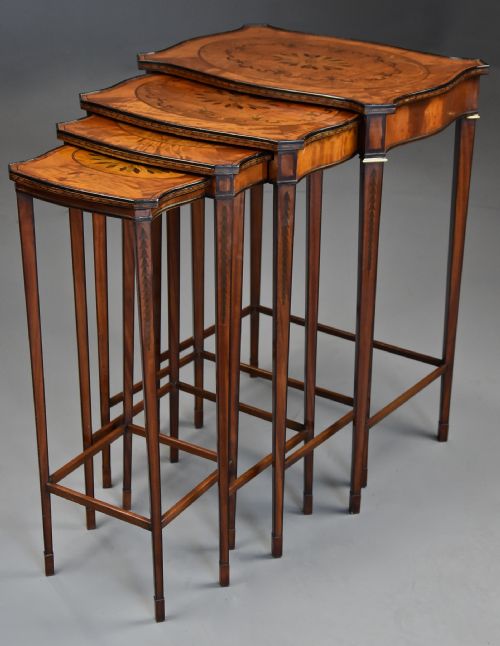
Makers utilised various timber frames to support elaborate decorative tops, ranging from quartetto sets to serpentine and kidney-shaped designs. These portable surfaces served drawing rooms and parlours efficiently without cluttering the floor space.
Materials and construction
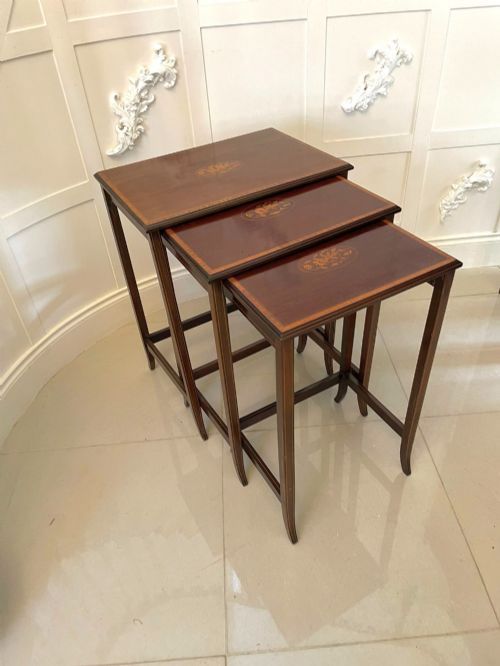
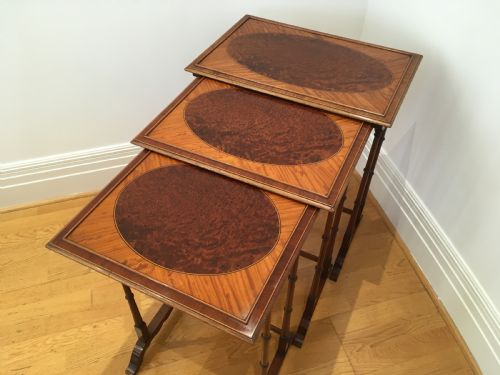
Craftsmen built the primary frames using robust timbers such as mahogany, walnut, and rosewood, ensuring structural integrity for the smaller sliding frames. Contrasting woods like satinwood and amboyna provided striking borders and panels.
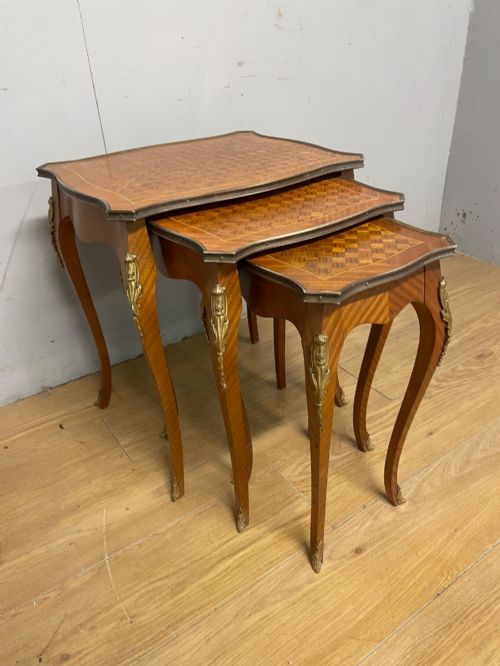
The decorative surfaces rely on intricate wood veneer and marquetry inlay, where different tinted and grained timbers are fitted together to form floral or geometric compositions. Parquetry variations also occur, employing geometric arrangements of wood blocks.
Some nineteenth century tables hide secret botanical stories in their floral marquetry, using native Irish woods to signal local patriotism.
Assessing quality and execution
Superior examples display exceptional precision in the timber inlay, where individual veneer pieces fit together seamlessly without excessive filler. The complexity of the floral or geometric motifs distinguishes standard production from masterwork output.
The choice of secondary woods and the stability of the nesting mechanism reveal the maker's standard of construction. Clean lines in serpentine or kidney shapes demand greater joinery skill than standard rectangular tops.
Émile Gallé
The Marquetry Nesting Tables Glossary
- Marquetry
- Decorative veneer work where pieces of wood are assembled to form pictorial or ornamental patterns on a solid backing. This technique transforms a simple tabletop into a detailed canvas.
- Quartetto
- A matched set of four graduated occasional tables designed to nest together. The term frequently appears in Edwardian and Victorian catalogue descriptions.
- Parquetry
- A geometric mosaic of wood pieces used for decorative floors and tabletops. It differs from marquetry by focusing on repeating angles and geometric grids rather than pictorial scenes.
- Satinwood
- A luminous hardwood with a golden yellow sheen, frequently utilised for contrasting borders and inlay work. It brings brightness and high contrast to dark mahogany frames.
Marquetry Nesting Tables: Frequently Asked Questions
How were nesting tables used historically?
These tables functioned as movable side surfaces during afternoon tea, card games, or letter writing in Victorian and Edwardian drawing rooms. Servants or hosts could easily pull out individual tables as guests required extra places for cups or books.
Because they slid compactly together when the gathering ended, they preserved valuable floor space in formal rooms. This practicality made them a staple of fashionable late nineteenth and early twentieth century interiors.
How do I distinguish Edwardian from Victorian sets?
Victorian examples tend to be heavier in construction, often utilising solid mahogany frames with darker finishes and robust inlay. Late Victorian pieces sometimes feature specialised regional designs like Killarney ware.
Edwardian tables frequently lean towards lighter satinwood accents, delicate serpentine contours, and Sheraton revivals. The overall aesthetic shifts from heavy formal presence to lighter, airier elegance.
What is the difference between marquetry and parquetry?
Marquetry involves cutting and assembling wood veneers to create pictorial representations, such as flowers, scrolls, or landscapes. The craft requires immense patience to match wood grains and tones.
Parquetry relies strictly on geometric patterns like cubes, chequered squares, or triangles. Both techniques adorn the tops of nesting tables, but their visual effects differ completely.
Are French nesting tables different from British ones?
French variations often embrace Art Nouveau curves, asymmetrical floral motifs, or provincial walnut frames. Makers such as Émile Gallé pushed sculptural boundaries with specimen woods.
British iterations generally adhere more closely to classical revival styles, such as Sheraton proportions or standard Georgian mahogany forms. Both traditions prioritized decorative veneer work, but the styling reflects distinct continental tastes.