
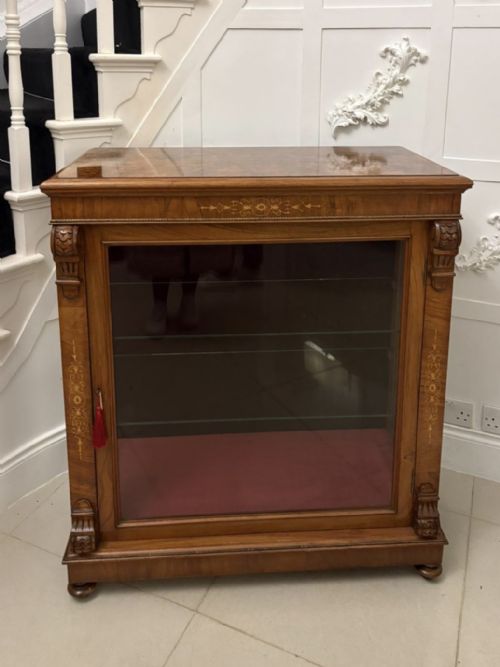
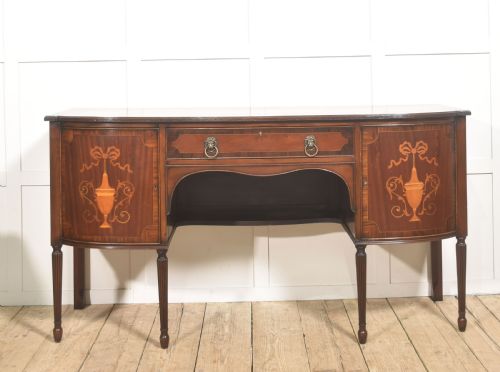

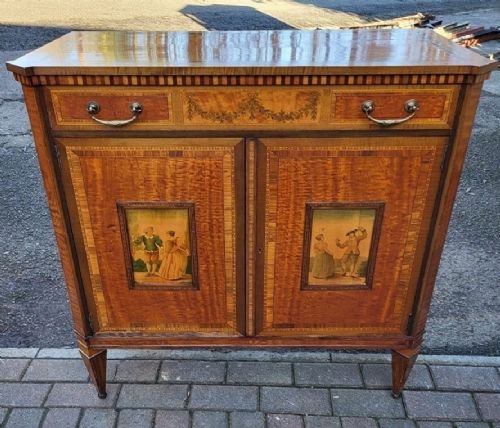
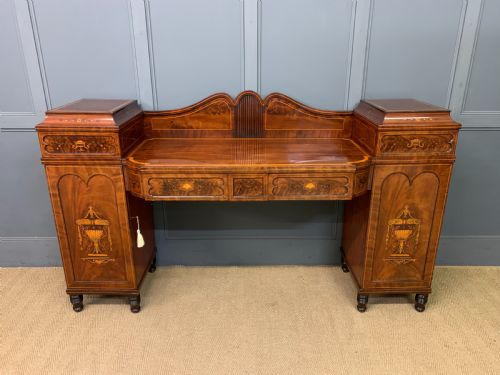


Marquetry Mahogany Credenza
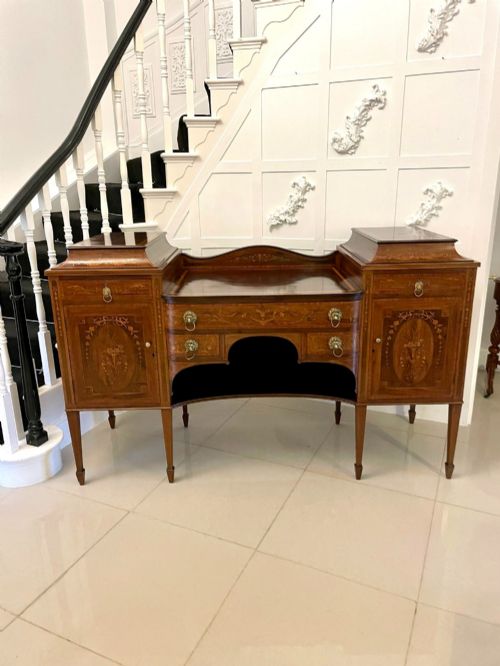
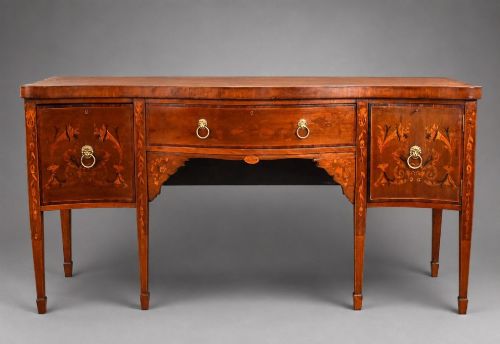
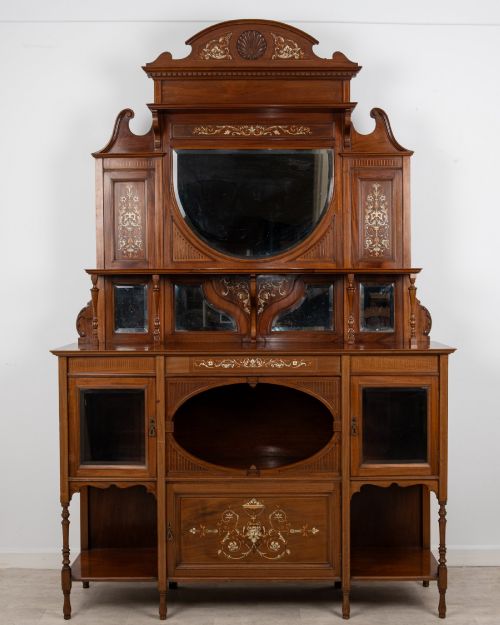
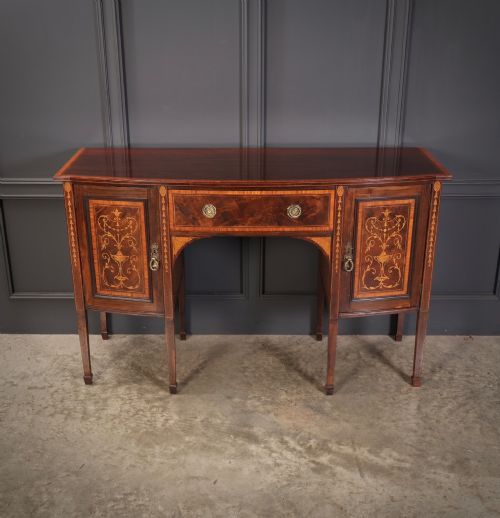
A marquetry mahogany credenza brings together rich tropical timber and intricate inlaid details for a commanding presence in a room.
Marquetry Mahogany Credenza
When you search for a marquetry mahogany credenza, you encounter large storage pieces that combine solid and veneered timber with complex floral or geometric wood patterns. These items appear across various periods, including the Victorian, Edwardian, and Georgian eras.
The most common form you will meet on this page is the sideboard or side cabinet, often shaped with a bow front or serpentine profile. Makers also produced display cabinets, commodes, and chiffoniers alongside the traditional credenza form.
Origins span English workshops influenced by Sheraton Revival designs as well as continental pieces featuring French or Italian styling. Each variation serves the primary purpose of providing formal display and storage within a principal living space.
Materials and Construction Methods
Cabinet makers utilised a mahogany carcase as the foundational structure, applying fine veneers to large flat surfaces to display the grain. Satinwood, boxwood, and various fruitwoods provided the contrasting colours necessary for detailed marquetry panels.
Inlaid motifs required cutting contrasting wood veneers by hand and fitting them precisely into prepared recesses within the mahogany background. Brass mounts, glass panels, and mirror backs frequently completed the construction of the finer examples.
Some nineteenth-century cabinets hide drop-centre writing surfaces behind formal sideboard doors, keeping correspondence out of sight.
Separating the Best from the Standard
The distinction between ordinary and superior pieces rests on the crispness of the marquetry cutting and the integration of contrasting timbers. Tight joints in the inlay work indicate an artisan who spent considerable time achieving a seamless surface.
Structural integrity also separates the grades, evident in the weight of the timber and the stability of the doors and drawers. Finer items exhibit thoughtful proportioning and restrained use of brass or gilt bronze mounts that complement rather than overwhelm the wood.
Hewetsons London·Maple and Co·Whytock and Reid of Edinburgh·Edwards and Roberts·Howard and Sons·Gillows
The Marquetry Mahogany Credenza Glossary
- Marquetry
- Decorative veneer work formed by fitting together small pieces of various coloured woods to create pictorial or geometric designs. This technique distinguishes standard storage furniture from high-status decorative pieces.
- Credenza
- A low cabinet or sideboard traditionally used for serving food or displaying plate and valuables. The form evolved through the nineteenth century into elaborate display furniture.
- Sheraton Revival
- A late nineteenth-century design movement inspired by the neoclassical furniture of George III designer Thomas Sheraton. Pieces in this style utilise delicate mahogany and satinwood inlay.
- Serpentine
- A furniture front or edge that curves outward in the centre and inward at the sides. This shape demands high carpentry skill to construct accurately.
- Satinwood
- A durable tropical wood with a lustrous yellowish sheen, frequently used for contrasting stringing and inlay on mahogany furniture. It provides bright highlights against darker woods.
Marquetry Mahogany Credenza: Frequently Asked Questions
What is a marquetry mahogany credenza used for?
These cabinets serve as principal storage and display furniture in dining rooms, libraries, or grand reception spaces. The interior shelving accommodates porcelain, glassware, or linens while the top surface holds decorative objects.
Their substantial presence makes them natural focal points within a room, combining practical utility with significant visual weight. Historically they functioned as serving stations or display surfaces for valuable household silver.
How do I distinguish Sheraton Revival pieces from earlier originals?
Sheraton Revival items typically date from the late nineteenth century and display a lighter, sometimes more decorative approach to neoclassical design. They often feature machine-prepared veneers alongside hand-cut marquetry.
Genuine eighteenth-century examples exhibit construction methods appropriate to the Georgian period, with hand-sawn timber framing and simpler, structural joinery. Examining the secondary woods inside the drawers helps clarify the actual period of manufacture.
Where should I place a large credenza in my home?
A credenza requires a substantial wall space where its length and decorative marquetry can be appreciated without obstruction. Dining rooms and wide hallways provide traditional settings that complement their proportions.
Avoid placing them in direct sunlight, which can fade the contrasting satinwood and mahogany veneers over time. Keeping them away from direct heat sources prevents the timber and inlay from drying and lifting.
What does serpentine front mean on a cabinet?
A serpentine front curves gently outward in the middle section and curves inward toward each end in an S-shape. This contour adds depth and elegance to the piece compared to a flat front.
Crafting a serpentine door or drawer front requires advanced woodworking skill to ensure the timber moves correctly with changes in humidity. The marquetry across these curves must follow the compound shapes without distorting the design.
How do I care for antique inlaid mahogany furniture?
Maintain the wood by applying a quality microcrystalline wax periodically to nourish the surface and protect the finish. Avoid silicone-based sprays that can penetrate old finishes and damage the veneer.
Dust the marquetry gently with a soft, dry cloth, taking care not to catch cloth fibres on any lifted edges of veneer. Stable indoor humidity levels will protect both the mahogany carcase and the delicate inlay work.