
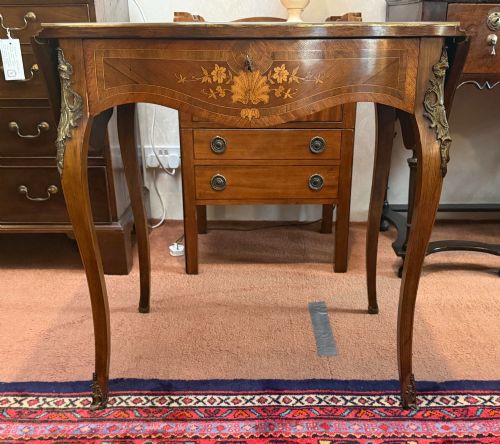
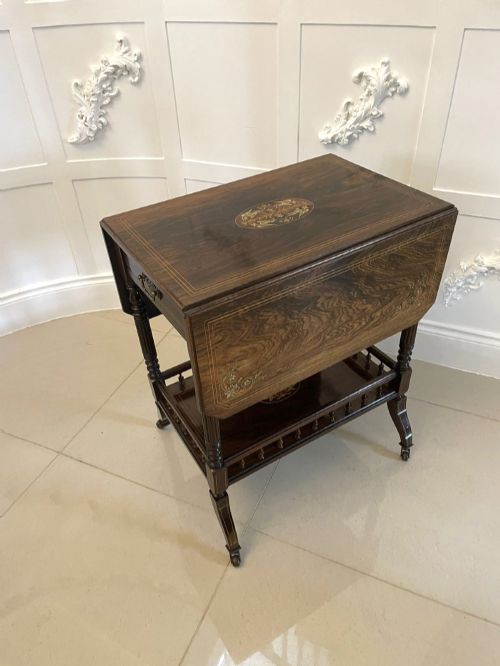
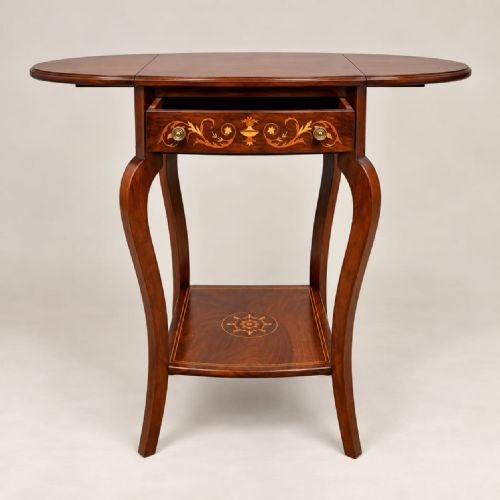

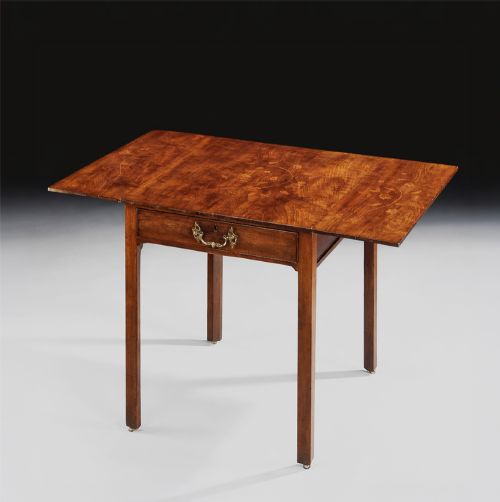


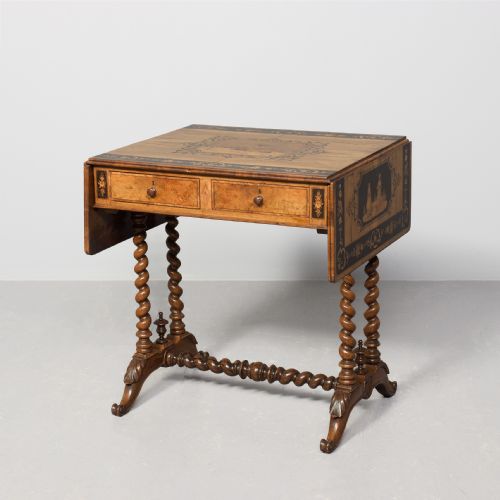
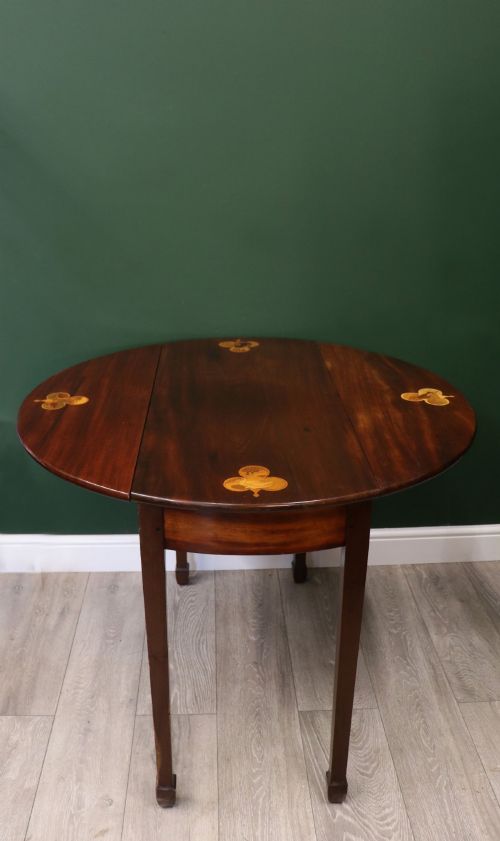
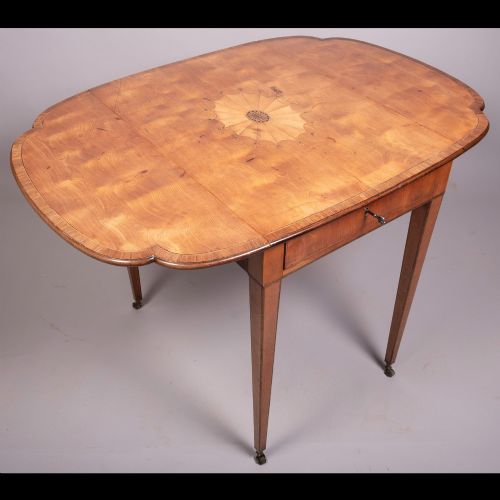
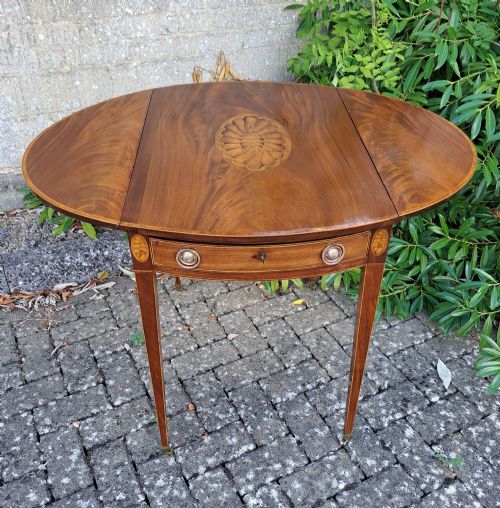
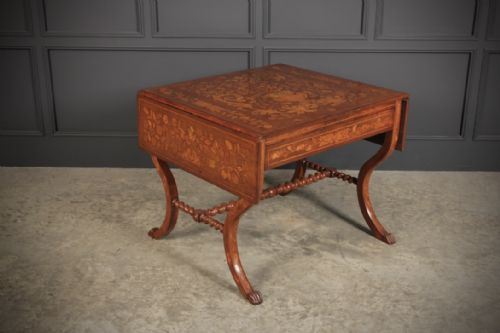
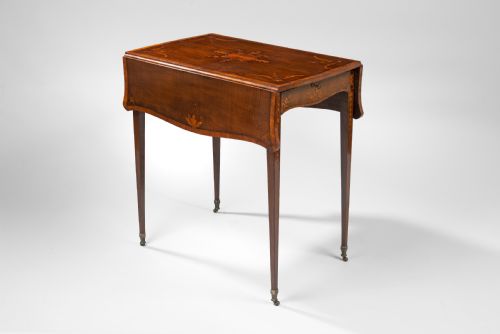


Marquetry Drop Leaf Table
These marquetry drop leaf table examples bring rich floral and geometric wood inlay into everyday spaces through versatile folding forms.
Marquetry Drop Leaf Table
A marquetry drop leaf table combines intricate timber inlay with hinged flaps designed to save space when lowered and expand surface area when raised. The examples you encounter span Georgian, Victorian and Edwardian periods, stretching from the eighteenth century into the early twentieth century.
The evidence shows these pieces appearing most frequently as Pembroke, Sutherland, occasional and sofa tables. Makers across England, France, Italy and the Netherlands utilised diverse regional aesthetics, yielding everything from oval walnut Sutherland tables to rectangular satinwood Pembroke designs.
While drop leaf tables serve functional roles as side, lamp or occasional furniture, their primary appeal lies in the decorated timber tops. Floral and geometric marquetry patterns transform practical folding furniture into decorative focal points for a room.

Materials and Technique
Cabinet makers constructed these tables using a solid timber frame of mahogany, walnut or rosewood, upon which they applied elaborate veneers and inlaid motifs. Satinwood, boxwood, kingswood and olivewood supplied the contrasting tones needed to render intricate floral sprays, urns and scrolling foliage.
The marquetry technique involved cutting thin pieces of varied woods and fitting them into a prepared ground before gluing the entire composition to the table top. Brass hardware frequently secured the folding leaves and drop flaps, while fine grain manipulation accentuated the natural figure of burr walnut or rosewood surfaces.
Marquetry Drop Leaf Table Retail Price Guide 2026
Typical asking prices for marquetry drop leaf table among the pieces listed under this phrase on Sellingantiques today, from the lower quarter to the upper quarter. They describe what is for sale here now, not the wider market.
Listings feature marquetry drop leaf tables spanning the eighteenth, nineteenth and twentieth centuries, incorporating rosewood, mahogany, walnut and satinwood.
Assessing the Workmanship
Quality in a marquetry drop leaf table rests upon the precision of the timber inlay and the crispness of the botanical or geometric design. Superior examples display seamless integration of contrasting woods without excessive filler, maintaining sharp, clean lines where different species meet.
The selection of the underlying cabinet timber also dictates the tier of the piece, with richly figured burr walnut, satinwood and rosewood commanding greater visual depth. Construction integrity in the folding mechanisms and drawer linings, where applicable, separates standard production from exceptional cabinet work.
The Marquetry Drop Leaf Table Glossary
- Marquetry
- A decorative technique where small pieces of coloured wood, veneer and other materials are fitted together to form pictorial or geometric patterns on a wooden surface.
- Drop leaf table
- A table featuring hinged flaps on one or both sides that fold down to reduce the overall footprint or lift to create a larger surface.
- Pembroke table
- A small occasional table characterised by two hinged drop leaves on opposite sides and usually one or two small drawers beneath the top.
- Sutherland table
- A narrow drop leaf table featuring exceptionally slender flaps that fold down almost vertically, supported by swing-out gate legs.
- Satinwood
- A lustrous, yellowish timber native to India and the Caribbean, frequently utilised in fine eighteenth and nineteenth century furniture for contrasting inlay details.
Marquetry Drop Leaf Table: Frequently Asked Questions
How did people use these tables originally?
These folding tables served multiple functions in period drawing rooms and parlours, shifting positions easily as tea, sewing or writing needs arose.
Dropping the leaves allowed the furniture to sit compactly against a wall until expanded for social gatherings.
Where should I place a drop leaf table?
Position a drop leaf table beside a sofa or chair where you can lower one flap to save floor space while keeping the surface accessible for lamps or drinks.
They also function well in hallways or entryways when fully folded.
How do I identify a Victorian example?
Victorian pieces often employ darker timbers like rosewood or burr walnut paired with dense, elaborate floral marquetry inlay across the folding top.
Heavier proportions and distinct turnings on the legs also point toward nineteenth-century manufacturing methods.
What is the difference between a Sutherland and a Pembroke?
Sutherland tables feature very narrow drop leaves supported by swinging gate legs, designed to fold down into a remarkably slim profile.
Pembroke tables typically include larger flaps supported by hinged brackets and frequently incorporate one or more drawers.