
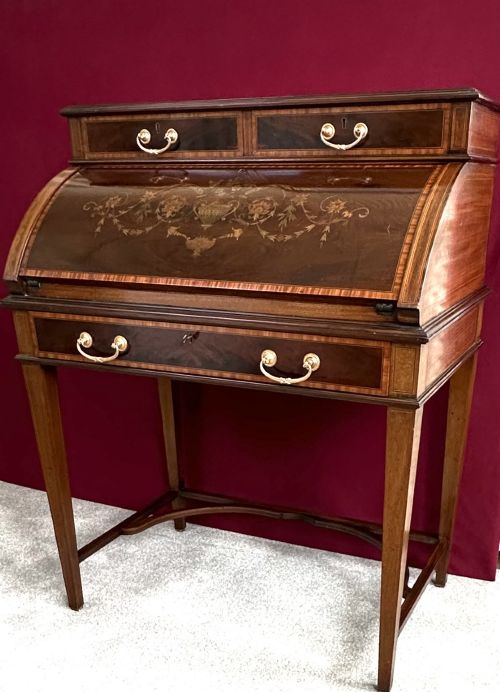
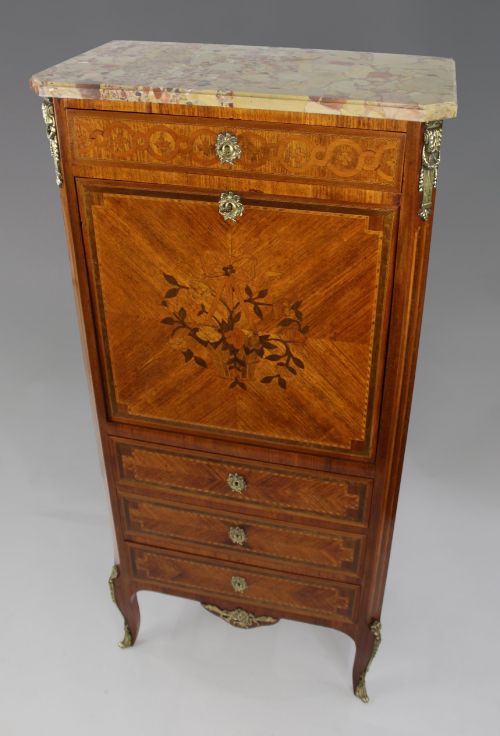
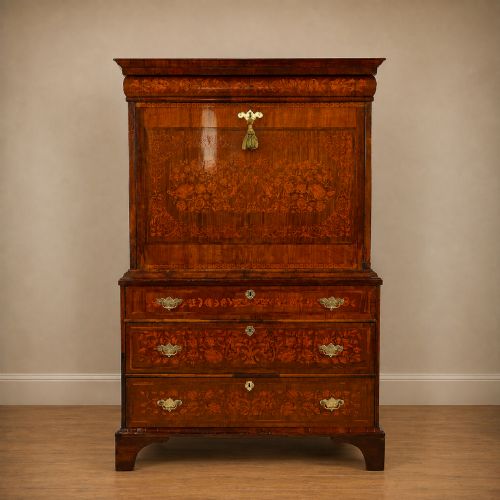

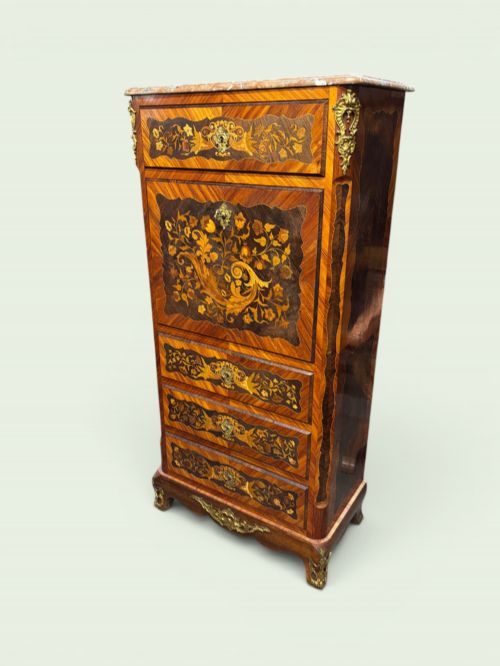


Marquetry Drop Front Desk
When you search for a marquetry drop front desk, you are looking at sophisticated writing furniture with inlaid wooden patterns that conceal fitted interiors.
Marquetry Drop Front Desk
A marquetry drop front desk is a writing cabinet featuring a hinged writing flap that opens down to reveal compartments and drawers. The form appears across the seventeenth, eighteenth, nineteenth, and early twentieth centuries, spanning periods from William and Mary to Edwardian times.
You will frequently encounter French and Dutch examples on this page, often styled in revival periods like Louis XV and Louis XVI. These pieces range from compact ladies bureaux in rosewood and mahogany to large walnut and satinwood escritoires.
The primary forms include the secretaire abattant, the bureau cabinet, and the traditional fall front bureau. Each version combines a display of decorative wood veneers with practical storage for writing materials.
How they were made
Craftsmen built these desks using cabinet timbers such as walnut, mahogany, rosewood, kingwood, and satinwood, often applying intricate floral marquetry and parquetry patterns across the surfaces. Fine wood veneers were meticulously cut and fitted together to create pictorial or geometric designs.
Many nineteenth-century continental examples incorporate cast ormolu mounts, gilt bronze details, and polished marble tops. Brass inlay and stringing also accent the mahogany and rosewood bodies of English and Victorian pieces.
Periods represented span from the 17th century through the Georgian, Victorian, and Edwardian eras up to around 1910.
What varies in quality
Quality rests upon the precision of the veneer work and the complexity of the marquetry design. Superior pieces display finely detailed floral motifs with natural shading in the woods, whereas simpler versions rely on repetitive geometric parquetry.
The selection of underlying timbers and the inclusion of original decorative mounts, such as cast ormolu and thick marble slabs, distinguish finer cabinetwork from more utilitarian desk production.
The Marquetry Drop Front Desk Glossary
- Marquetry
- Decorative veneer work forming pictures or patterns using various coloured woods. It transforms plain cabinet surfaces into elaborate floral or pastoral displays.
- Secretaire abattant
- A tall upright writing cabinet with a vertical drop front flap. This form originates in France and provides hidden drawers behind the main writing surface.
- Ormolu
- Gilt bronze mounts applied to furniture for decoration and edge protection. Makers used these cast metal elements lavishly on nineteenth-century French revival cabinets.
- Escritoire
- A traditional term for a writing desk or cabinet with a compartment for writing materials. These pieces often feature an inclined or vertical fall front.
Marquetry Drop Front Desk: Frequently Asked Questions
How do I use a drop front desk?
You lower the hinged writing flap to reveal an internal arrangement of small drawers and pigeonholes. This surface provides a dedicated writing space while keeping correspondence concealed when closed.
Many of these desks include locks to secure the drop front and protect sensitive documents stored inside.
Where were most marquetry desks made?
The pieces seen here originate primarily from workshops in England, France, and the Netherlands. French makers favoured elaborate floral marquetry and ormolu mounts.
Dutch makers frequently produced distinctive walnut bureaux with floral pictorial inlay across the entire cabinet front.
How do I tell different periods apart?
Stylistic details and timber choices indicate the era of manufacture. Seventeenth-century pieces often display oyster walnut, while eighteenth-century examples feature detailed floral marquetry.
Victorian and Edwardian pieces frequently revive earlier French aesthetics using rosewood, satinwood, and delicate brass inlay.
Can I use these desks for a laptop?
You can use the lowered flap for writing or compact modern devices, provided you check the interior depth and weight limits. Many period desks were designed for stationary rather than computers.
Care should be taken to protect antique wood and leather writing surfaces from scratches and moisture.