


Marquetry Back Bench
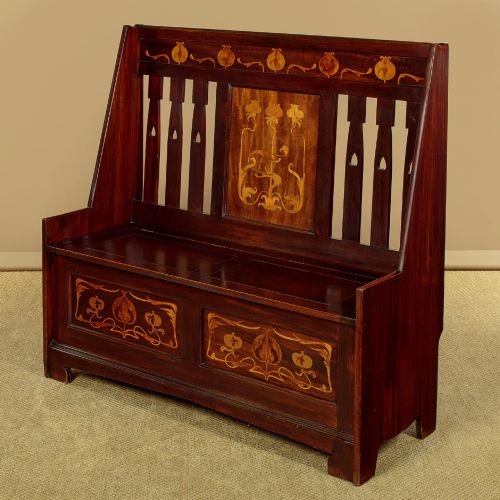
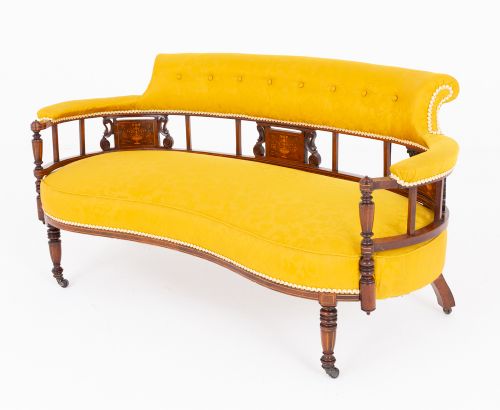
These marquetry back bench examples bring inlaid timber and elegant seating together to anchor a period hall or salon.
Marquetry Back Bench
A marquetry back bench is an upholstered or open seat accompanied by detailed decorative woodwork on the rear frame, spanning forms recorded as settees, sofas, benches, and window seats. When you browse for a marquetry back bench, you encounter pieces originating from the eighteenth century, the Victorian era, and the Edwardian period, alongside specific revivals.
The prevailing style on this page is Edwardian inlaid mahogany, frequently showing Sheraton Revival influences, alongside Victorian and Arts and Crafts interpretations. Regional and continental pieces also appear, including Italian Renaissance Revival and eighteenth-century examples from Lombardy.
Makers such as James Shoolbred and Co. contributed to this tradition, producing seating that combines structural timber frames with intricate surface decoration. These forms served as formal salon seating or substantial hall furniture, depending on their scale and upholstery.
Materials and construction
Makers constructed these frames predominantly in mahogany and rosewood, incorporating contrasting timbers for decorative effect. Satinwood, boxwood, and dedicated marquetry inlay create the detailed surface patterns across the backrests and frames.
Upholstery materials such as fabric and velvet were traditionally integrated into the seating surfaces, complementing the polished hardwood structures. Joinery techniques combined solid timber framing with precise veneer work to support both decorative aspirations and everyday use.
Even a window seat demands proper timber inlay.
Assessing quality
Quality rests in the precision of the timber inlay and the crispness of the carving on the frame. Finer examples display harmonious contrast between the primary mahogany or rosewood and the boxwood or satinwood elements.
The integrity of the structural joinery and the selection of timber grain separate standard production from exceptional pieces. Superior examples maintain balanced proportions and refined surface patination across both frame and decorative panels.
James Shoolbred and Co.
The Marquetry Back Bench Glossary
- Marquetry inlay
- A decorative technique where small pieces of veneer are fitted together to form pictorial or geometric patterns on a wooden surface. This method defines the primary visual appeal of the backrests.
- Satinwood
- A durable hardwood with a natural golden sheen, frequently utilised for contrasting inlay work. It brings brightness to darker mahogany and rosewood frames.
- Sheraton Revival
- A late nineteenth and early twentieth-century design movement drawing inspiration from eighteenth-century neoclassical furniture. Pieces in this style emphasise light proportions and delicate inlay.
- Arts and Crafts
- A movement prioritizing honest construction and material integrity over excessive ornamentation. Items from this tradition display simpler structural lines.
Marquetry Back Bench: Frequently Asked Questions
What periods do these pieces span?
The available selection covers items from the eighteenth century through the Victorian and Edwardian eras, including pieces dated across the late nineteenth and early twentieth centuries.
Revival styles from these periods frequently draw upon earlier neoclassical aesthetics, particularly Sheraton Revival and Italian Renaissance designs.
How were these benches used?
These pieces functioned as formal seating within salons, drawing rooms, and large hallways. Their decorative backs made them suitable for placement where the rear of the frame remained visible.
Some iterations, such as window seats and settees, provided comfortable lounging spaces, while hall benches offered more upright wooden seating.
How do I identify Edwardian examples?
Edwardian pieces often feature light mahogany frames combined with satinwood and boxwood inlay. They frequently reflect Sheraton Revival design principles.
These items generally date from the period around nineteen hundred to nineteen ten, exhibiting refined proportions and delicate decorative motifs.
What timbers are most common?
Mahogany and rosewood form the primary structural and visual foundation for the majority of these listings. These dark hardwoods provide a stable base for intricate veneer work.
Satinwood and boxwood appear specifically in the inlaid sections, creating contrast and detail across the backrests.